




Ford Fusion Hybrid Team Averages 81.5 MPG in '1,000-Mile Challenge'
During a fund raising effort, drivers trained in mileage-maximizing techniques achieved 1,445 miles on a single tank of gas in a 2010 Ford Fusion Hybrid and set world record for gasoline-powered, midsize sedan.
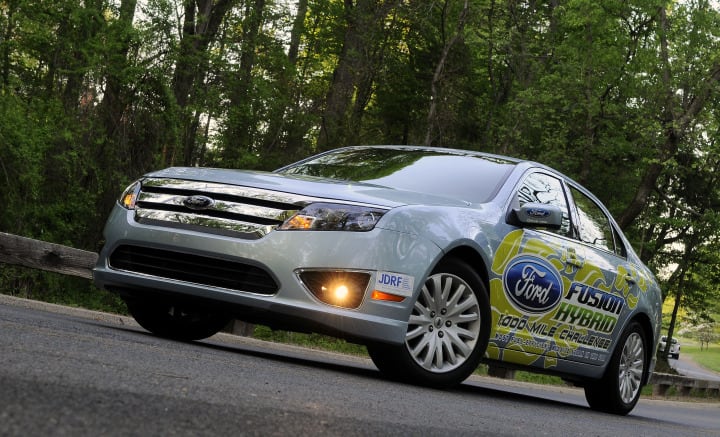
Drivers trained in mileage-maximizing techniques such as smooth acceleration and coasting to red lights were able to get an extraordinary 1,445.7 miles out of a single tank of gas during a fund-raising effort in Washington, D.C. that concluded April 28. They did it by averaging 81.5 miles per gallon in an off-the-showroom floor, non-modified 2010 Ford Fusion Hybrid, the most fuel-efficient midsize car in North America - nearly doubling its U.S. certified mileage.
The Fusion Hybrid 1,000-Mile Challenge started at 8:15 a.m. Eastern time on Saturday, April 25, from Mount Vernon, Va., and ended April 28 at 5:37 a.m. on George Washington Parkway. After more than 69 continuous hours of driving, the Fusion Hybrid finally depleted its tank and came to a stop with an odometer reading of 1,445.7 miles - setting a world record for gasoline-powered, midsize sedan.
The challenge team, which included NASCAR star Carl Edwards, high mileage trailblazer Wayne Gerdes and several Ford Motor Company engineers, raised more than $8,000 for the Juvenile Diabetes Research Foundation (JDRF) by exceeding the goal of 1,000 miles on a single tank of gas. The Fusion Hybrid's official estimated range is approximately 700 miles per tank.
Maximizing Mileage
A team of seven drivers prepared for the challenge by learning a few mileage-maximizing techniques, most of which can be used in any vehicle to improve fuel economy, but are especially useful in the Fusion Hybrid where the driver can take advantage of pure electric energy at speeds below 47 mph.
CleanMPG.com founder Wayne Gerdes, an engineer from Illinois who coined the term "hypermiling" to describe the mileage-maximizing techniques, provided the pointers. They include:
Slowing down and maintaining even throttle pressure;
Gradually accelerating and smoothly braking;
Maintaining a safe distance between vehicles and anticipating traffic conditions;
Coasting up to red lights and stop signs to avoid fuel waste and brake wear;
Minimize use of heater and air conditioning to reduce the load on the engine;
Close windows at high speeds to reduce aerodynamic drag;
Applying the "Pulse and Glide" technique while maintaining the flow of traffic;
Minimize excessive engine workload by using the vehicle's kinetic forward motion to climb hills, and use downhill momentum to build speed; and
Avoiding bumps and potholes that can reduce momentum
[PAGEBREAK]
In addition, it is important for Fusion Hybrid drivers to manage the battery system's state of charge through the use of regenerative braking and coasting, and balancing the use of the electric motor and gas engine in city driving to avoid wasting fuel.
Fusion Hybrid drivers also can stay more connected to the hybrid driving experience with Ford's SmartGaugeTM with EcoGuide, a unique instrument cluster that helps coach drivers on how to optimize performance of their hybrid.
The Challenge
The Fusion Hybrid 1,000-Mile Challenge team took turns driving several routes in and around the national capital over the course of approximately three days and nights. The route involved elevation changes, and ranged from the relatively open George Washington Parkway to a 3-mile stretch in the heart of the city that is clogged with roughly 30 traffic signals.
Ford NASCAR star Carl Edwards took time away from the high speed world of professional car racing to contribute to the Fusion Hybrid team's success in D.C.
"It was exciting to be an active part in this challenge. The fact that it will help spread the word about the Fusion Hybrid's great mileage, and help out a great charity, makes it even more special," said Edwards, whose '99' team has used fuel-saving techniques to win races. "There's no question that the Fusion Hybrid will help consumers save fuel when they drive it. Having driven the car, I feel strongly about how great it is - so strong that I've purchased
More Small Fleet


Developing Budget-Friendly Driver Safety Programs
From driver training and safety meetings to one-on-one coaching and incentive programs, several small fleets share how they have developed a safety culture with their drivers using low- to no-cost resources.
Read More →
Boosting Last-Mile Fleet Uptime, Safety, and Value with AI Vehicle Inspections
AI-powered inspections are transforming last-mile fleets by replacing manual checks with highly accurate automated scans that detect defects in seconds. By giving fleet operations visibility into the daily condition of their vehicles, you can identify trends over the vehicle’s lifecycle that enable improved procurement decisions, route management, driver training and accountability.
Read More →
Five Ways Seat Belts Help Prevent Injuries
There are five ways seat belts protect occupants from injuries, according to the Tennessee Department of Safety and Homeland Security.
Read More →
It’s here: The 2026 Fleet Technology Trends Report
What does AI mean for fleets? Get the answer — and learn other top tech trends.
Read More →
Small Fleets, Big Impact: How Independent Drivers Power Wreaths Across America
Check out how small fleets and independent drivers power Wreaths Across America each December and why their impact matters more than ever.
Read More →
VMS Survey Finds 65% of Small Fleet Managers Run Operations Alone
A new VMS survey shows small fleet managers are stretched thin, with most handling operations solo and eager to adopt digital tools for relief.
Read More →
Tips for Driving Safely on Halloween Night
This video features a reminder from the Connecticut Department of Transportation (DOT) and the Connecticut Police Chiefs Association, urging drivers to prioritize safety this Halloween.
Read More →
AI, Access, and Uptime: VMS’s Next Chapter with David Prusinski
VMS’s new Co-CEO, David Prusinski, shares how an AI-first approach will give small fleets and repair shops the tools to compete like big players.
Read More →
Fleet Managers Share Winter Prep Tips: It's Never Too Early!
Three fleets share best practices to prep vehicles for winter and prevent downtime when the cold sets in.
Read More →