





Want More? Truck Lifecycle Data Index Shows Fuel Savings, Emissions Reduction for Replacements
Fleets Focused on Truck Acquisition Challenges & More
A recent study showed how trends in fuel economy, maintenance, environmental concerns, and procurement strategies have changed since last year.
September 8, 2021
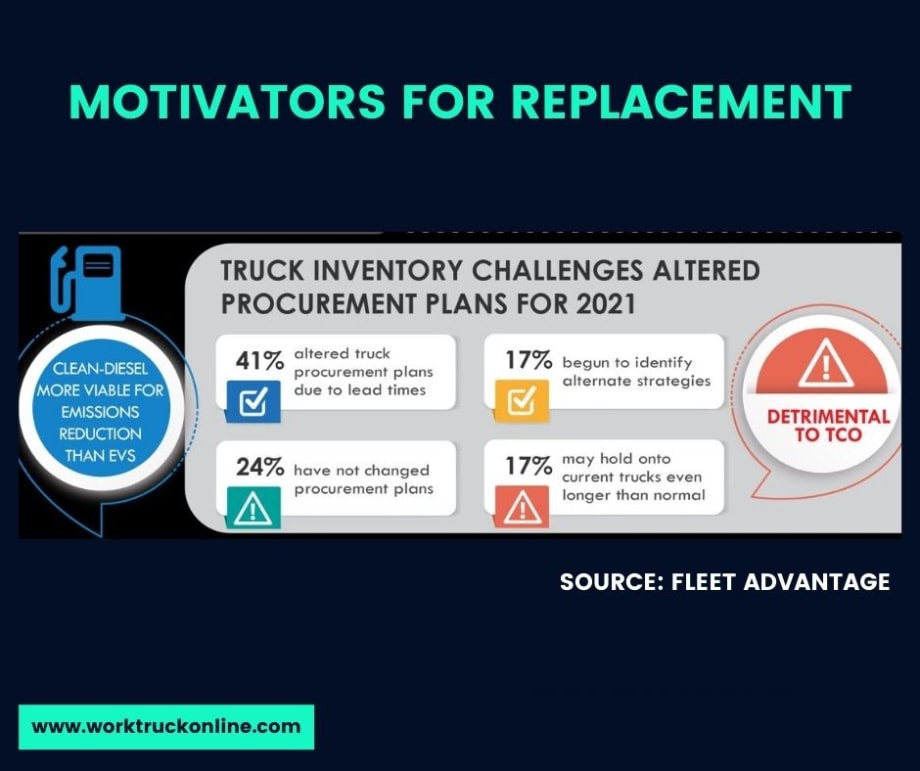
This year, 31% of fleet executives said their biggest motivator for procurement was to right-size the number of trucks in their fleet to align with economic conditions.
Source: Fleet Advantage
3 min to read
Fleet Advantage, a provider of truck fleet business analytics, equipment financing, and lifecycle cost management shared the results of its latest fleet industry benchmarking survey. This most recent study showed how trends in fuel economy, maintenance, environmental concerns, and procurement strategies have changed since last year.
Procurement Strategies & Lease Structure Are Top-of-Mind
According to this year’s survey, 41% of fleet executives say the supply of new trucks and inventory challenges have altered their truck procurement plans due to lead times. Also, 17% have begun to identify alternate procurement strategies in the acquisition of new trucks. Another 17% say the inventory challenges mean they may hold onto current trucks even longer than normal, which may be detrimental to their Total Cost of Ownership (TCO).
And, 31% of respondents said they are leasing their trucks, significantly up from last year when only 14% of fleet executives said they were leasing. However, lease structure is a major area of concern for many as 28% are in an unbundled lease agreement and “see greater value on flexible fuel and maintenance costs”. This compares to 20% who say they are locked in a full-service lease with some saying they are “trying to escape the contract because of inflexible costs on fuel and maintenance.”
Lastly, 68% stated they are monitoring possible tax policy changes as part of their procurement strategies.
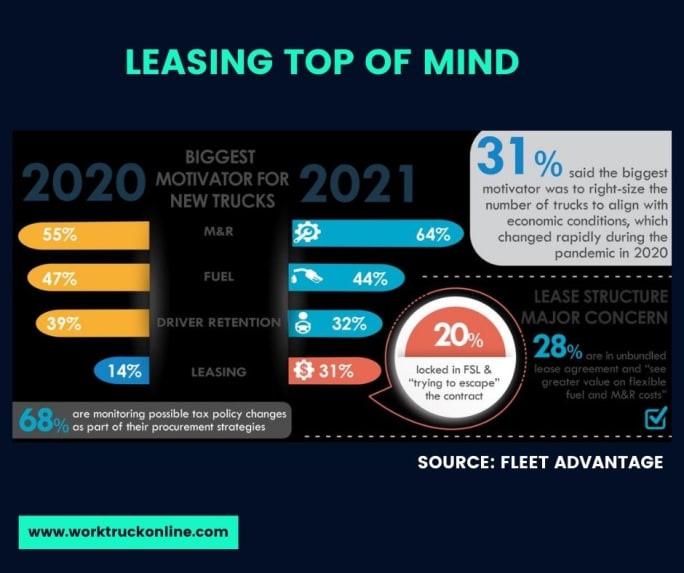
According to this year’s survey, 41% of fleet executives say the supply of new trucks and inventory challenges have altered their truck procurement plans due to lead times.
Source: Fleet Advantage
Biggest Motivators for Truck Replacement
Of respondents, 64% of fleet executives report costs associated with maintenance and repair (M&R), and 44% say improved fuel economy are the leading motivators for truck replacement. This is similar to last year when 55% of fleet executives cited M&R and 47% said improved fuel economy. This is interesting since 17% of fleets are considering holding onto their older, more inefficient trucks even longer than normal because of the current inventory challenges of new trucks as previously mentioned.
A new comment in this year’s survey because of pandemic-related business challenges, 31% of fleet executives said their biggest motivator for procurement was to right-size the number of trucks in their fleet to align with economic conditions, which changed rapidly during the pandemic in 2020. Other motivators included more safety features added by OEMs, the importance of improved corporate image and the conservation of natural resources/lower CO2 emissions through newer clean-diesel engines. This is reinforced in the National Private Truck Council’s (NPTC) 2021 Benchmarking Study which said 89% of fleets are investing in greening initiatives.
Furthermore, driver retention was the third-largest motivator to replace aging trucks, and in addition to new equipment, compensation and driver benefits were also listed as beneficial for driver retention.
Electrification Remains in the Distance for Fleets
The majority of fleets continue to believe clean-diesel technology remains more viable for emissions reduction than a move to electric vehicles. More than half of fleet respondents (54%) said they may consider electric class-8 trucks for over-the-road between 5-10 years from now, and only 3% of fleet executives are currently procuring electric trucks today. A year ago, 30% of respondents said they do not see electric trucks widely in service for another 10 years. Regarding autonomous trucks, 53% said they don’t see these widely in use for another 10 years (62% last year).
“Our annual benchmarking study provides us and the industry with a close look at the issues that are most important to fleet executives today, and the decisions that are helping to shape their business strategies,” said John Flynn, CEO of Fleet Advantage. “This year’s study shows that procurement strategies, an emphasis on unbundled leasing, specific replacement motivators and a stronger focus on environmental, social, governance (ESG) are all critical for fleets today.”
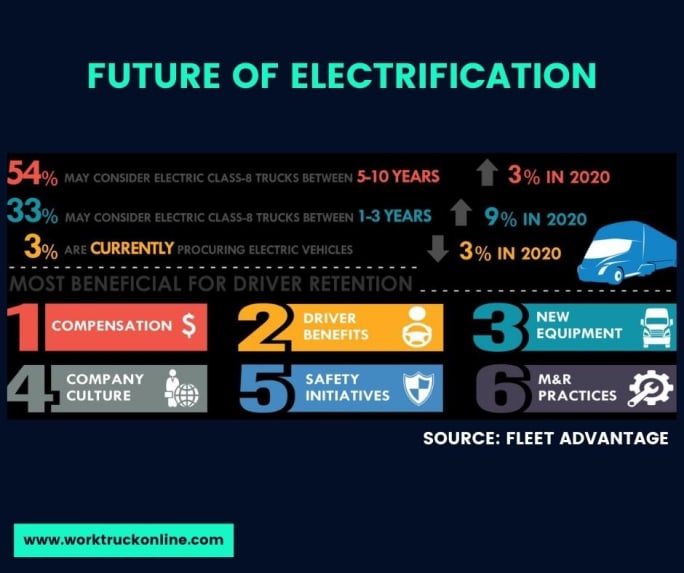
More than half of fleet respondents (54%) said they may consider electric class-8 trucks for over-the-road between 5-10 years from now.
Source: Fleet Advantage
The full survey results are available from Fleet Advantage.
More Operations
Family Ties Inside the Fleet Families Building Careers Across Generations
Three fleet families share what it really takes to work together, learn across generations, and keep business from following them home.
Read More →
Shades of Fleet Call for Voices: Fleet's Hidden Heroes
Fleet’s hidden heroes are often the ones keeping everything moving behind the scenes. September’s Shades of Fleet is looking for dispatchers, coordinators, parts specialists, and other support pros to share their stories.
Read More →
Truck Centers, Inc. Celebrates National Truck Driver Appreciation Week with $1,000 Fuel Card Giveaways
During National Truck Driver Appreciation Week, Truck Centers, Inc. is offering customers a chance to fuel up for free. Customers at all Truck Centers locations can enter to win one of four $1,000 fuel cards from Sept. 14 - 18.
Read More →
Fleet Guides, AI Time-Savers, Truck Tariffs & Fuel Strategy Lead the News
This week’s Truck Chat Cheat Sheet covers new fleet vehicle guides, practical AI use cases, U.S.-Canada truck production, mixed-energy strategy, and more.
Read More →
What Fleet Employers Are Missing When Hiring Veterans
What if some of the strongest candidates for fleet are already out there, but their experience is written in a language our industry does not always recognize?
Read More →
Automotive Fleet Opens 2026 Personal Use Survey for Commercial Fleet Managers
Less than two weeks left! Commercial and corporate fleet managers are invited to share how their organizations handle company vehicle personal-use policies, charges, and driver eligibility.
Read More →
What Resilient Fleets Do Differently When Conditions Change
Fleet resilience is about more than reacting to disruption. Lauren Fletcher talks with AP Fleet’s Alex Coveney about flexibility, planning, scaling, and what helps fleets adapt when business conditions shift.
Read More →
If We Want the Next Generation in Automotive, We Have to Give Them a Reason to Care
The automotive industry talks constantly about its workforce shortage. But before we can recruit the next generation, we may need to do a better job giving kids a reason to care about automotive in the first place.
Read More →
Ram ProMaster City Under $40K, Truck Tariffs, and AI Maintenance Lead the News
A sub-$40K commercial van, tariff questions, AI-powered maintenance, and a new EV production strategy headline this week’s Truck Chat Cheat Sheet.
Read More →
Bob Adamsky Shares the Fleet Lessons You Usually Learn the Hard Way
After more than 30 years in fleet, Arrow International’s Bob Adamsky has learned that the job is about far more than vehicles. He shares the lessons he wishes every fleet manager could learn a little earlier.
Read More →