




Adsorbent Natural Gas Tank Applied to First Fleet Vehicle
Cenergy Solutions has been testing an adsorbent natural gas (ANG) tank on a 2001 Dodge Ram 2500 van. ANG tanks can extend a vehicle’s range and lower the cost of gas because it needn’t be pumped to high pressures.

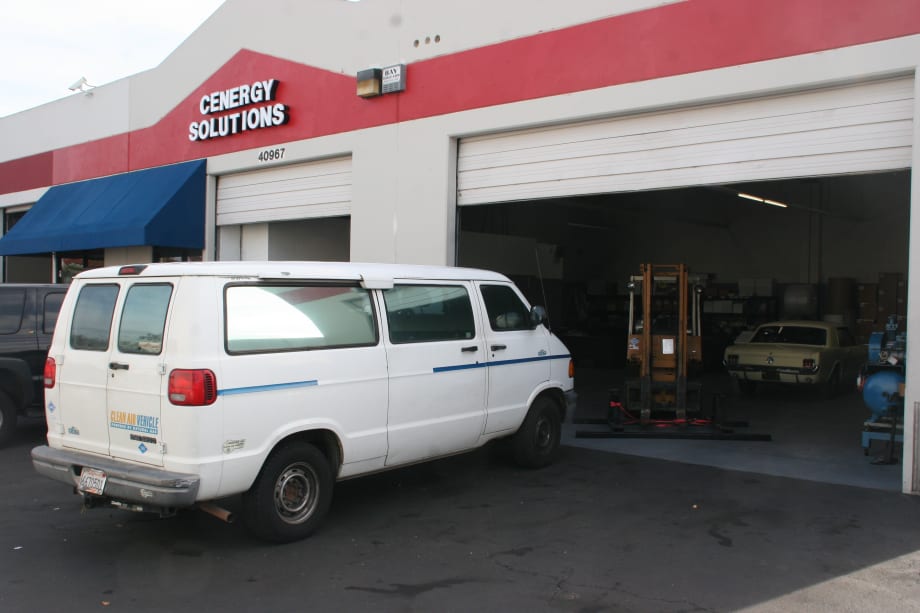
Dodge B2500 is back in the fleet customer's hands after Cenergy outfitted the van with an ANG tank. It still has its original CNG tanks. Photo courtesy of Cenergy Solutions.
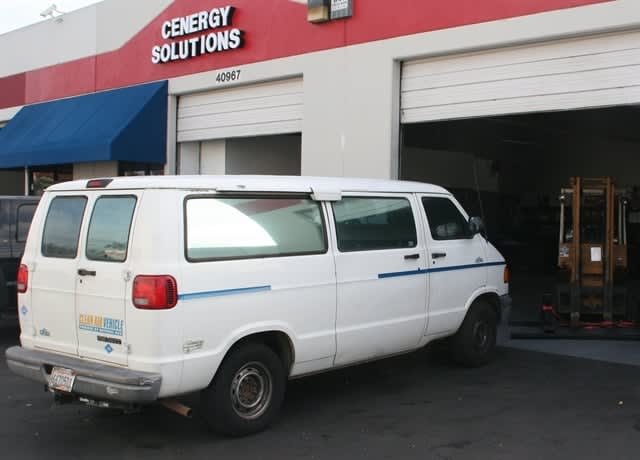
Dodge B2500 is back in the fleet customer's hands after Cenergy outfitted the van with an ANG tank. It still has its original CNG tanks. Photo courtesy of Cenergy Solutions.
Cenergy Solutions, a developer of adsorbent natural gas storage systems, reports that it has delivered its first ANG vehicle to be used in a commercial fleet.
The fleet customer sent the truck to Cenergy for modification, said Gary Fanger, Cenergy’s chief operating officer, and now it’s been returned. The 2001 Dodge Ram B2500 van, with a 5.2-liter V-8 engine, is used by technicians who service power generation equipment. It was originally set up by Chrysler to use compressed natural gas.
Cenergy technicians added an ANG tank, then tested the truck to gauge performance and gas flow to the engine.
“We have been getting great results driving it in a variety of conditions, including steep grades in the mountains” near Cenergy’s tech center in Fremont, Calif., Fanger said. “You couldn’t tell the difference” in performance whether gas was taken from the ANG tank or stock CNG tanks.
“Some questioned whether the flow rate for ANG would be sufficient, and it seemed to be better,” Fanger said. “We think gas is de-adsorbing in the tank and flows better” than when it’s released under higher pressure from the stock tanks.
Cenergy’s adsorbent system uses carbon blocks or powder inside a tank, according to Fanger. When gas is pumped in, high amounts of it cling to the carbon instead of having to be crammed into the tank under high pressure. An adsorbent tank can hold six times more natural gas at 250 psi than a conventional tank, and 20% more in a tank pumped to 3,600 psi, the usual fill-up pressure for CNG.
ANG tanks can extend a vehicle’s range and lower the cost of gas because it needn’t be pumped to high pressures, Fanger said. Technicians are now retrofitting existing DOT compliant natural gas cylinders with their proprietary system. This equipment makes it possible to use low pressure (350- to 500-psi) tanks that are lighter and can be conformed to fit in various areas of empty space in a vehicle.
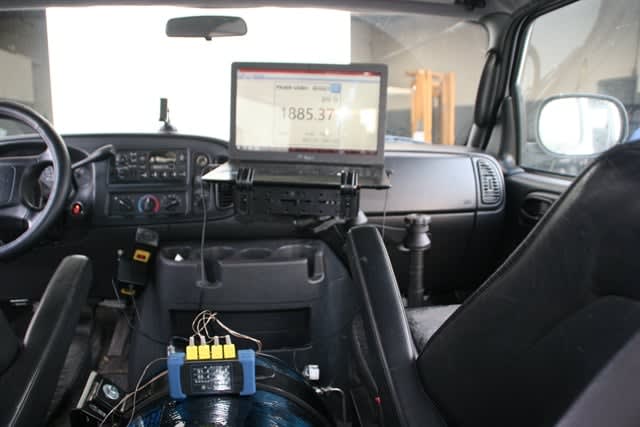
Test instruments in a Dodge Ram van measures gas flow and engine performance. ANG tank sits between the seats per customer's request. Photo courtesy of Cenergy Solutions.
As work continues, a concrete ready-mix company in the Midwest that has committed to fueling its trucks with natural gas is interested in using adsorption tanks, which would be the first application in heavy trucks.
Cenergy meanwhile is working with a California biomethane-generation plant to boost storage capacity in existing tanks with ANG technology. The plant has been in operation for two years and will soon exceed storage capacity for natural gas in its low-pressure tanks.
Cenergy's ANG system is getting considerable interest from overseas because it has uses in stationary as well as vehicle fuel storage, he said.
ANG technology can be applied to virtually any type of natural gas storage system, including CNG vehicles, fueling stations, transport trucks and stationary natural gas storage. In its development work, Cenergy is collaborating with EnerG2, a global energy storage supplier.
Originally posted on Automotive Fleet
More Green Fleet

Fleet Forward Conference Introduces One-Day Passes for 2026
New one-day registration gives fleet professionals the flexibility to attend Tuesday, Wednesday, or Thursday, with passes available for $199 through Sept. 18.
Read More →
CALSTART Rebrands as Catalyst Mobility, Will Combine with Forth in 2027
CALSTART has rebranded as Catalyst Mobility and will combine with Forth at the start of 2027. The new organization said it is poised to become one of the world's largest, strongest, and most impactful clean transportation nonprofits.
Read More →
Electric Truck and Charging Programs to Boost Sustainability at NY & NJ Ports
Together, the Port Authority of New York and New Jersey and CALSTART will electrify drayage and terminal operations serving the East Coast’s busiest container port. A pair of incentive programs totaling $45 million has launched to accelerate adoption of zero-emission drayage trucks and terminal tractors.
Read More →

The Smart Way to Build a Mixed-Energy Fleet Isn’t About Picking a Side
Mixed-energy fleets aren’t about picking a winning fuel. Sarah Booth of WEX explains how vehicle data, duty cycles, charging strategy, and real-world costs can help fleets choose the right energy source for each job.
Read More →
Xos Hub Surpasses One Gigawatt-Hour of Energy Delivered in the Field
A single Xos Hub has surpassed one gigawatt-hour of energy across more than 33,600 charging sessions in the field, demonstrating performance that supports Xos' expansion across new products and markets.
Read More →
Carrier Transicold Launches All-Electric Vector 8200 TRU for Diesel-Free On-Site Cold Storage
Carrier Transicold’s first engineless multi-temperature TRU helps fresh- and frozen-food fleets add supplemental cold storage capacity during seasonal peaks.
Read More →
Narro Trucks Introduces Electric Utility Vehicle
Narro Trucks officially launched its operations on Aug. 20 and hosted a ride and drive to showcase its electric truck, which will be produced in Virginia.
Read More →
Samsung SDI Takes Full Control of GM Battery JV as Indiana Plant Pivots to Energy Storage
Samsung SDI is taking full control of its Indiana battery plant with GM, marking a major shift from the EV-focused joint venture Charged Fleet first covered in 2023.
Read More →
NWSA Taps CALSTART to Administer Zero-Emission Drayage Assistance Program
CALSTART will provide free technical assistance services to drayage fleets serving the Ports of Seattle and Tacoma and looking to transition to cleaner technologies and help decarbonize freight hubs.
Read More →
EV Fleet Reality Check: What Operators Wish They Knew Before Electrifying Their Work Vans
Electric work truck upfits bring new compatibility questions. Learn how parts availability, OEM guidance, power demands, and route planning can affect fleet performance.
Read More →