




510K Commercial Vehicles Annually Used Bridge Before Collapse
The Francis Scott Key Bridge was a major traffic route used by more than 500,000 commercial vehicles that annually made a combined more than 4.2 million trips across the roadway spanning the Patapsco River.

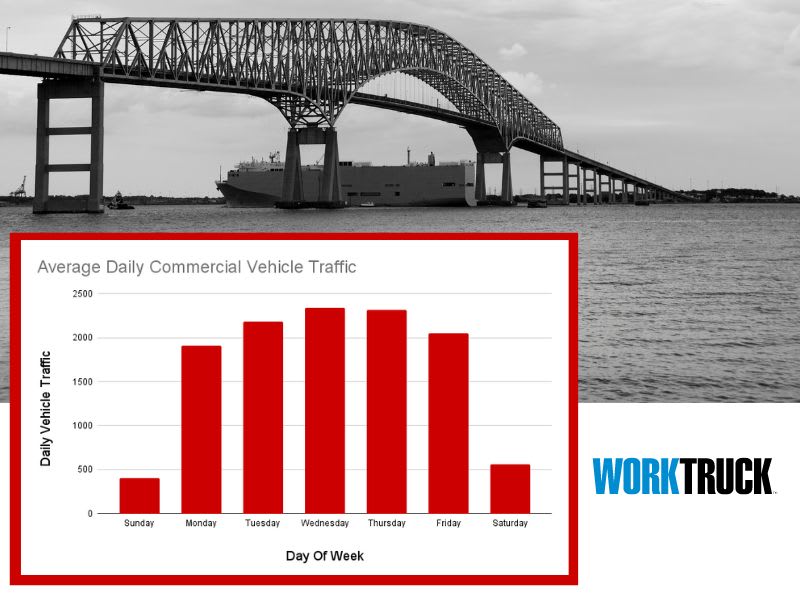
The Francis Scott Key Bridge, before last week's collapse, was a route for a large number of commercial vehicles, primarly during the work week.
Photo: Canva/Geotab ITS/WT Illustration
Just a week after the collapse of the Francis Scott Key Bridge, one temporary shipping channel has been opened and a second, deeper channel is soon to open. However, the extended time needed to rebuild the bridge will likely hamper commercial vehicle traffic for an undetermined amount of time.
A cargo ship, the Dali, lost power and struck the bridge March 26, causing sections of the bridge to collapse into the Patapsco River. Construction workers on the bridge at the time and two were rescued following the collapse. Two others were later found dead in a pickup that fell into the water and four remain missing and presumed dead.
The collapse blocked shipping access to the Port of Baltimore, which handled about 3% of East Coast and Gulf Coast imports and 10% of containerized freight imported into the Northeast in the 12 months prior to Jan. 1.
Impact on Commercial Vehicle Traffic
According to research provided by Geotab ITS, more than 510,000 commercial vehicles traveled the Francis Scott Key Bridge, part of Interstate 695, annually.
Telematics provider Geotab launched a new business unit, Geotab ITS, to provide agencies and organizations with actionable, real-world aggregate insights to improve transportation networks. Geotab ITS provided Work Truck with data, from its Altitude analytics platform, detailing pre-disaster commercial vehicle movements on the bridge by annual trips, vehicle types, time of day, and day of the week.
The majority of the commercial vehicle traffic, 44%, was attributed to heavy-duty trucking. Light-duty trucks accounted for 14% of the commercial traffic, followed by medium-duty trucks at 11%. The remaining 30% of commercial vehicle traffic was comprised by a mixture including passenger vehicles, buses, and other multi-purpose vehicles, according to Geotab ITS.

Among commercial vehicles, heavy-duty trucks were the largest segment using the bridge, followed by medium duty.
Source: Geotab ITS
While Geotab ITS reports 510,000 commercial vehicles used the bridge each year, the volume of commercial vehicle traffic tallied to a massive 4.2 million trips between March 1, 2023, and the same date this year.
Geotab ITS drilled deeper into the data and looked further at the annual commercial vehicle traffic, finding that the largest percentage of vehicles were local, 36%.
Geotab ITS’s breakdown of the commercial vehicles that used the bridge, by vocational classification, includes:
36% - Local
21% - Regional
16.5% - Uncategorized
10%- Hub and spoke
10% Long haul
5% - Door-to-door

Local commercial vehicles were the leading business users of the bridge, followed by regional, and long haul.
Source: Geotab ITS
The Maryland Transportation Authority (MDTA) is providing a website with suggested alternative routes for traffic as well as ongoing traffic updates.
Three days after the collapse, the Maryland Motor Truck Association asked the state’s transportation secretary to take steps to assist commercial trucking. A letter from MMTA President and CEO Louis Camion requested:
Driver hours of service extensions
Electronic logging device exceptions
International Registration Plan waivers
International Fuel Tax Agreement waivers
Limited route openings
Financial assistance for local business
Response to the Collapse of the Francis Scott Key Bridge
Maryland Gov. Wes Moore, during a press conference this week, outlined four directives to guide the response and recovery following the bridge disaster. Those are:
Recover the remaining victims and bring closure for their families.
Clear the channel and open vessel traffic for the port.
Take care of all the people affected by the crisis.
Rebuild the Francis Scott Key Bridge.
Response to the disaster is not resting solely on the shoulders of one leader, nor just one government entity. The efforts are being coordinated through the Key Bridge Response 2024 Unified Command, which is comprised of the U.S. Coast Guard, the U.S. Army Corps of Engineers, the Maryland Department of the Environment, the Maryland Transportation Authority, Maryland State Police, and a representative of Synergy Marine.
Low-Interest Disaster Loans Available to Help Impacted Businesses
The U.S. Small Business Administration (SBA) has made Maryland businesses impacted by the Francis Scott Key Bridge collapse eligible for low-interest, long-term Economic Injury Disaster Loans (EIDLs) to help overcome the temporary loss of revenue as a result of the bridge collapse.
Eligibility, according to the SBA, is based on the financial impact to the business based on the bridge disaster. Two SBA Business Recovery Centers opened this week, one located inside the City of Baltimore and the other in Baltimore County, to help businesses seek the funding.
According to the Baltimore City Mayor’s Office these loans may be used to pay normal operating expenses, such as:
Fixed debts
Payroll
Accounts payable
Other bills that can't be paid because of the disruption
The mayor has also ordered the formation of the Intergovernmental Economic Response Team to bring together state, local, and federal resources to help the local economy.
“We are mobilizing every resource and agency available to help deal with the fallout of the Key Bridge collapse and will continue to do so until the entire Baltimore region overcomes the impacts,” said Mayor Brandon M. Scott.
Clearing the Channel and Removing Debris
According to the U.S. Coast Guard, Monday afternoon a barge laden with jet fuel was the first to pass under the bridge by way of a new temporary channel that has opened on the northeast side of the main shipping channel. A second channel to the southeast is set to open soon, offering a 15- to 16-foot draft restriction compared to the 11-foot allowable depth of the temporary northeast channel.
While multiple agencies and departments — local, state, and federal — are working in coordination, the U.S. Army Corp of Engineers (USACE) will be leading the salvage operations and clearing of the main channel. USACE has outlined three priorities.
The first priority is to clear the federal channel. The first step is establishing a wreckage consolidation point and then positioning cranes to remove the bridge span from the ship. The wreckage will be then removed from the ship and from the federal channel.
Second, USACE will refloat and remove the ship. The cargo will be assessed, and containers removed as necessary. Then, workers will stage assets for repositioning the ship before refloating and removing the ship.
The third, and final priority, will be to clear the remaining wreckage. In this final phase, USACE will clear the wreckage from outside the federal channel and the operation will be facilitated through coordination with the Maryland Department of Emergency Services.
Estimates to rebuild the bridge range from 18 months to several years, the Associated Pressreported. When the Sunshine Sky Way Bridge, in Florida, was struck by a ship and collapsed in 1980, rebuilding took five years. However, after a more recent bridge collapse in 2007, when the Interstate 35 westbound bridge collapsed into the Mississippi River in Minnesota, rebuilding the span took 14 months.
“We will make sure that the new bridge honors the spirit of the city of Baltimore,” Scott said.
“In terms of rebuilding the bridge, we continue to work with our federal partners in basically coming up with the innovative design that that the governor mentioned so that we can deliver this bridge as quickly and safely as possible,” said Maryland Secretary of Transportation during a press conference this week.
More Operations
Family Ties Inside the Fleet Families Building Careers Across Generations
Three fleet families share what it really takes to work together, learn across generations, and keep business from following them home.
Read More →
Shades of Fleet Call for Voices: Fleet's Hidden Heroes
Fleet’s hidden heroes are often the ones keeping everything moving behind the scenes. September’s Shades of Fleet is looking for dispatchers, coordinators, parts specialists, and other support pros to share their stories.
Read More →
Truck Centers, Inc. Celebrates National Truck Driver Appreciation Week with $1,000 Fuel Card Giveaways
During National Truck Driver Appreciation Week, Truck Centers, Inc. is offering customers a chance to fuel up for free. Customers at all Truck Centers locations can enter to win one of four $1,000 fuel cards from Sept. 14 - 18.
Read More →
Fleet Guides, AI Time-Savers, Truck Tariffs & Fuel Strategy Lead the News
This week’s Truck Chat Cheat Sheet covers new fleet vehicle guides, practical AI use cases, U.S.-Canada truck production, mixed-energy strategy, and more.
Read More →
What Fleet Employers Are Missing When Hiring Veterans
What if some of the strongest candidates for fleet are already out there, but their experience is written in a language our industry does not always recognize?
Read More →
Automotive Fleet Opens 2026 Personal Use Survey for Commercial Fleet Managers
Less than two weeks left! Commercial and corporate fleet managers are invited to share how their organizations handle company vehicle personal-use policies, charges, and driver eligibility.
Read More →
What Resilient Fleets Do Differently When Conditions Change
Fleet resilience is about more than reacting to disruption. Lauren Fletcher talks with AP Fleet’s Alex Coveney about flexibility, planning, scaling, and what helps fleets adapt when business conditions shift.
Read More →
If We Want the Next Generation in Automotive, We Have to Give Them a Reason to Care
The automotive industry talks constantly about its workforce shortage. But before we can recruit the next generation, we may need to do a better job giving kids a reason to care about automotive in the first place.
Read More →
Ram ProMaster City Under $40K, Truck Tariffs, and AI Maintenance Lead the News
A sub-$40K commercial van, tariff questions, AI-powered maintenance, and a new EV production strategy headline this week’s Truck Chat Cheat Sheet.
Read More →
Bob Adamsky Shares the Fleet Lessons You Usually Learn the Hard Way
After more than 30 years in fleet, Arrow International’s Bob Adamsky has learned that the job is about far more than vehicles. He shares the lessons he wishes every fleet manager could learn a little earlier.
Read More →