





Beyond Efficiency: How Fleet Technology Is Saving Lives
2023 Study Unveiled New Key Priorities of Fleet Managers
A J. J. Keller study reveals the persistent challenges faced by fleet managers in staying updated with regulatory changes and improving driver expertise.
June 13, 2023
Photo: Work Truck
3 min to read
A new study revealed that fleet managers face ongoing challenges in keeping pace with regulatory updates and enhancing driver expertise.
"The State of Fleet Management: Insights on Priorities for Today's Fleet Managers," commissioned by the J. J. Keller Center for Market Insights, the research division of J. J. Keller & Associates, draws on a survey conducted in February 2023.
There has been a significant shift in the priorities of fleet managers, such as:
The number of fleet managers prioritizing the safe and correct operation of specific vehicle types by their drivers has increased by 39% compared to 2022.
The importance of quickly identifying vehicle or trailer damage or non-compliance has risen by 24% from last year.
There has been a 13% increase in the value placed on having all driver files consolidated in one place, enabling fleet managers to demonstrate compliance easily.
These findings highlight fleet managers' evolving concerns and focus areas in their quest for improved safety and regulatory adherence.
Increasing Emphasis on Regulatory Awareness for Fleet Managers
The study revealed that 42% of fleet managers emphasized the importance of staying informed about regulatory changes as the key element of Federal Motor Carrier Safety Administration compliance.
Respondents expressed their challenges in the job, with some highlighting the difficulty of ensuring compliance and staying updated with rule changes. Maintaining continuous compliance with all vehicles was also mentioned as a significant challenge.
One respondent specifically mentioned the need to keep track of various OSHA or FMCSA requirements and state, city, and county guidelines relating to safety and DOT regulations.
Another respondent pointed out the struggle to take all necessary steps during driver recruitment.
These comments shed light on the multifaceted responsibilities faced by fleet managers in achieving and maintaining compliance in a dynamic regulatory landscape.
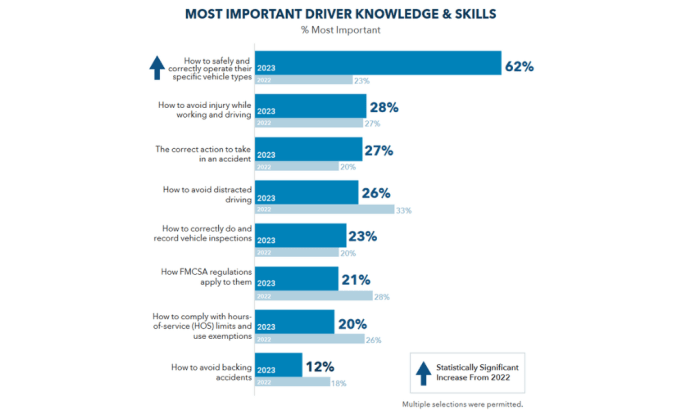
Survey results on what fleet managers identify as the most knowledge and skills of their drivers.
Photo: J. J. Keller
Fleet Managers Identify Key Areas for Improvement
Fleet managers consistently evaluate and enhance their drivers' knowledge and skills, with certain areas deemed more crucial than others.
The highest priority, according to 62% of respondents, is the safe and correct operation of a specific vehicle type, marking a significant 39% increase from 2022.
Other important driver knowledge and skills identified include:
Preventing injuries while working and driving (28%).
Knowing the appropriate actions to take in the event of an accident (27%).
Avoiding distracted driving (26%).
Joshua Lovan, Business Industry Advisor at J. J Keller noted, "Companies that prioritize safety as their primary goal tend to receive a more positive response from drivers," explaining why 63% of fleet managers believe their company predominantly or entirely emphasizes continuous learning.
Regarding driver training, respondents emphasize the importance of the practical application of learned skills (52%) and tailored training that meets individual needs (45%).
Furthermore, demonstrating comprehension of the training content experienced a 12% rise from 2022 to 2023.
Regrettably, 37% of respondents expressed dissatisfaction with the level of support they receive from their companies regarding continuous learning.
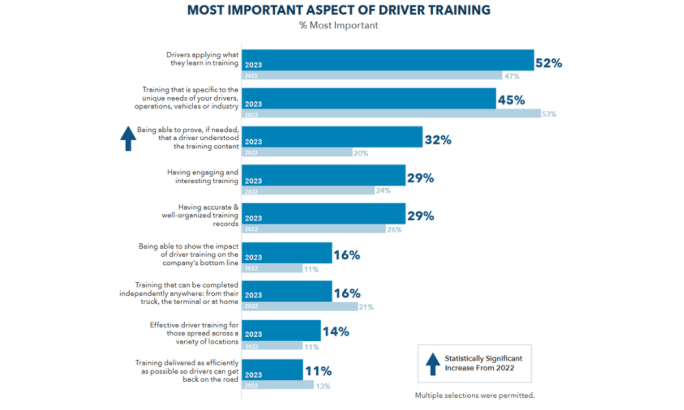
Fleet managers were surveyed what they believe is the most important aspect of driving training.
Photo: J. J. Keller
Staying Ahead of the Curve
As the risk of “nuclear verdicts” and FMCSA audits continue to increase, fleet managers will likely prioritize staying up-to-date with regulatory requirements and improving driver knowledge and skills.
With the insights shared in the report, stakeholders within the industry can better discuss the priorities and constraints fleet managers face and continue to help them going forward.
More Operations
Family Ties Inside the Fleet Families Building Careers Across Generations
Three fleet families share what it really takes to work together, learn across generations, and keep business from following them home.
Read More →
Shades of Fleet Call for Voices: Fleet's Hidden Heroes
Fleet’s hidden heroes are often the ones keeping everything moving behind the scenes. September’s Shades of Fleet is looking for dispatchers, coordinators, parts specialists, and other support pros to share their stories.
Read More →
Truck Centers, Inc. Celebrates National Truck Driver Appreciation Week with $1,000 Fuel Card Giveaways
During National Truck Driver Appreciation Week, Truck Centers, Inc. is offering customers a chance to fuel up for free. Customers at all Truck Centers locations can enter to win one of four $1,000 fuel cards from Sept. 14 - 18.
Read More →
Fleet Guides, AI Time-Savers, Truck Tariffs & Fuel Strategy Lead the News
This week’s Truck Chat Cheat Sheet covers new fleet vehicle guides, practical AI use cases, U.S.-Canada truck production, mixed-energy strategy, and more.
Read More →
What Fleet Employers Are Missing When Hiring Veterans
What if some of the strongest candidates for fleet are already out there, but their experience is written in a language our industry does not always recognize?
Read More →
Automotive Fleet Opens 2026 Personal Use Survey for Commercial Fleet Managers
Less than two weeks left! Commercial and corporate fleet managers are invited to share how their organizations handle company vehicle personal-use policies, charges, and driver eligibility.
Read More →
What Resilient Fleets Do Differently When Conditions Change
Fleet resilience is about more than reacting to disruption. Lauren Fletcher talks with AP Fleet’s Alex Coveney about flexibility, planning, scaling, and what helps fleets adapt when business conditions shift.
Read More →
If We Want the Next Generation in Automotive, We Have to Give Them a Reason to Care
The automotive industry talks constantly about its workforce shortage. But before we can recruit the next generation, we may need to do a better job giving kids a reason to care about automotive in the first place.
Read More →
Ram ProMaster City Under $40K, Truck Tariffs, and AI Maintenance Lead the News
A sub-$40K commercial van, tariff questions, AI-powered maintenance, and a new EV production strategy headline this week’s Truck Chat Cheat Sheet.
Read More →
Bob Adamsky Shares the Fleet Lessons You Usually Learn the Hard Way
After more than 30 years in fleet, Arrow International’s Bob Adamsky has learned that the job is about far more than vehicles. He shares the lessons he wishes every fleet manager could learn a little earlier.
Read More →