





Dig Deeper: Which Trucks and SUVs are Expected to Have the Most Recalls?
'What's the Over/Under?'
Remember the so-called $100,000 luxury SUV tax loophole? It’s been closed. Sport utility vehicles placed in service after Oct. 22, 2004 with a GVWR over 6,000 lbs. are now limited to a business-use first year deduction of $25,000.
March 1, 2005
Source: Bobit
3 min to read
Remember the so-called $100,000 luxury SUV tax loophole? It’s been closed. Sport utility vehicles placed in service after Oct. 22, 2004, with a GVWR (gross vehicle weight rating) over 6,000 lbs are now limited to a business-use first-year deduction of $25,000.
The hoopla shouldn’t overshadow the fact that the $100,000 first-year deduction is still in place for any other work truck over 6,000 lbs. There are a lot of vehicles in that category. And it may have some beneficial tax consequences for your business.
Let’s say your business is making a hefty profit this year. You need to acquire work vehicles but also want to lessen your tax burden. If you were thinking about a higher-priced SUV, you might now consider one of those new pickup models with a roomier, more SUV-like interior, such as a Dodge Ram, Nissan Titan, or Chevy Silverado with a Crew or King Cab.
All have GVWRs over 6,000 lbs. However, the most luxurious and pricey crossover pickups—the Lincoln Mark LT, Cadillac Escalade EXT, and Hummer—don’t qualify. IRS tax rules require an open cargo area of six feet or more in length. Do you think those truck beds will grow a few inches in years to come? I wonder.
Remember, the $25,000 first-year write-off for SUVs over 6,000 lbs is still pretty good. To get a hard dollar figure on potential tax savings, I ran some numbers on a Web-based program.
This program will determine the tax implications of any business vehicle purchase six ways to Sunday. (Actually, it does much more. It’ll take any vehicle on the market and compare expenditures on a lease, buy, or reimburse program from a financial and a tax standpoint. You’ll find more on this program in the next issue.)
I configured a Lexus and a BMW X5 at a total purchase price of $40,000. Both are fine vehicles. However, the Lexus weighs 5245 lbs GVWR, while the BMW tips the scales at 6,008 lbs. On the X5, you can write off $28,480 in first-year depreciation and $39,393 on a four-year loan merely because it’s 763 lbs. heftier than the Lexus. The Lexus is stuck at only a $2,960 first-year write-off under IRS limits and $12,285 total for four years.
Many other factors weigh into your vehicle purchase decision. (Remember, these are projected tax estimates for next year.) But from a purely tax standpoint, the BMW will save you a whopping $27,108 in tax liability over four years.
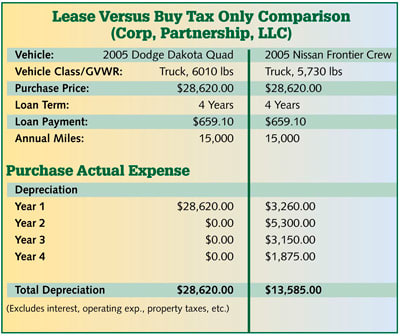
Finally, let’s look at a few medium-size pickups, a segment that has beefed up in recent years. In any configuration, the new Nissan Frontier and Toyota Tacoma fall just under the desired GVWR. But the 2005 Dodge Dakota gained just enough to weigh in at 6,010 lbs.
Running the numbers, you’ll see a total tax savings of $15,035 over four years by purchasing the Dakota over the Frontier. If you’re buying 10 for your fleet, you do the math.
Any football fan asks, “What’s the over/under?” before plunking down a bet on his favorite team in Vegas. Regarding the tax implications of purchasing work trucks, the same question should be asked.
Subscribe to Our Newsletter
More Small Fleet

Developing Budget-Friendly Driver Safety Programs
From driver training and safety meetings to one-on-one coaching and incentive programs, several small fleets share how they have developed a safety culture with their drivers using low- to no-cost resources.
Read More →
Sponsored•March 9, 2026
Boosting Last-Mile Fleet Uptime, Safety, and Value with AI Vehicle Inspections
AI-powered inspections are transforming last-mile fleets by replacing manual checks with highly accurate automated scans that detect defects in seconds. By giving fleet operations visibility into the daily condition of their vehicles, you can identify trends over the vehicle’s lifecycle that enable improved procurement decisions, route management, driver training and accountability.
Read More →
Five Ways Seat Belts Help Prevent Injuries
There are five ways seat belts protect occupants from injuries, according to the Tennessee Department of Safety and Homeland Security.
Read More →
Sponsored•January 14, 2026
It’s here: The 2026 Fleet Technology Trends Report
What does AI mean for fleets? Get the answer — and learn other top tech trends.
Read More →
Small Fleets, Big Impact: How Independent Drivers Power Wreaths Across America
Check out how small fleets and independent drivers power Wreaths Across America each December and why their impact matters more than ever.
Read More →
VMS Survey Finds 65% of Small Fleet Managers Run Operations Alone
A new VMS survey shows small fleet managers are stretched thin, with most handling operations solo and eager to adopt digital tools for relief.
Read More →
Tips for Driving Safely on Halloween Night
This video features a reminder from the Connecticut Department of Transportation (DOT) and the Connecticut Police Chiefs Association, urging drivers to prioritize safety this Halloween.
Read More →
AI, Access, and Uptime: VMS’s Next Chapter with David Prusinski
VMS’s new Co-CEO, David Prusinski, shares how an AI-first approach will give small fleets and repair shops the tools to compete like big players.
Read More →
Fleet Managers Share Winter Prep Tips: It's Never Too Early!
Three fleets share best practices to prep vehicles for winter and prevent downtime when the cold sets in.
Read More →