




What Staples Expects from All-Electric Medium-Duty Work Trucks
Mike Payette, manager of fleet equipment for the office supply company, discusses his experience with all-electric trucks and factors fleet managers should consider when including such vehicles in fleet.

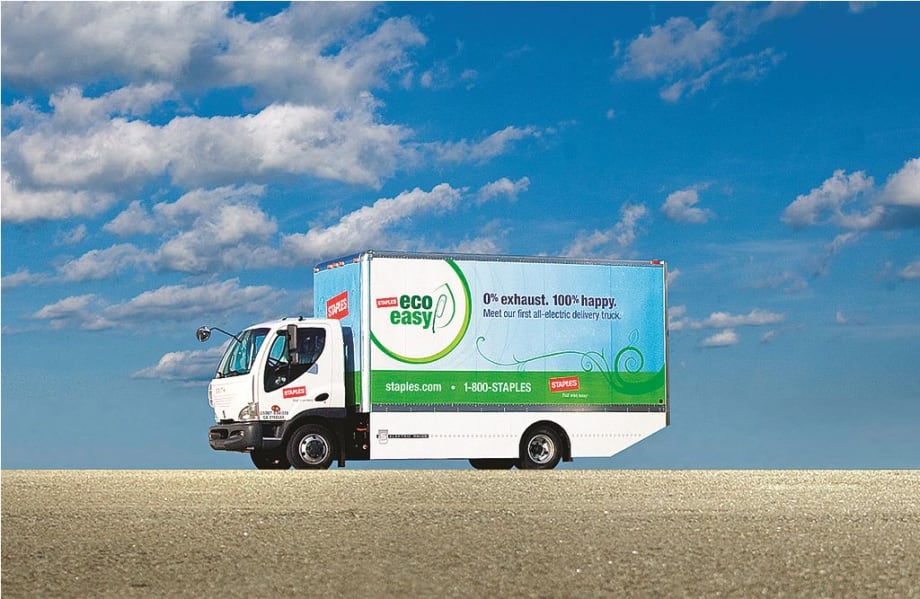
Manufactured by Smith Electric Vehicles, the Newton all-electric medium-duty chassis offers a range up to 100 miles, top speed of 50 mph, and a payload capacity up to 16,000 lb., ideal for short-range urban delivery applications.
Photo: Smith Electric Vehicles
Last November, office supply giant Staples, Inc., of Framingham, Mass., added 41 new all-electric medium-duty Class 6 Smith Newton delivery trucks to its fleet of 2,000 vehicles in North America.
The purchase is part of Staples' ongoing fuel-efficiency initiative, started in 2006, to achieve a 40-percent improvement in fleet fuel economy by 2015 and significantly reduce its carbon footprint.
Manufactured by Smith Electric Vehicles, based in Kansas City, Mo., the Newton all-electric medium-duty chassis offers a range of up to 100 miles, a top speed of 50 mph, and a payload capacity of up to 16,000 lbs., ideal for short-range urban delivery applications that demand heavy stop-and-go driving.
In what instances do medium-duty electric trucks make financial sense for fleets? What are realistic fuel savings expectations? How long should it take to recoup the higher initial cost? What impact do electric trucks make on day-to-day fleet operations, including driver training and maintenance schedules?
Work Truck magazine spoke with Mike Payette, manager of fleet equipment at Staples, who spearheaded the company's electric truck initiative, to get his real-world perspective on these questions and more.
WT: When do medium-duty electric trucks make sense for a fleet? What's the ideal application?
PAYETTE: What's not a good fit is if you have to take the truck out on the freeway and drive 20 miles at 55 mph. That will drain your battery too quickly.
The ideal setup is to be able to pull out of a terminal and make the first delivery within a mile of where the vehicle left. We have several of those situations at Staples.
In Los Angeles, for example, 180 of our routes operate between 35-70 miles per day. That's why electric vehicles are perfect for the L.A. market, as well as many other inner-city metropolitan-type markets.
The shorter routes are actually more harmful for the diesel. We found that with some of our diesels in the L.A. market, we'll pull a download off the engine control module (ECM) and find the ECM called for a regeneration of the diesel particulate filter (DPF) 119 times, but was only able to complete the re-gen three times because the vehicle was not running long enough for the 20 minutes required to clean that filter out.
If we're making 50-60 deliveries per day, the truck is running about eight minutes between stops. The driver must pull the truck over to the side of the road, put it in park, hit the exhaust re-gen button, and let it go through a 20-minute re-gen.
By pulling those diesels out of the short-mileage routes and incorporating electric trucks, you're helping the diesel vehicles run cleaner and putting the electric in its optimal operating environment.
WT: What is the upgrade cost going to the all-electric versus diesel power?
PAYETTE: When you factor available federal and state funds, the cost of these electric trucks is roughly two times the cost of a conventional-powered diesel truck.
WT: How long do you anticipate it will take for you to recoup that investment?
PAYETTE: Understand that over the life of the vehicle, the equation in place today will change. Fuel prices will change; the electric rate I'm paying is likely to change. However, if you use today's numbers, here's what you're looking at:
If you're going to run a diesel truck on a 100-mile route at 10 miles per gallon, that's roughly $35 in diesel fuel to cover the route. In California, by charging electric trucks during off-peak hours, we're paying $9 in electricity to run the same 100-mile route. So that's about $8,900 per year for fuel and $2,300 in electricity.
Since we plan to keep these units in service at least 10 years, the overall differential is $66,000 per truck - if fuel remained $3.50 per gallon or $0.10-$0.12 per kilowatt hour. That alone offsets the incremental cost of the electric vehicle over 10 years without even talking maintenance.
WT: What's different with maintenance?
PAYETTE: On an equivalent 100 mile-per-day diesel vehicle, we spend roughly $900 per year in preventive maintenance - oil changes, filter changes, anti-freeze adds, and eventually transmission oil changes. With the electric vehicles, we take that down to $250 per year.
The electric trucks are only equipped with four grease fittings and no engine or transmission oil. The truck must still be taken to look at brake lines and other wear components that may be cracked. Overall, there is virtually nothing that goes wrong with these things.
You're running air disc brakes that, with regenerative braking (a system that leverages the motor to slow the truck when you take your foot off the accelerator, reducing wear on the brakes, while also restoring charge to the battery), gives us two to four times the brake life over a conventional set of hydraulic brakes.
The electric motors are expected to last about 20 years. By the fifth year, you get into what's called a "battery-refresh" program. The truck is removed from service and the large battery pods are pulled off each side. They're opened up and disassembled. There are individual battery cells inside each pod, which are put through a complete regenerative process, one at a time. Any bad [cells] are removed, new ones are put in, and the battery pack is reassembled. They're good to go for another five years after that.
The estimated cost for this five years from now is between $4,000-$5,000. That's strictly an estimate, which assumes you need to replace at least 10 percent of the batteries on board.
WT: What is the impact on your drivers? What adjustments do they need to make?
PAYETTE: You can't just grab somebody and say, "OK, push this button, do this, and drive this pretty much like a diesel." There's a sophisticated driving program we put the drivers through, which focuses primarily on battery conservation.
When drivers leave in the morning, they're leaving when the truck is at its heaviest, which is when they are going to use the most power. However, it is also when drivers get the greatest regeneration capacity by lifting their foot off the accelerator, which pushes more "juice" back into the battery.
These trucks are also wired with full telemetry, and part of the program where we get money from [the federal government] is to report to the government on the performance of these vehicles, with data automatically downloaded from the truck itself.
This helps us see how effective our driver training has been, in terms of power conservation - how they're operating the trucks, how hard they're depressing the accelerator pedal, and how hard they're coming down on the brakes. How much coasting time do they have? We encourage them, if driving down a long hill on the way to the first stop, to take their foot off the accelerator and let the truck "juice up," or put juice back into the battery.
It's educating drivers on how the system works and how they can get optimal performance out of it. We'll adapt our driver program as we learn from these 41 trucks.
WT: What are the main differences with operating electric trucks?
PAYETTE: There are several different factors you must take into consideration, not the least of which is the fact these trucks make virtually no noise except from rolling resistance from the tires on the road or gravel. If the windows are down, you may hear the tires, but that's about it for noise. So drivers must be very aware of pedestrians on the sidewalk. If they don't hear the vehicle, the driver must be aware they could step out in front of it.
The controls to operate the vehicles are very simple. The driver enters the vehicle and turns the key to the "on" position, which wakes up the 24v control module on these electric trucks. The driver then bumps the key against the starter as if it were a gasoline or diesel engine, which activates the traction motor system. That sends the signal that says, "OK, we're ready to go."
There's a small handle not much larger than a pen, with a mushroom-shape button on the top. The driver simply slides that from a neutral position to forward or reverse and takes off. There's no gear shifting.
A small screen, mounted just above the driver's visor, shows the state of charge, how many amps it's drawing, and the range the driver should attempt to stay in. There's also a conventional fuel gauge on the dashboard tied to the state-of-charge gauge. If the state-of-charge gauge shows 50 percent, the "fuel gauge" will show halfway, much like the gauge in a conventional truck.
WT: How do the electric trucks impact your job as fleet manager?
PAYETTE: A few things: First, there's no real history really in the U.S. to help make qualified decisions on all-electric trucks. I've had to work real hard to bring all the key parties together. I organized meetings with Penske's maintenance team, Smith Electric, and Morgan [Corporation]. We had two days of meetings to explain how these trucks operate and what would be required of Penske and Morgan in designing the body.
My role as a fleet manager has been to bring these parties together, educate them all, and enforce the education to make sure everybody is on the same page. It's been a learning curve for all of us. I try to do as much thinking for everyone as possible to see what we are willing to be exposed to in terms of risk. All of us are taking some risks.
The second thing is managing the impact on vehicle lifecycles and how our leases are structured for diesel trucks. If a fleet manager is used to operating a fleet with 100-percent diesel vehicles and, for example, has 2,000 diesel vehicles in service, some of those trucks run 5,000 miles per year while others run 50,000 miles per year.
When you try to standardize a fleet to seven years and 230,000 miles, you can move vehicles around from route to route. After two years, you can pull a diesel off a 100,000-mile route and put it on a route that will run only 10,000 or 20,000 miles during the next few years so you can equalize your mileage. You've kept your cost of operation down and cost per mile right within the tolerances you expected. And you can make a good business plan for that.
However, when you suddenly start to pull low-mileage options out to place a high-mileage diesel and replace the low-mileage diesel with an electric vehicle, now you're changing how you arrange leasing parameters for the diesel.
In other words, by bringing in the electrics for the short routes, you no longer have a 10,000-mile route to move that 50,000-mile diesel truck down to. You're going to achieve 230,000 miles out of that truck, but you may hit that 230,000 now in five years instead of seven.
So you have to start reorganizing your lease structure. If you're paying $700 per month on the lease, expecting it to go seven years, you may have to pay $850 to as much as $900 per month because the truck is only going five years. The vehicle should be worth a little more because it is two years newer, but it still has high miles on it, which impacts the residual.
WT: From your perspective, what will it take for wider spread adoption of all-electric trucks?
PAYETTE: Over time, as the cost of these electric vehicles begins to drop, the expectation is that at some point, federal [government] incentives will go away and these vehicles have to stand on their own merits. We all understand that to get there, the business case has to be made to increase production, including reduced vehicle costs, lower maintenance costs, and improved range.
It's all about battery capacity and weight and how that impacts your payload. And over the last 10 years or so, we've started to get our hands around those things.
More Green Fleet

Fleet Forward Conference Introduces One-Day Passes for 2026
New one-day registration gives fleet professionals the flexibility to attend Tuesday, Wednesday, or Thursday, with passes available for $199 through Sept. 18.
Read More →
CALSTART Rebrands as Catalyst Mobility, Will Combine with Forth in 2027
CALSTART has rebranded as Catalyst Mobility and will combine with Forth at the start of 2027. The new organization said it is poised to become one of the world's largest, strongest, and most impactful clean transportation nonprofits.
Read More →
Electric Truck and Charging Programs to Boost Sustainability at NY & NJ Ports
Together, the Port Authority of New York and New Jersey and CALSTART will electrify drayage and terminal operations serving the East Coast’s busiest container port. A pair of incentive programs totaling $45 million has launched to accelerate adoption of zero-emission drayage trucks and terminal tractors.
Read More →
Xos Hub Surpasses One Gigawatt-Hour of Energy Delivered in the Field
A single Xos Hub has surpassed one gigawatt-hour of energy across more than 33,600 charging sessions in the field, demonstrating performance that supports Xos' expansion across new products and markets.
Read More →
Carrier Transicold Launches All-Electric Vector 8200 TRU for Diesel-Free On-Site Cold Storage
Carrier Transicold’s first engineless multi-temperature TRU helps fresh- and frozen-food fleets add supplemental cold storage capacity during seasonal peaks.
Read More →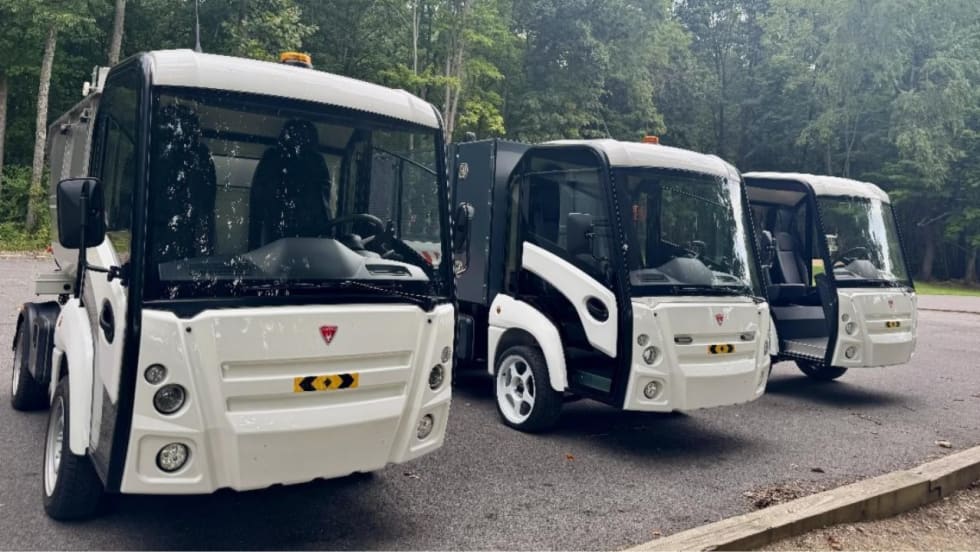
Narro Trucks Introduces Electric Utility Vehicle
Narro Trucks officially launched its operations on Aug. 20 and hosted a ride and drive to showcase its electric truck, which will be produced in Virginia.
Read More →
Samsung SDI Takes Full Control of GM Battery JV as Indiana Plant Pivots to Energy Storage
Samsung SDI is taking full control of its Indiana battery plant with GM, marking a major shift from the EV-focused joint venture Charged Fleet first covered in 2023.
Read More →
NWSA Taps CALSTART to Administer Zero-Emission Drayage Assistance Program
CALSTART will provide free technical assistance services to drayage fleets serving the Ports of Seattle and Tacoma and looking to transition to cleaner technologies and help decarbonize freight hubs.
Read More →
EV Fleet Reality Check: What Operators Wish They Knew Before Electrifying Their Work Vans
Electric work truck upfits bring new compatibility questions. Learn how parts availability, OEM guidance, power demands, and route planning can affect fleet performance.
Read More →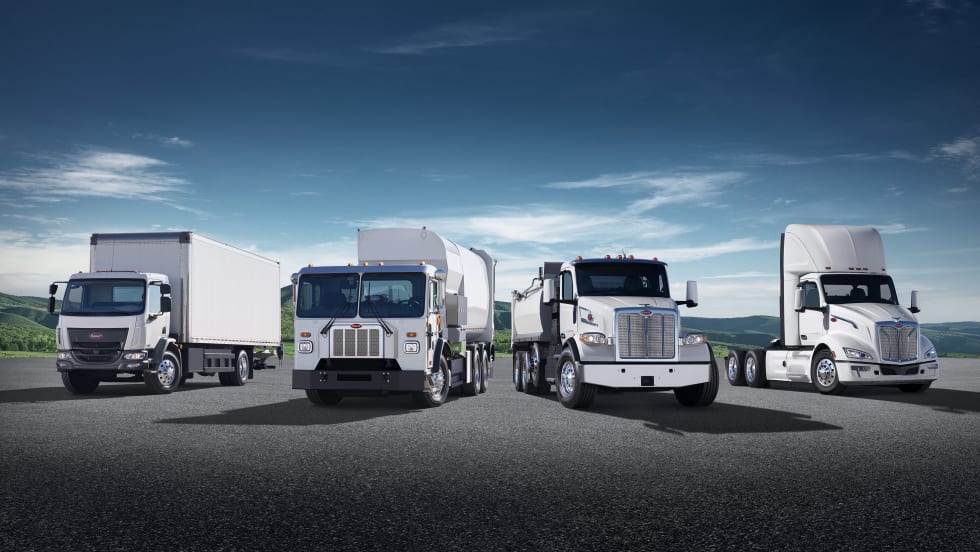
Peterbilt Expands Sourcewell Partnership with Electric Vehicle Lineup
Peterbilt Motors Company’s cooperative purchasing agreement with Sourcewell and its Canadian partner, Canoe Procurement Group, now includes including Peterbilt's battery-electric vehicle lineup.
Read More →