




Vocational Spotlight: Cable and Telecom
Cable and telecom fleets provide services vital to just about every other industry and vocation — they keep businesses able to communicate. Downtime is not an option, and upfitting needs are unique.

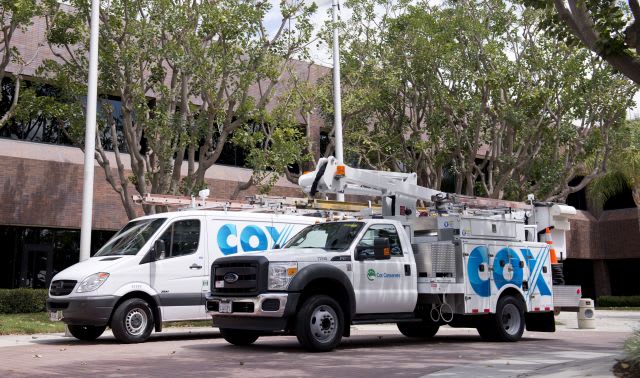
Cox Enterprises fleet vehicles are mainly used for cable installation, service, and sales, with each unit traveling approximately 18,000 miles annually. (PHOTO: COX ENTERPRISES)
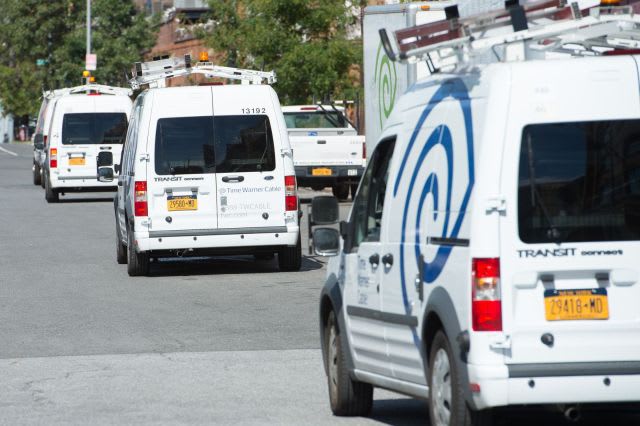
Each unit in the 20,000-plus vehicle fleet for Time Warner Cable travels approximately 13,000 miles each year. (PHOTO: TIME WARNER CABLE)
With homes and businesses depending on cable and telecom fleet vehicles for installation, service, and maintenance, fleet vehicles need to be on the road every day, all day. In addition, the vehicles require unique upfits and have geographical challenges that must be overcome.
Time Warner Cable Focuses on Upfitting
Working to standardize vehicle upfitting, Time Warner Cable has made some significant changes to its upfit process, as well as focused on improving vehicle reliability and reducing repair time.
Each of Time Warner Cable vehicles will travel approximately 13,000 miles each year and are used to service both residential and commercial customers for installations and service calls.
The 20,000-plus vehicle fleet is comprised of about 54% customer facing trucks, 27% support vehicles (pickups and SUVs primarily for engineers and supervisors), and 15% aerial devices, which are used to support service distribution assets above ground. The 10% balance is miscellaneous vehicles. Only 242 passenger cars are operated as part of the fleet.
Time Warner Cable has been on an aggressive track to standardize upfitting. The fleet has recently moved from 18 van upfits to two. In addition, there are 25 upfit versions for pickups, and three alternative aerial trucks. Everything in the fleet short of (most) SUVs and passenger cars has upfits.
“We have also added diesel power plants at every opportunity in the past two years — more than 1,500 vehicles have switched to diesel — and we have been reducing the weight of our core trucks (not necessarily payload) in service bodies, van interiors, and pickups diligently,” said George Survant, senior director of Fleet Management for Time Warner Cable.
The communications fleet has also focused on improving the reliability and reducing the repair times on its trucks.
“This has moved the fleet from 10 mpg in early 2015 to 11.8 today. We are on track in 2016 to use 1.8 million gallons of fuel less than the 2015 performance (on a 25 million gallon per year burn rate). This is in spite of the fleet driving an increasing number of miles year-over-year,” he said.
In addition, Time Warner Cable reduced its daily standing out-of-service vehicle count from around 514 to approximately 346 units.
“This has added the equivalent of 168 additional trucks per day to the fleet compliment,” Survant noted.
In addition, Time Warner Cable established a strategic “center-lead” team with a tactically focused, field-based organization.
“This team approach allows us to maximize the use of our assets across the enterprise,” Survant explained. “We gain the best possible advantage from economies of scale and improve the consistency of our product offering as well as improved budgeting and forecasting.”
In this process, Time Warner Cable consolidated 17 separate corporate identities into one unified operation.
One of Survant’s top challenges includes meeting the upward demand for more vehicles requested independently of the budget cycle.
“To resolve this challenge, we work to identify and utilize each and every vehicle in the fleet, ensuring that vehicles ‘idled’ as a result of employee turnover and organizational changes are captured, refurbished, and made available to reassign,” Survant explained.
Geography also presents challenges, included maintaining a high standard of repair excellence with more than 3,000 independent service vendors nationally and ensuring effective two-way communications across 18,000 assigned drivers and their leaders.
“We set clear and attainable maintenance and repair accountabilities with goals and standards that we monitor continuously. In addition, we keep our messaging simple, hone listening skills, and focus on capturing and responding to feedback,” he said. “We also automate each and every task that we can and invest in/train to turn data into solid, fact-based decision-making tools.”
And, while Survant noted that many fleet challenges are common over time and all locations, “The CATV segment, however, with the expansion of sophisticated and complex product offerings (data transmission speeds and capacity for example), have ancillary effects on the design and mission of the supporting vehicles. That, along with our committed goal to significantly improve the customer experience, is changing fleet size and dispatching practices. Both of those influences are driving changes in this fleet at a rate greater than I have seen in my career,” Survant concluded.
Cox Enterprises Keeps Fleet In-House
With a focus to keep as many fleet-related functions under their roof as possible, the Cox Enterprises fleet has brought upfitting and maintenance both in-house.
The fleet of approximately 13,000 vehicles includes just about all vehicle classes, with approximately 1,500 cars, 4,500 light- and medium-duty trucks, 80 heavy-duty trucks, and 5,000 vans and crossovers.
The vehicles are used for cable installation, service, and sales, with each vehicle traveling approximately 18,000 miles each year.
Unique to the communication fleet is its ownership of Manheim, allowing the ability to upfit vehicles in-house.
“Our situation is a bit unique because we are able to upfit vehicles in our own Manheim locations. My advice would be to look at it like any other business case and let the numbers guide you to the right decision,” said Jim Bigelow, senior director, Enterprise Fleet at Cox Enterprises.
According to Bigelow, the benefits are better controls over cost, quality and time commitments.
“Making this change was all about cost, quality, and keeping fleet in-house,” Bigelow said. “As far as time savings, we have very few delays and missed time commitments.”
Recently, the fleet implemented a new fleet asset maintenance management system (FAMMS) and brought maintenance in-house.
“We faced the same challenges that any Fleet would have with implementing a new FAMMS, developing the business case, putting together a good rollout plan along with the corresponding time line. We put together a great ‘core team’ and gave them the authority to work the plan,” Bigelow explained.
For fleets looking to implement a new FAMMS, Bigelow recommends to “put together a great team and conduct a thorough request for proposal (RFP). Along with the parameters and guidelines, give your team the authority to make decisions.”
One other challenge Bigelow noted was related to ensuring proper driver training.
“In terms of driver training, from a fleet perspective we work with our drivers from day 1 on the job and we have constant contact with them regarding their vehicle,” Bigelow said.
DISH Communicates its Way to Success
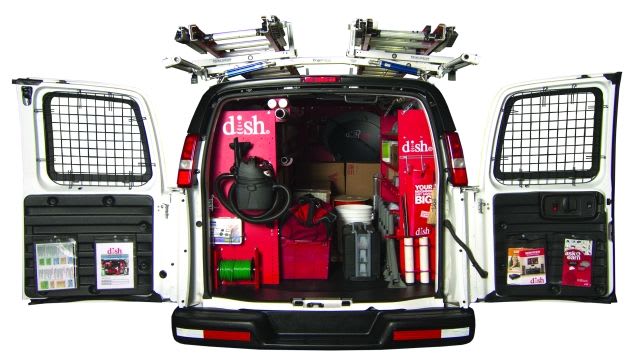
Traveling approximately 21,500 miles each year, each of the approximately 4,200-vehicle fleet is the result of communication and company-wide involvement. (PHOTO: DISH)
With the geographic dispersal of its fleet, DISH ensures that proper communication takes place and that all key stakeholders remain involved through multiple feedback channels.
DISH vehicles are utilized by the company’s in-home services field technicians who connect, upgrade, and service the video needs of new and existing residential and commercial customers.
The DISH fleet consists of approximately 4,200 vehicles, of which 500 are light-duty trucks and the rest are vans. Each vehicle travels approximately 21,500 miles annually.
“Upfitting is one of the most critical components in a DISH vehicle. This includes not only interacting with our suppliers on the products that are attached to the vehicle but working across various teams internally to incorporate specific placement locations for all of our tools and products within the vehicle,” according to Abe Stephenson, fleet and administration manager at DISH.
Although there are specific dimensions, sizes, and quantities of items stored, vehicles still need to provide flexibility for future business changes, according to Stephenson, most of which are typically unknown and undefined until a later date.
“The long life of a vehicle needs to have flexibility in accommodating a changing business environment without becoming obsolete or unusable,” he said.
To that extent, DISH is highly engaged in the vehicle upfitting process.
“We continue to delve deeper each year into the technician experience and their interaction with their vehicles. This also includes new opportunities being presented through the Euro-style vans,” Stephenson said.
DISH uses multiple feedback channels to ensure that all key stakeholders stay involved in the process.
“We have various roundtables and invitationals we do at the corporate office, inviting different types of field employees from all over the country. We also have demo vehicles at corporate to showcase new things we’re working on,” he said. “In addition, we do field trials with new vehicles and new upfitting to give field employees an appropriate amount of time to get used to new solutions and make changes accordingly before executing larger rollouts.”
DISH also has ongoing fleet council meetings with management representation from our various field regions, plus involvement from safety, industrial engineering, mobility, and inventory and warehouse teams to proof through solutions as well.
“Organizational executives are also included to provide input, help choose and prioritize options, and ultimately provide sign-off and sponsorship for final specifications,” he said.
And, while upfitting has proven to be a recent success at DISH, it has also been a challenge.
“Working with technicians and what’s most efficient and most ergonomic with how they interface with their vehicles is an everyday effort and concern,” Stephenson said. “Fleet managers need to be highly engaged and should not outsource these efforts in their entirety to their suppliers or their fleet management companies."
Only internal employees can understand the nuances and frequency with when tools and products are accessed and how they are used.
An additional challenge facing the telecommunications fleet is turnover.
“Technicians in the telecom industry fight the elements year round and can spend a significant portion of their day both inside and outside a customer’s homes,” Stephenson explained. “Not everyone is cut out for this as they go through extreme seasons. Heat, humidity, and sun are exhausting and can be dangerous, and the cold air of winter just plain hurts. And, new employees are not always familiar with the considerations of driving service vehicles, which can include compromised visibility, longer braking distances, and inexperience with truly safe driving practices.”
Another challenge DISH is facing head on is common across just about all fleet industries: managing costs.
“Cost controls are always a primary responsibility of fleet managers. Productivity impacts are a particularly complex influence on lifecycle costs. With today’s vehicle options, upfitting choices, and a vast array of developing fleet related technologies, we are beginning to see more spend on core fleet costs but with a bigger payoff in productivity,” Stephenson said. “Unfortunately, this means the fleet costs on the profit and loss (P&L) may go up, but with the savings captured within labor time and costs.”
To face this challenge, Stephenson noted that hourly pay savings and even time studies can be employed to help measure productivity, ensure it’s reflected in the return on investment (ROI), and made visible to senior management.
Finally, as with all fleet industries, change is constant ad evolution is a necessity.
“Tools and products are continuously evolving. Add in changes in the scope of business and other business technology impacts, and there can be consistent factors influencing vehicle choices and upfitting to accommodate this. Telecom technicians also face the elements every day through every season. Comfort and efficiency throughout long work days are primary considerations. From tech to exec, many levels should be involved with the design of the vehicle,” Stephenson concluded.
More Operations
Family Ties Inside the Fleet Families Building Careers Across Generations
Three fleet families share what it really takes to work together, learn across generations, and keep business from following them home.
Read More →
Shades of Fleet Call for Voices: Fleet's Hidden Heroes
Fleet’s hidden heroes are often the ones keeping everything moving behind the scenes. September’s Shades of Fleet is looking for dispatchers, coordinators, parts specialists, and other support pros to share their stories.
Read More →
Truck Centers, Inc. Celebrates National Truck Driver Appreciation Week with $1,000 Fuel Card Giveaways
During National Truck Driver Appreciation Week, Truck Centers, Inc. is offering customers a chance to fuel up for free. Customers at all Truck Centers locations can enter to win one of four $1,000 fuel cards from Sept. 14 - 18.
Read More →
Fleet Guides, AI Time-Savers, Truck Tariffs & Fuel Strategy Lead the News
This week’s Truck Chat Cheat Sheet covers new fleet vehicle guides, practical AI use cases, U.S.-Canada truck production, mixed-energy strategy, and more.
Read More →
What Fleet Employers Are Missing When Hiring Veterans
What if some of the strongest candidates for fleet are already out there, but their experience is written in a language our industry does not always recognize?
Read More →
Automotive Fleet Opens 2026 Personal Use Survey for Commercial Fleet Managers
Less than two weeks left! Commercial and corporate fleet managers are invited to share how their organizations handle company vehicle personal-use policies, charges, and driver eligibility.
Read More →
What Resilient Fleets Do Differently When Conditions Change
Fleet resilience is about more than reacting to disruption. Lauren Fletcher talks with AP Fleet’s Alex Coveney about flexibility, planning, scaling, and what helps fleets adapt when business conditions shift.
Read More →
If We Want the Next Generation in Automotive, We Have to Give Them a Reason to Care
The automotive industry talks constantly about its workforce shortage. But before we can recruit the next generation, we may need to do a better job giving kids a reason to care about automotive in the first place.
Read More →
Ram ProMaster City Under $40K, Truck Tariffs, and AI Maintenance Lead the News
A sub-$40K commercial van, tariff questions, AI-powered maintenance, and a new EV production strategy headline this week’s Truck Chat Cheat Sheet.
Read More →
Bob Adamsky Shares the Fleet Lessons You Usually Learn the Hard Way
After more than 30 years in fleet, Arrow International’s Bob Adamsky has learned that the job is about far more than vehicles. He shares the lessons he wishes every fleet manager could learn a little earlier.
Read More →