





Read More: How a Digital Key is Transforming Corporate Carsharing
Transform Your Fleet Using Keyless & Automated Technologies
How can the latest in digital key technology transform your fleet operations? For starters, a key in the cloud becomes associated with a person rather than a vehicle, ultimately allowing for more control.
May 16, 2022
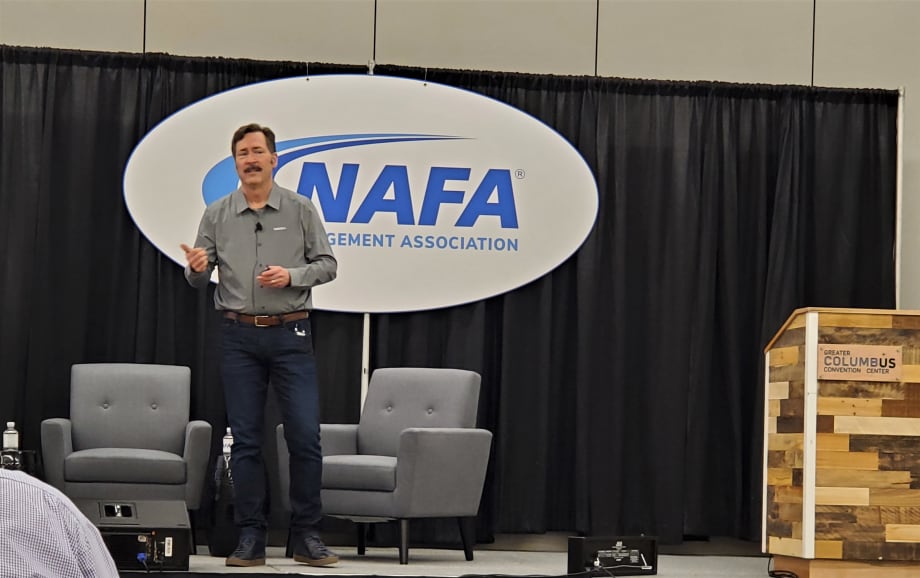
Mark Thomas of Ridecell takes attendees at his NAFA session last March through how to implement digital keys into their fleets.
Photo: Amanda Huggett
5 min to read
Using new technologies can totally transform your fleet organization, Mark Thomas, VP of marketing and strategic alliances at Ridecell, proclaims. But connected vehicles are not enough. Automation is essential.
But first, what does that even mean? “It’s using digital technologies to create new or modify existing business processes, culture, and customer experiences that can meet changing business and market requirements,” Thomas explained.
But how the heck do you digitize a vehicle? Well, you can’t move an entire vehicle to the cloud, but you can digitize a few physical objects connected to it, thereby changing everything. The most important object here: the key.
“Whoever holds the physical key, holds access rights to get in and use that vehicle,” Thomas said. “By taking the key and moving it to the cloud, you can dramatically change the kinds of things you can do with your fleet.”
“Keyless has always been thought of as something for shared mobility,” he continued. “That’s what companies like Zipcar use. What we're here to talk about today is actually challenging that assumption of what happens if you were to move the key to the cloud and how would that potentially make people’s lives better.”
The three phases of transformation fleet businesses through digital transformation are:
Automation: Turn fleet management insights into automated actions.
Digital Control: Digitally change the vehicle state with access and immobilization.
Operational & business models: Process transformations; New consumer facing value propositions.
Thomas made clear that this is not about getting rid of jobs; rather, it’s making parts of our jobs easier and more streamlined by removing the drudgery and making manual processes automatic.
He used the example of all your systems that monitor your fleet and send notifications or “triggers” — including GPS and telematics, cabin and driver monitoring, asset management, scheduling, accounting, maintenance, and diagnostics — and turning them into a series of automated workflows such as self-created work orders or dispatching a vendor.
“Having the ability to understand and automatically begin resolving these issues means that you’re in the process of moving from connected vehicles and fleet management systems with insights to something that probably most people consider impossible, which is moving toward self-managing fleets,” Thomas said.
But back to the key. Digital vehicle control is keyless, but it’s more than about entry, he argued. It’s also about immobilization. “Having the ability to digitally prevent that car from starting even if somebody has the key is one of the huge advantages of keyless.”
Just like a valet key restricts access to parts of a vehicle, using a keyless solution you can restrict access to the glove box or trunk, or offer the maintenance worker access rights where they can enter the vehicle but not start it. Management could also digitally unlock a vehicle for service or assign a driver a new key for an alternate car.
Think of it like badging into a secure facility, where the vehicle could know if a driver has been terminated of it’s already been reserved for someone else. “So, the concept of keyless really changes the notion that the key is associated with the vehicle and instead the key becomes associated with the person,” Thomas said.
For last-mile delivery fleets, keyless technology can actually improve uptime. In one example Thomas provided, one person realized that at any given time, 20% of vehicles had a check engine light on. “Drivers are not incentivized to stop their shift and say, ‘Hey there is an issue with this van, can you give me a different one?’” he said. “Having the ability to create automation that does the vehicle health check before the driver arrives, rather waiting for them to turn the key and see if something wrong, is a simple but important step.
44% of #fleets report rising costs as a challenge in daily operations, but #technology and #fleetmanagement solutions are emerging as ways to reduce costs and optimize operations. Check out our full infographic to learn how #fleetautomation impacts fleets. https://ridecell.com/the-impacts-of-fleet-automation-solutions-infographic/pic.twitter.com/R20kInxwBI
— Ridecell (@ridecell) April 29, 2022
In another example, the typical delivery driver doesn’t lock or turn off the vehicle because their hands are full of packages and they’re on a time constraint. When the key is in the cloud, they would just need to bump the door closed. Once they’re an assigned amount of distance away, the vehicle locks. “And if somebody has the audacity to look in and see if there's keys in the ignition and breaks the window and jumps in and tries to steal the van, they won’t be able to because of the digital immobilizer,” he explained. “This is a game changer because it not only secures the vehicle from theft, but it improves customer satisfaction.”
And in the off chance a thief loads the vehicle on a flatbed, GPS steps in to sense movement, track the location, and send an alert. In the case of an actual Ridecell custom with this system installed, they were able to reduce their vehicle recovery time from weeks to mere hours. “All they did was activate the immobilizer, so once the vehicle was stopped and parked, it wasn’t able to be restarted and the thieves abandoned the van. The company didn't even need to involve the authorities. They just sent their driver in an Uber with a digital key. Driver got there, unlocked the vehicle, brought it home” and saved the company thousands of dollars with that vehicle being back in service sooner.
For companies that perform driver’s license checks, the system can run a background check, make sure a license isn’t revoked and an individual isn’t on a watch list. “There are huge, huge implications to a company brand they can help safeguard through digital transformation,” Thomas said.
Lastly, for motorpools, government fleets, and universities, Thomas endorsed Geotab’s keyless solution, calling it an “easy plug and play style of integration that will let you experiment and start adding keyless into fleets” and a smart alternative to lock boxes.
To get started on implementing keyless technology into your fleet, Thomas recommends looking closely at your needs and pain points to pick the right solution.
Originally posted on Automotive Fleet
Subscribe to Our Newsletter
More Small Fleet


Developing Budget-Friendly Driver Safety Programs
From driver training and safety meetings to one-on-one coaching and incentive programs, several small fleets share how they have developed a safety culture with their drivers using low- to no-cost resources.
Read More →
Sponsored•March 9, 2026
Boosting Last-Mile Fleet Uptime, Safety, and Value with AI Vehicle Inspections
AI-powered inspections are transforming last-mile fleets by replacing manual checks with highly accurate automated scans that detect defects in seconds. By giving fleet operations visibility into the daily condition of their vehicles, you can identify trends over the vehicle’s lifecycle that enable improved procurement decisions, route management, driver training and accountability.
Read More →
Five Ways Seat Belts Help Prevent Injuries
There are five ways seat belts protect occupants from injuries, according to the Tennessee Department of Safety and Homeland Security.
Read More →
Sponsored•January 14, 2026
It’s here: The 2026 Fleet Technology Trends Report
What does AI mean for fleets? Get the answer — and learn other top tech trends.
Read More →
Small Fleets, Big Impact: How Independent Drivers Power Wreaths Across America
Check out how small fleets and independent drivers power Wreaths Across America each December and why their impact matters more than ever.
Read More →
VMS Survey Finds 65% of Small Fleet Managers Run Operations Alone
A new VMS survey shows small fleet managers are stretched thin, with most handling operations solo and eager to adopt digital tools for relief.
Read More →
Tips for Driving Safely on Halloween Night
This video features a reminder from the Connecticut Department of Transportation (DOT) and the Connecticut Police Chiefs Association, urging drivers to prioritize safety this Halloween.
Read More →
AI, Access, and Uptime: VMS’s Next Chapter with David Prusinski
VMS’s new Co-CEO, David Prusinski, shares how an AI-first approach will give small fleets and repair shops the tools to compete like big players.
Read More →
Fleet Managers Share Winter Prep Tips: It's Never Too Early!
Three fleets share best practices to prep vehicles for winter and prevent downtime when the cold sets in.
Read More →