




Tesla's Electric Pickup: Is It a Work Truck?
An up-close dose of Tesla’s Cybertruck from last night’s reveal in Hawthorne, Calif. answers some initial questions on whether it can function in a traditional fleet capacity.

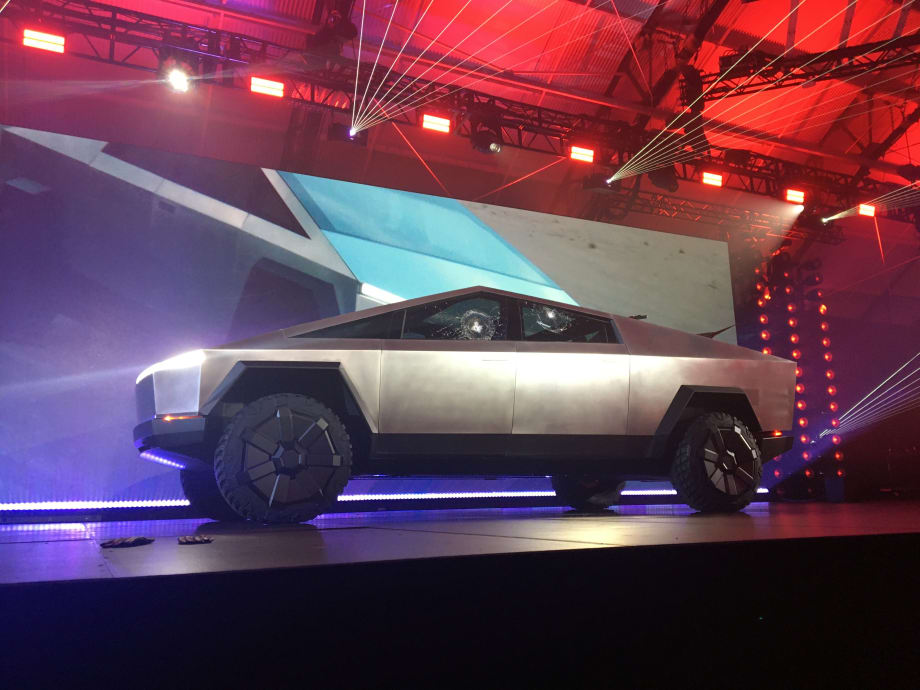
The night of broken glass: In the event’s soon-to-be legendary “uh-oh moment,” Musk asked Tesla’s chief designer, Franz von Holzhausen, to test the window strength by throwing a steel ball at it. It broke, twice.
Photo by Chris Brown
Holy cow that was one heckuva party. Famous movie cars, a Vegas club laser show, a Ramen bar, an alcohol bar, Dr. Megavolt getting zapped by a giant Tesla coil, a hologram introduction, and of course, Elon Musk. The event — held Thursday night at Tesla’s Design Center next to SpaceX in Hawthorne, Calif. — was fanboy heaven. As it was meant to be.
And then there was the truck, which crawled on stage from an alternate universe or a Paul Verhoeven movie. In the default universe, new vehicle models are first teased as concepts in the cliched glamour of a traditional auto show. By the time the production model drives into showrooms, the concept has morphed from inspirational to utilitarian. We accept this bargain.
Whatever images were leaked or conjured of the Tesla Cybertruck, the model we saw onstage was more cyberpunk, more polarizing, more, more, more everything than the pre-reveal speculations.
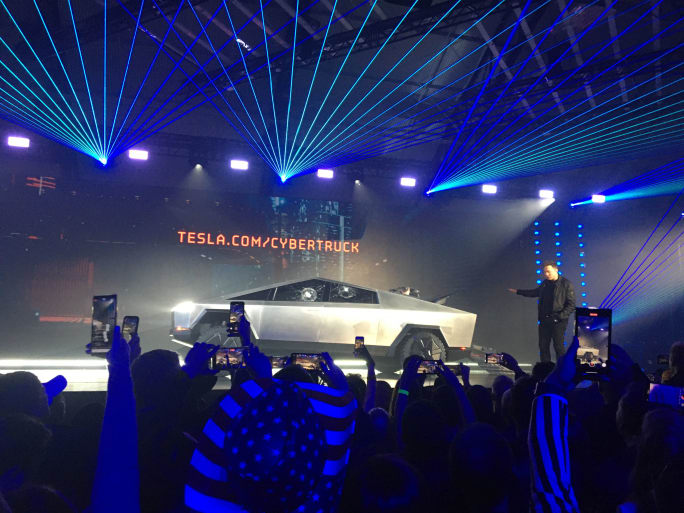
Elon Musk, the other star of the show.
Photo by Chris Brown
First off, the look: The truck is more futuristic mini troop carrier than pickup. It’s got so many sharp angles you might get impaled. The truck’s profile forms a near-perfect 120-degree angle peak from the front grille to the rear tailgate. Traditional headlights have given way to a thin bar projecting a sliver of light. Any outward display of pickup truck-ness is concealed by an angled tonneau cover that covers the bed.
Form over function? I can just see the engineers at Knapheide with arms crossed and quizzical stares. With its angled sides, the Cybertruck is not designed for rack and bin packages, truck caps, ladder racks, or wheel well toolboxes — at least traditional ones.
With those angled sides, it’ll be much harder to swing tools and gear into the bed. Access is better served from the tailgate, removing traditional pickup functionality.
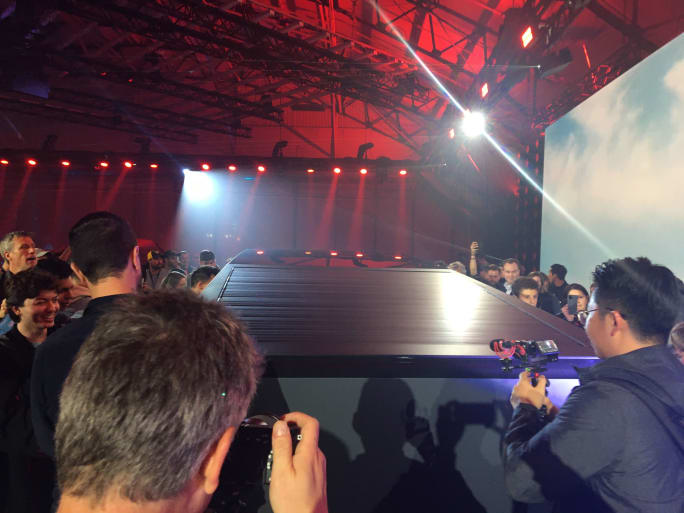
There is a pickup truck bed under there, somewhere.
Photo by Chris Brown
Let’s be clear, what rolled onto stage may not exactly be what rolls into driveways in late 2021 or early 2022. (And we’ve played Tesla’s waiting game before.) When I jumped on stage and beelined to the truck, I was caught by security before I could touch the supposedly bulletproof stainless-steel alloy compound.
The specs, however, are eye popping, at least on paper. The truck can carry 3,500 lbs. and maxes out towing at 14,000 lbs., putting it in the range of a ¾-ton pickup. The all-wheel drive truck will be available in single-, dual-, and tri-motor versions, which offer 250-, 300-, and 500-mile ranges. The tri motor is purportedly able to do 0-60 in 2.9 seconds. Wow.
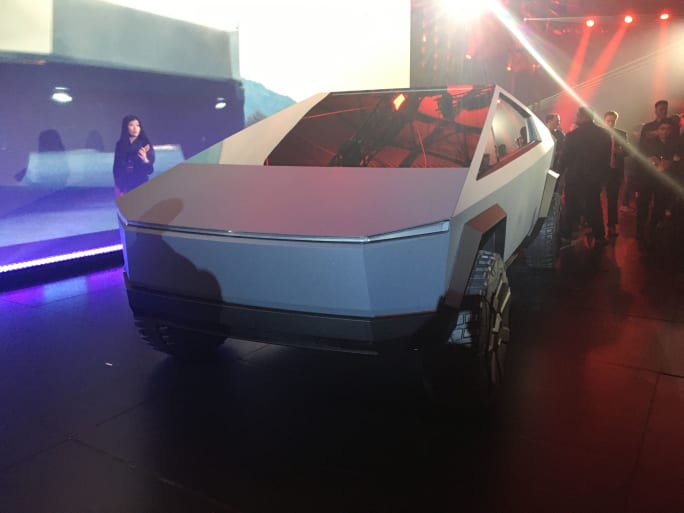
The Tesla Cybertruck is already polarizing the pickup market — as Tesla intends.
Photo by Chris Brown
The price reveal — $39,900 for the base model — drew approving gasps from the crowd, particularly as there was speculation the truck would retail for just shy of $50k. But let’s be real, whatever price tag Elon Musk tosses out on stage is disassociated with the reality of supply and demand and the vehicle itself.
The Tesla Model 3 came with a well-publicized $35,000 base sticker, which is still only a phantom for the great majority of buyers. The Cybertruck, with more range, an unbreakable skin, and able to tackle extreme off-road tests like the Rubicon (said Musk onstage), is leaps ahead in the engineering department.
The max price of $69,900 for the tri motor feels more like the range this truck will play in for the foreseeable future. As a comparison, the almost-production ready Rivian R1T electric will start at $69,000.
Is this — could this ever be — a work truck? Work trucks don’t live in polarizing environments, particularly when they need to deal with all types of customers with whom contractors and plumbers interact. Who knows, companies like Red Bull will look to make a statement in the Cybertruck.
On the passenger side, fleets can soon look forward to more Model 3 sales, and Model Y (compact crossover) sales down the road. For the Cybertruck, we’ll have to wait to see how production specs, pricing, and customer acceptance fare before anyone touches it in a work capacity. That might take a while.
Some speculated on the show floor that the Cybertruck could be an off-road pursuit vehicle. If I’m to be arrested in any vehicle, I suppose it’d be that one.
Originally posted on Charged Fleet
More Green Fleet

Fleet Forward Conference Introduces One-Day Passes for 2026
New one-day registration gives fleet professionals the flexibility to attend Tuesday, Wednesday, or Thursday, with passes available for $199 through Sept. 18.
Read More →
CALSTART Rebrands as Catalyst Mobility, Will Combine with Forth in 2027
CALSTART has rebranded as Catalyst Mobility and will combine with Forth at the start of 2027. The new organization said it is poised to become one of the world's largest, strongest, and most impactful clean transportation nonprofits.
Read More →
Electric Truck and Charging Programs to Boost Sustainability at NY & NJ Ports
Together, the Port Authority of New York and New Jersey and CALSTART will electrify drayage and terminal operations serving the East Coast’s busiest container port. A pair of incentive programs totaling $45 million has launched to accelerate adoption of zero-emission drayage trucks and terminal tractors.
Read More →
Xos Hub Surpasses One Gigawatt-Hour of Energy Delivered in the Field
A single Xos Hub has surpassed one gigawatt-hour of energy across more than 33,600 charging sessions in the field, demonstrating performance that supports Xos' expansion across new products and markets.
Read More →
Carrier Transicold Launches All-Electric Vector 8200 TRU for Diesel-Free On-Site Cold Storage
Carrier Transicold’s first engineless multi-temperature TRU helps fresh- and frozen-food fleets add supplemental cold storage capacity during seasonal peaks.
Read More →
Narro Trucks Introduces Electric Utility Vehicle
Narro Trucks officially launched its operations on Aug. 20 and hosted a ride and drive to showcase its electric truck, which will be produced in Virginia.
Read More →
Samsung SDI Takes Full Control of GM Battery JV as Indiana Plant Pivots to Energy Storage
Samsung SDI is taking full control of its Indiana battery plant with GM, marking a major shift from the EV-focused joint venture Charged Fleet first covered in 2023.
Read More →
NWSA Taps CALSTART to Administer Zero-Emission Drayage Assistance Program
CALSTART will provide free technical assistance services to drayage fleets serving the Ports of Seattle and Tacoma and looking to transition to cleaner technologies and help decarbonize freight hubs.
Read More →
EV Fleet Reality Check: What Operators Wish They Knew Before Electrifying Their Work Vans
Electric work truck upfits bring new compatibility questions. Learn how parts availability, OEM guidance, power demands, and route planning can affect fleet performance.
Read More →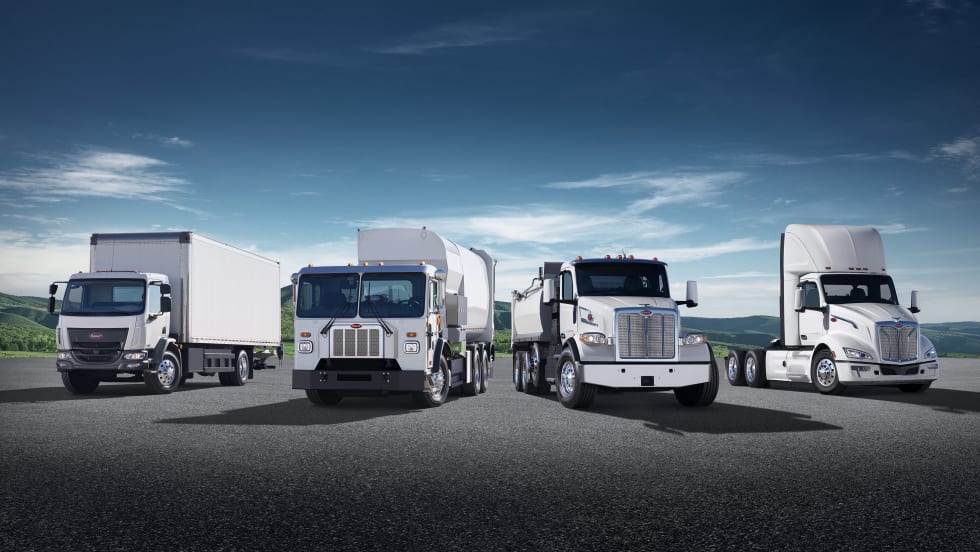
Peterbilt Expands Sourcewell Partnership with Electric Vehicle Lineup
Peterbilt Motors Company’s cooperative purchasing agreement with Sourcewell and its Canadian partner, Canoe Procurement Group, now includes including Peterbilt's battery-electric vehicle lineup.
Read More →