





Related: An EV History Lesson for Overcoming EV’s Challenges Today
Planning for Fleet Electrification through a Distributed Charging Network
“Everyone comes into fleet electrification talking about hardware, and they leave talking about software workflow and project management,” says Michael Hughes of ChargePoint.
June 9, 2020
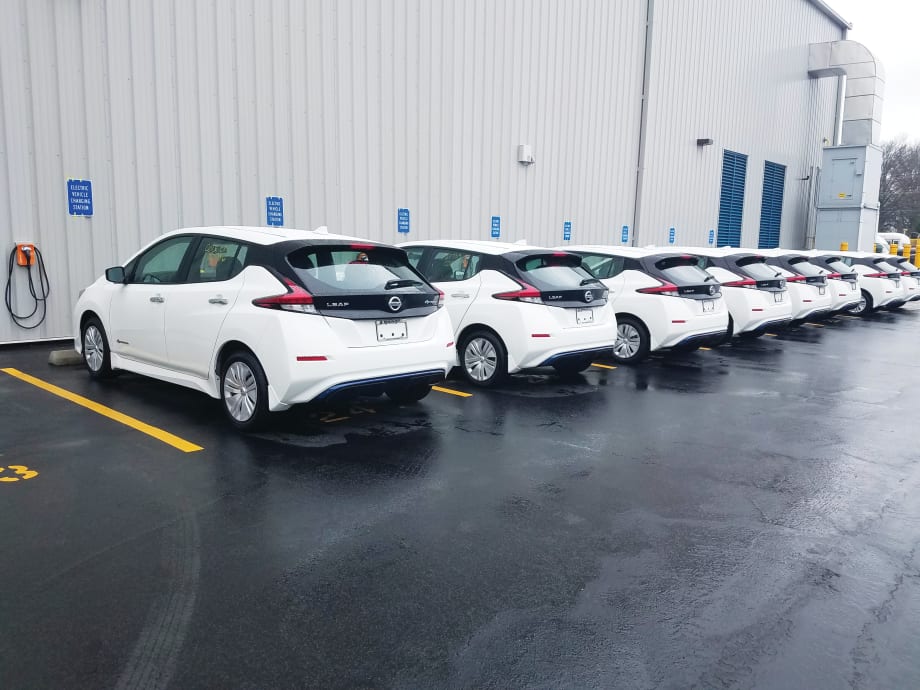
On the passenger car side, which has a more developed product cycle, the hot sector is municipal and corporate motor pools.
Photo courtesy of City of Columbus.
4 min to read
When Amazon threw down the gauntlet with its commitment to have at least 100,000 electric delivery trucks by 2030, the world started waking up to fleet electrification. In October 2023, Amazon announced it has 10,000 Rivian electric delivery vehicles making routes across the U.S. and Europe.
“We've always thought this was the year of the electric fleet pilot. It is, but we’re starting to see some significant implementations as well,” says Michael Hughes, chief commercial and revenue officer at ChargePoint, an electric vehicle charging network company.
Hughes points to pilots in Classes 6 to 8 with high-profile fleets such as PepsiCo, FedEx, and UPS, and actual implementations in municipal bus transit agencies across the country. The market leaders in bus manufacturing — New Flyer and Gillig — are retooling their production pipeline toward electric, while new players such as BYD and Proterra make only electric buses.
On the passenger car side, which has a more developed product cycle, Hughes says the hot sector is municipal and corporate motor pools. He cites implementations in municipalities in California, the cradle of EV civilization in the U.S., but also cities such as Atlanta, Columbus, and New York City.
The duty cycles of a typical municipal motor pool aren’t complex, such as a staffer who takes a sedan for an inspection or a meeting across town. The cars come back to a central depot and charge overnight.
Moreover, cities are more conscious of air quality. “I can't imagine being in a major urban area and not considering electric vehicles in 2020,” Hughes says.
Logistics fleets — particularly last mile — present the next big opportunity, which dwarfs all other markets by size. Yet this market is “orders of magnitude more complex,” considering payload, power requirements, route factors such as temperature and terrain, and the mission-critical nature of deliveries.
As electrification develops in the commercial vehicle market, fleets are faced with building out infrastructure that plans for growth with electric vehicles of various sizes and applications.
Managed, Distributed Charging
Most EV charging needs today are met by Level 2 (240-volt) charging. Electric vehicles need to convert the alternating current (AC) typically found in household outlets to the direct current (DC) needed for the EV battery. This happens through the EV’s onboard charger.
For many fleet applications, today and in the future, Level 2 charging will be sufficient. “We have seen very few use cases in which dwell times aren’t long enough to support getting a full charge for the next day’s route,” Hughes says.
Hughes points to PepsiCo, which has 70,000 trucks delivering both heavier weight liquids and lightweight snacks. About 84% of those vehicles run fewer than 100 miles per day and are domiciled for 13 hours overnight.
Level 3 DC fast chargers, however, make this conversion within the charging station itself to deliver DC power directly to the battery, which is why they charge faster — to 80% capacity in approximately 30 to 60 minutes for most EVs available today.
Down the road, fleets with larger vehicles, such as over-the-road big rigs, and longer routes will have to plan for the incorporation of DC fast charging. Yet most fleets starting the process right now shouldn’t have to worry about building DC fast charging infrastructure out of the gate.
They do, however, need to plan for a distributed charging network, in which a central hub distributes power to multiple smart dispensers at various locations that are independently controlled and managed.
Early electric pilots made the mistake of unmanaged charging where vehicles would return to the depot and plug into a self-contained charger that was subject to the utility rate at that moment. “It just doesn't make sense long term to have a completely independent set of manageable endpoints,” Hughes says.
Managed charging requires inputs and algorithms that consider vehicle type, battery size, current state of charge, utility rates, and required range — all in relation to the rest of the fleet needing to be charged. Done effectively, charging costs can be greatly reduced.
DC fast charging infrastructure is, at this point, a lot more expensive than Level 2 charging. But the cost of a distributed charging system will be more manageable than three separate fast chargers.
The power conversion behind the fence “will cost a bit,” Hughes says, but the dispensers themselves won’t. And the managed controlling of utility rates will lower costs further.
Learning Curve
Hughes stresses that at the onset of the process fleet operators are surprised at how long it takes and how much there is to learn, particularly when dealing with utilities. “The ones who get in late won’t have gone through those lessons,” he says.
This is even more critical for fleets operating in cities such as New York, San Francisco, and Los Angeles that are considering various forms of carbon emissions restrictions. “They have to get in the game, otherwise they're going to be left behind,” he says.
Fleets need to view electrification through software and controlling the distribution of power. This then expands into route management using telematics data and other data sources such as weather and topography.
“Everyone comes into fleet electrification talking about hardware,” Hughes says. “And they leave talking about software workflow and project management.”
Editor's Note: This article was orignally published June 2020 and was updated for clarify on Nov. 2023.
Originally posted on Charged Fleet
Subscribe to Our Newsletter
More Small Fleet


Developing Budget-Friendly Driver Safety Programs
From driver training and safety meetings to one-on-one coaching and incentive programs, several small fleets share how they have developed a safety culture with their drivers using low- to no-cost resources.
Read More →
Sponsored•March 9, 2026
Boosting Last-Mile Fleet Uptime, Safety, and Value with AI Vehicle Inspections
AI-powered inspections are transforming last-mile fleets by replacing manual checks with highly accurate automated scans that detect defects in seconds. By giving fleet operations visibility into the daily condition of their vehicles, you can identify trends over the vehicle’s lifecycle that enable improved procurement decisions, route management, driver training and accountability.
Read More →
Five Ways Seat Belts Help Prevent Injuries
There are five ways seat belts protect occupants from injuries, according to the Tennessee Department of Safety and Homeland Security.
Read More →
Sponsored•January 14, 2026
It’s here: The 2026 Fleet Technology Trends Report
What does AI mean for fleets? Get the answer — and learn other top tech trends.
Read More →
Small Fleets, Big Impact: How Independent Drivers Power Wreaths Across America
Check out how small fleets and independent drivers power Wreaths Across America each December and why their impact matters more than ever.
Read More →
VMS Survey Finds 65% of Small Fleet Managers Run Operations Alone
A new VMS survey shows small fleet managers are stretched thin, with most handling operations solo and eager to adopt digital tools for relief.
Read More →
Tips for Driving Safely on Halloween Night
This video features a reminder from the Connecticut Department of Transportation (DOT) and the Connecticut Police Chiefs Association, urging drivers to prioritize safety this Halloween.
Read More →
AI, Access, and Uptime: VMS’s Next Chapter with David Prusinski
VMS’s new Co-CEO, David Prusinski, shares how an AI-first approach will give small fleets and repair shops the tools to compete like big players.
Read More →
Fleet Managers Share Winter Prep Tips: It's Never Too Early!
Three fleets share best practices to prep vehicles for winter and prevent downtime when the cold sets in.
Read More →