Piedmont Natural Gas Aims for CNG Truck Conversions
Growing in use in truck fleets, compressed natural gas is a clean alternative to gasoline and diesel. One natural gas utility fleet is working to grow its use of natural gas vehicles and promote the technology.
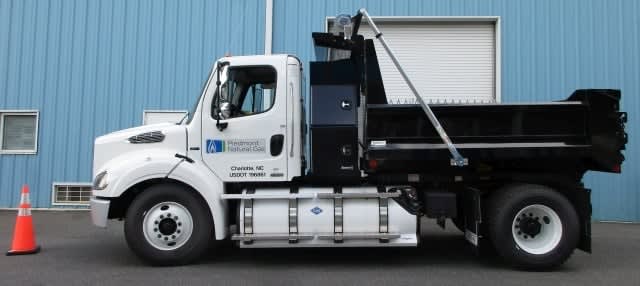
Piedmont Natural Gas utilizes compressed natural gas in its fleet of dump trucks. (Photo: Piedmont Natural Gas)
The use of natural gas in truck fleets is on the rise. According to the National Petroleum Council (NPC), under an “aggressive” scenario, they predict that by 2050 natural gas vehicles (NGVs) will capture 50% of the light-duty market, upwards of 35% of the medium-duty truck market, and almost 50% of the heavy-duty truck market.
Ad Loading...
Some of the fleets taking advantage of growing their natural gas fleet include transit, refuse, airport, and utility/energy fleets.
Ad Loading...
One such fleet growing its NGV fleet is Piedmont Natural Gas, a business unit of Duke Energy. The company serves about 1 million natural gas customers including homes and businesses in Tennessee, North Carolina, and South Carolina. The company also sells, installs, and repairs natural gas appliances and equipment and offers repair plans.
Rallying for Natural Gas
The American Public Gas Association, American Gas Association, and NGVAmerica held the second annual natural gas vehicle (NGV) Road Rally, “From Sea to Shining Sea,” which took place over two weeks in June 2017, starting in Wilmington, Calif., and culminating in Washington, D.C. Piedmont Natural Gas was the host of the only stop in South Carolina.
“We were proud to be the only stop in South Carolina for the national natural gas road rally because we believe in the benefits of using safe, reliable natural gas as a transportation fuel,” said David Nestor, director of CNG for Piedmont Natural Gas.
Piedmont hosted the event at its Spartanburg, S.C., CNG station and drove a leg of the rally to Salisbury, N.C., in two Piedmont NGVs.
“The event showcased the growing use of natural gas as a transportation fuel and drew attention to the VW settlement program, educating state officials on why NGVs are the most cost-effective use of funds for clean transportation projects outlined in the $2.9 billion Environmental Mitigation Trust Agreement,” Nestor said.
Growth of an NGV Fleet
Of the 1,215 vehicles in Piedmont’s fleet, the natural gas company has converted approximately 38% to NGVs since 2009. As of June 2017, it expects that percentage to grow to approximately 42% by the end of the year.
The NGV fleet is predominantly used for customer service-related calls and natural gas pipeline construction and maintenance.
“We have several different models of NGVs in our fleet, with the majority being Ford F-150, F-250, or F-350 trucks. We also have some transit vehicles, such as the Honda Civic, Chevrolet Tahoe, and Ford Transit Connect. We also have been adding CNG dump trucks to our fleet,” said David Nestor, director of CNG for Piedmont Natural Gas.
Piedmont Natural Gas Fleet
Ad Loading...
Asset Type
% of Fleet
Car
9%
SUV
1%
Truck HD
1%
Truck LD
73%
Van
16%
Grand Total
100%
SOURCE: PIEDMONT NATURAL GAS
Piedmont Natural Gas is committed to promoting the use of natural gas vehicles as part of its commitment to sustainable business practices.
“We’ve experienced an approximate 30% growth in CNG from 2015 to 2016, and we expect our CNG business to grow up to another 30% in 2017,” Nestor said.
In 2016, Piedmont and its CNG customers together displaced more than 5 million gallons of gasoline and diesel fuel.
Challenges to Using CNG
The CNG industry is still relatively new, but as more companies choose to convert their fleets to natural gas vehicles, CNG infrastructure and technology will become more widely available.
Ad Loading...
CNG’s popularity is increasing as more fleet operators are realizing the benefits of compressed natural gas for transportation. According to NGVAmerica, there are currently more than 165,000 NGVs on U.S. roads and more than 1,640 CNG and 123 LNG stations in the U.S. to serve their fueling needs.
“Piedmont is doing our part to promote this technology by helping to build a network of both public and private refueling infrastructure throughout our service territory,” Nestor said.
Piedmont strategically locates its publicly accessible refueling stations near interstates and along major trucking routes.
“We just opened our 11th station, strategically located near the junction of I-40 and US 321 in Hickory, N.C., and we are continually looking at opportunities to expand our footprint and strengthen the CNG infrastructure at our existing stations,” Nestor added. “Our stations are professionally maintained by experienced Piedmont CNG technicians to ensure reliability for our customers. Our public CNG stations accept all major fleet cards for payment to make it easier for our customers.”
Piedmont is also building stations with larger horsepower compressors to accommodate the larger truck tank package and to also reduce the amount of time required to fill the tanks.
Ad Loading...
Tips from the Field
Piedmont’s experience in growing a natural gas fleet has been positive, with continued growth on the horizon. For fleets looking to start a conversion, or convert even more vehicles to natural gas, Nestor had some advice.
“Businesses that are considering alternative-fuel sources as part of their sustainability initiatives should consider natural gas. NGVs produce significantly fewer emissions when compared to gasoline and diesel-powered vehicles,” Nestor said.
In addition, Nestor said the largest growth opportunity is in fleet operators who operate heavy-duty trucks. Furthermore, fleets that run regular routes and return to a fixed refueling base, such as delivery vehicles and refuse trucks, can benefit from using CNG.
National and regional fleets can use the CNG station locator on the Department of Energy’s website (www.afdc.energy.gov) to explore more strategic transportation routes that can help a fleet owner increase their CNG utilization.
One major recommendation Nestor had for fleets looking to grow the number of NGVs in use is to have vendors in place to help configure the vehicle correctly for its application.
Ad Loading...
“In addition, have access to maintenance providers who have facilities set up to work on natural gas vehicles with trained technicians,” Nestor said.
Also, don’t forget to contact your local Clean Cities coalition for networking opportunities and additional assistance.
New one-day registration gives fleet professionals the flexibility to attend Tuesday, Wednesday, or Thursday, with passes available for $199 through Sept. 18.
CALSTART has rebranded as Catalyst Mobility and will combine with Forth at the start of 2027. The new organization said it is poised to become one of the world's largest, strongest, and most impactful clean transportation nonprofits.
Together, the Port Authority of New York and New Jersey and CALSTART will electrify drayage and terminal operations serving the East Coast’s busiest container port. A pair of incentive programs totaling $45 million has launched to accelerate adoption of zero-emission drayage trucks and terminal tractors.
A single Xos Hub has surpassed one gigawatt-hour of energy across more than 33,600 charging sessions in the field, demonstrating performance that supports Xos' expansion across new products and markets.
Carrier Transicold’s first engineless multi-temperature TRU helps fresh- and frozen-food fleets add supplemental cold storage capacity during seasonal peaks.
Narro Trucks officially launched its operations on Aug. 20 and hosted a ride and drive to showcase its electric truck, which will be produced in Virginia.
Samsung SDI is taking full control of its Indiana battery plant with GM, marking a major shift from the EV-focused joint venture Charged Fleet first covered in 2023.
CALSTART will provide free technical assistance services to drayage fleets serving the Ports of Seattle and Tacoma and looking to transition to cleaner technologies and help decarbonize freight hubs.
Electric work truck upfits bring new compatibility questions. Learn how parts availability, OEM guidance, power demands, and route planning can affect fleet performance.
Peterbilt Motors Company’s cooperative purchasing agreement with Sourcewell and its Canadian partner, Canoe Procurement Group, now includes including Peterbilt's battery-electric vehicle lineup.