




Oscar Mayer's Wienermobile Fleet Hits the Road
Built on a GM chassis, Oscar Mayer’s orange-and-yellow Wienermobile features a 27-foot-long fiberglass hot dog. Currently, six Wienermobiles are touring the country — each with plenty of Wienermobile whistles to hand out.


Hot Doggers (Jennifer Chow and Donald Knoelke) in front of the Oscar Mayer Wienermobile. Photo by Amy Winter-Hercher.
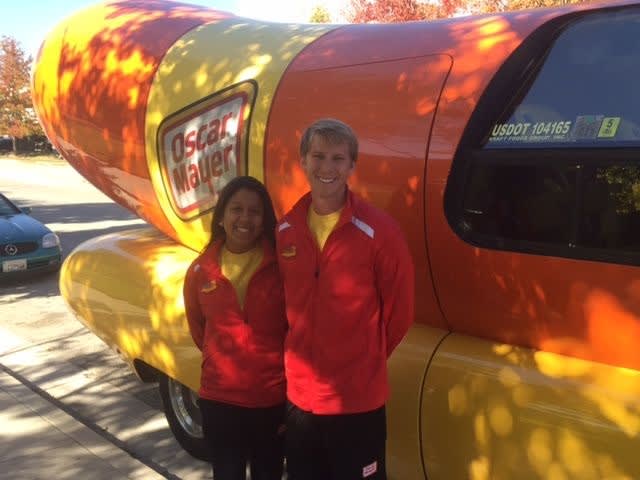
Hot Doggers (Jennifer Chow and Donald Knoelke) in front of the Oscar Mayer Wienermobile. Photo by Amy Winter-Hercher.
Each year, there is a new class of Hot Doggers. The competition is fierce, but in the end there are only 12 Hot Dogger spots for the Oscar Mayer Wienermobile program. Under the same Kraft Foods/Heinz brand, the Wienermobile program is run very similar to Planters’ Nutmobile Tour.
“Last year, there were 1,200 applicants for the 12 Hot Dogger positions,” says Donald Knoelke, a Hot Dogger for the Southwest region and recent graduate of the University of Wisconsin. “I was one of the ‘lucky dogs.’”
Now in its 28th year, the one-year Hot Dogger program recruits recent grads. Currently, there are six Wienermobiles traveling across the country, with two Hot Doggers per mobile. Knoelke has been on the road with his partner Jennifer Chow since June. In January, they will switch partners and regions.
“Each Wienermobile has its own respective region,” says Chow. “So far, we have been in California, Arizona, New Mexico, Texas, Colorado and Idaho.”
Every week is a different city. Knoelke and Chow have brought the Wienermobile to everything from a parade to a festival to grocery stores to nursing homes. At each event, they hand out wienermobile whistles and have bacon and hot dog cut-outs for people to take photos.
“We have gone to the L.A. Auto Show, participated in a hot dog festival, went to a Boys & Girls Club and helped with the Susan G. Komen Race for the Cure,” says Chow.
Wienermobile: Inside and Out
The 27-foot-long fiberglass hot dog was built on a General Motors chassis.
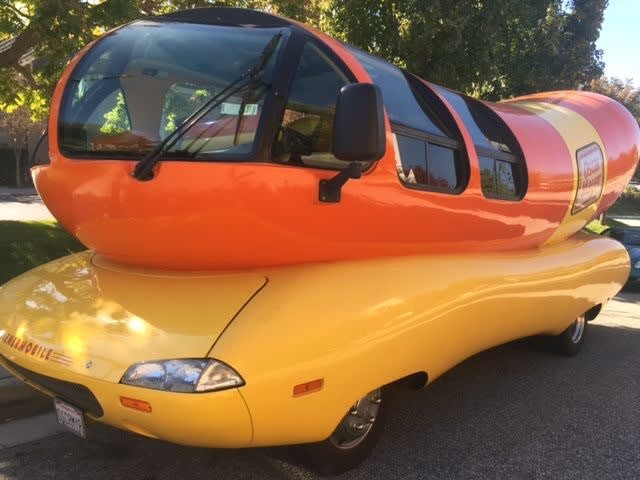
The Wienermobile is built on a GM chassis. Photo by Amy Winter-Hercher.
Prototype Source, a designer of mobile marketing vehicles, worked with automotive designer Harry Bradley to establish the Wienermobile’s chassis requirements, seating positions, interior layout, etc. The company has refurbished all of Oscar Mayer’s current Wienermobiles.
“We take existing vehicles and then completely gut them,” says Dorian Duke, owner of Prototype Source. “We install the fiberglass body on a new chassis. We put in new windows and update all electrical, audio and video. The only thing reused is the body.”
The whole process usually takes between 16 and 22 weeks, according to Duke.
The first Wienermobile dates back to 1936 when Carl Mayer had an advertising idea for his Uncle Oscar: a 13-foot-long hot dog car that would travel the streets of Chicago. With open cockpits in the center and rear, General Body Co. of Chicago designed the first Wienermobile.
Over the years, the Wienermobile has gone through several redesigns, according to the Oscar Mayer website. In 1952, five new Wienermobiles were designed by Gerstenslager on a Dodge chassis. The 22-foot-long hot dogs had a sound system and sunroof. In 1958, Brooks Stevens added buns into the Wienermobile design. After retiring from service for several years, six new 23-foot-long fiberglass hot dogs on wheels toured the country in 1988.
In 1995, Harry Bradley created a 27-foot-long, 11-foot high GM unit with video equipment, a big screen TV and a hot dog-shaped dashboard. Prototype Source started building the Wienermobiles in 2004. The fiberglass hot dog on a fiberglass bun sits on a converted Chevrolet W4 series chassis.
Inside the mobile, there is space for supplies including Wienermobile whistles, signage, tables, chairs and a tent. According to Chow, they typically have at least 3,000 whistles on hand.
The vehicle is filled with premium unleaded fuel, according to Knoelke. Each week is different in how many times they need to refuel; it depends on the number of miles between cities.
When it comes to maintenance, Penske services the mobiles. Every 30 to 45 days, the Wienermobile is taken to a local Penske shop for a maintenance check-up. “We usually take the vehicle to a Penske shop that has worked on it before and is familiar with it,” says Knoelke.
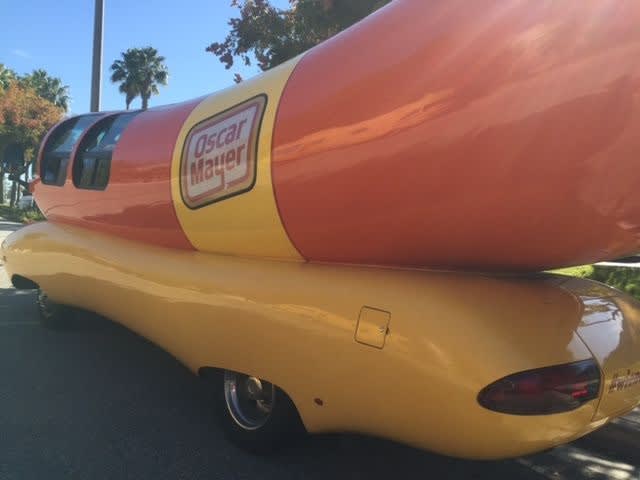
Each Wienermobile features a 27-foot-long fiberglass hot dog. Photo by Amy Winter-Hercher.
Each Wienermobile is tracked by a GPS system. “Our boss gets reports on our location, speeds we are hitting and when the engine is turned off and on,” says Knoelke.
Driving the Hot Dog
Driving a 27-foot-long hot dog vehicle makes it more difficult to maneuver, get into tighter spaces and back up. Knoelke says it’s important to look out for things low to the road since you are sitting about 7 feet up, above the engine.
To become more comfortable with driving the Wienermobile, each Hot Dogger completes a driver’s training course during the Hot Dog High two-week training class in Madison, Wis.
So far, there haven’t been any accidents with the Wienermobiles this year, but there was an incident last year in Pennsylvania. According to Knoelke, the mobile hit some ice and flipped off the road. Luckily, no on was hurt and the damage was minimal.
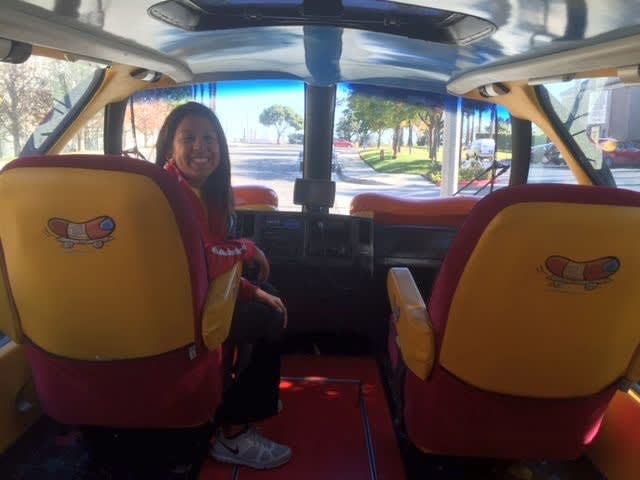
Jennifer Chow in the driver's seat.
“You never know what’s going to happen when you go out on the road driving a 27-foot-long hot dog around,” says Knoelke. “You have people smiling and waving. Everyone is happy to see us. We have the ability to make someone’s day just by passing by.”
For Wienermobile fans, check out the Wienermobile app, where you can track the locations of each mobile and get “behind the wheel” in a driving simulation game.
More Small Fleet


Developing Budget-Friendly Driver Safety Programs
From driver training and safety meetings to one-on-one coaching and incentive programs, several small fleets share how they have developed a safety culture with their drivers using low- to no-cost resources.
Read More →
Boosting Last-Mile Fleet Uptime, Safety, and Value with AI Vehicle Inspections
AI-powered inspections are transforming last-mile fleets by replacing manual checks with highly accurate automated scans that detect defects in seconds. By giving fleet operations visibility into the daily condition of their vehicles, you can identify trends over the vehicle’s lifecycle that enable improved procurement decisions, route management, driver training and accountability.
Read More →
Five Ways Seat Belts Help Prevent Injuries
There are five ways seat belts protect occupants from injuries, according to the Tennessee Department of Safety and Homeland Security.
Read More →
It’s here: The 2026 Fleet Technology Trends Report
What does AI mean for fleets? Get the answer — and learn other top tech trends.
Read More →
Small Fleets, Big Impact: How Independent Drivers Power Wreaths Across America
Check out how small fleets and independent drivers power Wreaths Across America each December and why their impact matters more than ever.
Read More →
VMS Survey Finds 65% of Small Fleet Managers Run Operations Alone
A new VMS survey shows small fleet managers are stretched thin, with most handling operations solo and eager to adopt digital tools for relief.
Read More →
Tips for Driving Safely on Halloween Night
This video features a reminder from the Connecticut Department of Transportation (DOT) and the Connecticut Police Chiefs Association, urging drivers to prioritize safety this Halloween.
Read More →
AI, Access, and Uptime: VMS’s Next Chapter with David Prusinski
VMS’s new Co-CEO, David Prusinski, shares how an AI-first approach will give small fleets and repair shops the tools to compete like big players.
Read More →
Fleet Managers Share Winter Prep Tips: It's Never Too Early!
Three fleets share best practices to prep vehicles for winter and prevent downtime when the cold sets in.
Read More →