




Is Carbon Fiber the Future of Truck Bodies?
While cost remains an obstacle to widespread acceptance of carbon-body trucks, this lightweight, durable, and strong material can facilitate fleet vehicle downsizing, promote fuel-efficient engines, and help extend lifecycles.

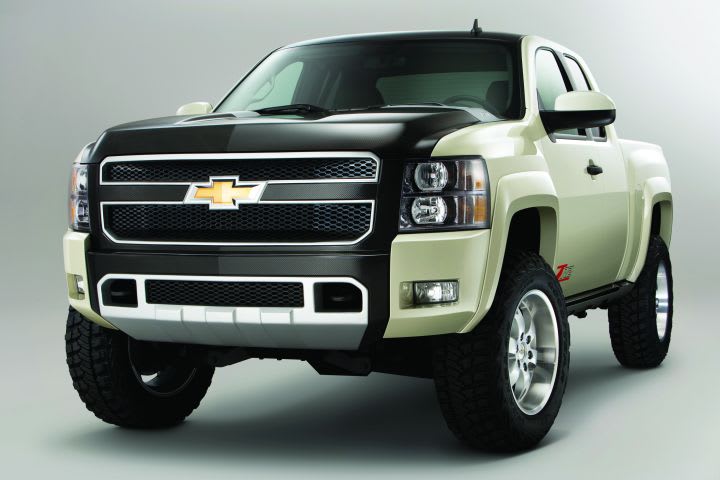
Much of the Chevrolet’s Silverado ZR2 concept pickup body is constructed of carbon fiber, including the front fenders, extractor-style hood, rocker extensions, and tailgate.
Photo: General Motors
Imagine - what if you could spec a service body with material that's one-fifth the weight of steel, yet just as strong and, in some cases, even stronger and more rigid? What if this ultra-lightweight service body could last for decades, through multiple remounts with minimal maintenance? What if this material enabled 10% to 20% or more savings in fuel cost per vehicle?
A fleet manager's dream? Yes. But according to industry experts, this dream could be a reality in the next five to 10 years as carbon fiber gains greater acceptance in the truck equipment and specialty vehicle markets.
"The future in truck bodies lies in the research and development of low-cost carbon fiber. The research and development are all centered around lightweight material technology as a replacement for legacy products like steel and aluminum," says Eric Paul, VP, sales and marketing, Brand FX Body Company based in Ft. Worth, Texas.
Bob Johnson, fleet relations director for the National Truck Equipment Association (NTEA), agrees. "As fuel economy standards become more stringent for commercial trucks, there's going to be a lot of pressure on fleets to reduce weight to cut fuel consumption. You're going to see a lighter, more durable, more aerodynamic body. Down the road, you could conceivably have a carbon-fiber service body that weighs no more than a couple of hundred pounds, where the sub-frame would be the heaviest part of the whole body."
The lighter body produces better fuel economy and lower emissions, equipping fleets to support company sustainability initiatives. According to the U.S. Department of Energy (DOE), for every 10%t of weight eliminated from a vehicle's total weight, fuel economy improves by 6% to 8%. Therefore, if truck body weight is reduced by 50%, 60%, and even 70%, significant fuel cost savings can be achieved. Extrapolate the savings over the number of units in fleet, whether 10, 50, 100, 1,000, or tens of thousands of vehicles, the reduction in a fleet's fuel bill could be staggering - money that goes straight to the company's bottom line.
What exactly is carbon fiber? What are the possibilities? What are the barriers to widespread adoption? What does the future hold?
Carbon Fiber: Lighter than Steel, But as Strong & Rigid
Carbon fiber is a material consisting of extremely thin fibers, thinner than human hair, about 0.005-0.010 mm in diameter, and mostly carbon atoms. Several thousand carbon fiber strands are twisted together to form a "yarn," which is woven, molded, and coated with a stiff resin or plastic to form a composite material weighing significantly less than steel, yet offering comparable strength and rigidity.
Carbon fiber is used in spacecraft, satellites, aircraft, Formula One racecars, architectural structures, and in other applications requiring light materials capable of withstanding high stress.
How does carbon fiber compare with other lightweight materials, such as aluminum and fiberglass?
Aluminum is significantly lighter and more corrosion-resistant than steel. However, aluminum usually costs more, although recent market conditions have significantly narrowed the gap. The downside to aluminum is that it's not as strong or durable as steel and is often more expensive to repair.
Compared to aluminum, carbon fiber is lighter and offers similar corrosion-resistant capabilities, but is considerably more durable, with strength on par with steel.
What about fiberglass? "Carbon fiber is stronger than fiberglass and a little bit lighter," says Paul. "The carbon fiber will have a lot of the same characteristics as fiberglass, but will be about 10-15% lighter and to what degree stronger, I don't know yet because we're still in the [research and development] phase with carbon fiber."
Paul offers this example as a frame of reference: "The weight of a typical 8-foot steel service body is 1,248 lbs. The weight of our [composite] body, which is a hybrid of aluminum and fiberglass, is 590 lbs. We believe we can build a body out of carbon fiber for around 400 lbs.," says Paul.
That's a more than an 800-lb. increase in payload with carbon fiber, compared to steel, without sacrificing strength.
Overcoming the Cost Barrier Depends on Further Development
Despite the promise of carbon fiber in the truck body market, one major obstacle stands in the way: cost.
"I don't see [carbon fiber] around the corner yet. It's at least 10 years out," says Johnson. "It's not really an available technology [to body companies] at the moment because of cost, but I think eventually it will be."
According to the 2008 Progress Report on Lightweighting Technologies by Oak Ridge National Laboratory (ORNL) - a science and technology laboratory managed for the U.S. Department of Energy (DOE) by UT-Battelle, LLC - carbon fiber is too expensive at $20 per pound for large-scale automotive use. The cost must be cut to $5 per pound before significant use of carbon fiber is seen in the automotive industry.
What will drive down the cost to a more acceptable level? In December 2009, the U.S. government earmarked funds to ORNL to find the answer. Through the American Recovery and Reinvestment Act, the DOE allocated $34.7 million to establish the Carbon Fiber Center at ORNL. The project will further the research, development, and commercialization of low-cost carbon fiber.
Ray Boeman, director of ORNL Advance Transportation Systems Programs, says ongoing research focus areas include identifying low-cost carbon fiber precursors (raw materials), developing advanced technologies for converting precursors to carbon fiber, and testing low-cost composite design and manufacturing capabilities.
"The new technology center's capabilities are expected to advance these research efforts, while enabling the development of new innovations and commercialization opportunities," says Boeman. "The facility will be highly flexible and instrumented to demonstrate and evaluate the scalability of science and technology for lowering carbon fiber costs at least 50% and improving the affordability of carbon fiber in high-volume applications."
According to Paul, if carbon fiber costs drop low enough for major automotive OEMs to sign on, the heightened demand and resulting material standards would make the ultra-lightweight material more financially viable for the specialty vehicle market.
"What the U.S. government is trying to do is to take carbon fiber out of the aerospace sector and put it into the automotive sector, where it's more mainstream. What you'll find, as with any new technology, is that it will be more expensive the first go-around, probably adding a premium of an additional $1,000-2,000 [to the price of the body]. And then, as it becomes more and more used in the process, it will start to get cheaper," says Paul.
"The OEMs are using fiberglass and other composite materials on their fenders, doors, and so forth. But it is slow getting into the specialty vehicle market, because [the carbon fiber industry] is such a disorganized market, with so many players," Paul adds. "You have a lot of different products and theories out there. I suspect that as carbon fiber reaches GM, Kenworth, International, and Freightliner through carbon-fiber leaf springs and other components of the vehicle, you'll start to see the price of carbon fiber go down. Then that $1,000-$2,000 premium won't be there."
How Carbon Fiber will Impact Fleets
1. Downsizing chassis without downsizing payload.
"It used to be that steel was cheap and oil was cheap. The attitude was, 'If I need more payload, I'll just buy a bigger truck.' That's not the mentality anymore. Everything is about getting smaller," says Paul.
Low-cost, ultra-lightweight carbon fiber will enable fleets to downsize from, say, a Class 4 truck to a Class 3 without sacrificing payload. This move not only offers potential fuel savings, which lowers operational costs, but when considering the price difference between an F-350 and F-450 chassis, typically $2,000-$3,000 or more, chassis acquisition costs are significantly reduced.
Another avenue for vehicle downsizing will be with carbon-fiber truck inserts, designed for pickups. "[The inserts] are basically like a self-contained capsule similar to a work topper that fits in the back of a pickup. The capsules have a lifespan of 20-25 years," says Paul. "Companies are migrating from vans to pickups with these modules in them primarily for fuel economy reasons. Vans typically get 10-11 miles per gallon, whereas a half-ton chassis will get 16-18 miles per gallon."
Brand FX currently builds truck inserts with fiberglass, but is in the design phase of a carbon fiber truck insert.
2. Enabling new, more efficient engine technologies.
"Lightweight material technology is what the Department of Energy calls an enabling technology, a mass compounder. If I take the weight out of my body, then I can go with an alternative propulsion system, such as a hybrid, because you're putting weight back into the chassis," says Paul. "If you look at the two Chevrolet pickups today, the hybrid has about 1,000 lbs. more curb weight than a standard gasoline motor because of the batteries and other extra equipment to run the hybrid. Lightweight material technologies enable other technologies to take place."
3. Extending body lifecycles.
Steel bodies, even when treated and dipped for corrosion resistance, eventually encounter rust issues, especially in coastal regions and climates with harsh winters that require de-icing road salts. Aluminum bodies are extremely resistant to corrosion, but are less durable and more expensive to repair than steel.
Carbon fiber, on the other hand, according to Paul, won't exhibit the corrosion issues of steel and, unlike aluminum, will hold up to the day-to-day stress a work truck typically experiences without significant repairs. He estimates a carbon-fiber body could last for decades with routine maintenance and minor refurbishment to retain its original luster.
Since the cost of remounting a body is significantly less than purchasing a new body each time a truck is replaced, the durability and longevity of carbon fiber offers fleets considerable potential cost savings down the road.
Price to Determine Timing of Carbon-Fiber Body Availability
Is carbon fiber the future of truck bodies? It seems likely, considering both private and public sectors are investing significant dollars in research and development in low-cost carbon fiber as a means to achieve greater fuel economy and reduction in harmful emissions. The timing depends on price. When the cost goes down, the market for carbon-fiber truck bodies will expand.
More Vehicle Research
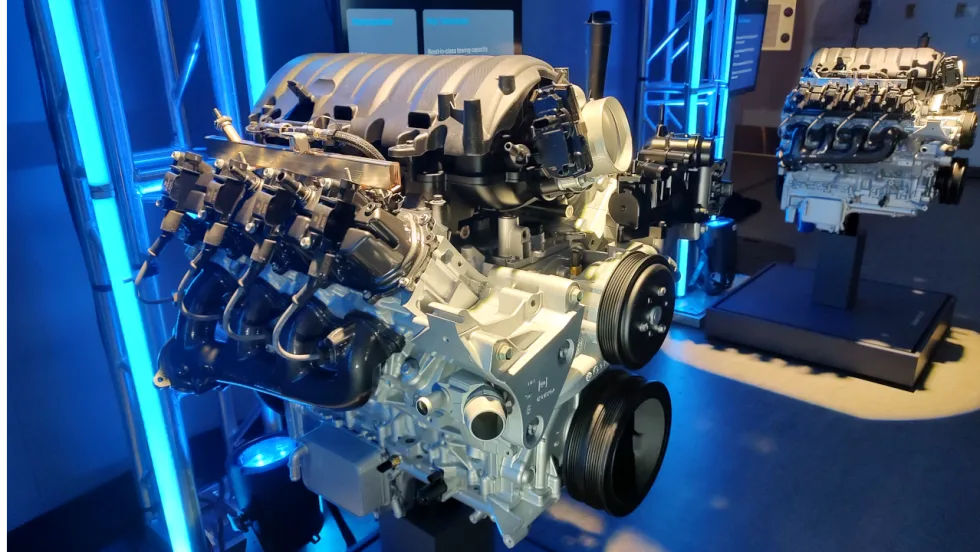
GM Unveils New Sixth-Generation Small Block Engines for 2027 Light-Duty Pickups
General Motors unveiled two new small-block engines, backed by extensive real-world validation and more than 70 years of small-block V8 manufacturing experience, as part of the engine portfolio for the 2027 Chevrolet Silverado 1500 and GMC Sierra 1500.
Read More →
Chevrolet Silverado 1500 Fleet Guide Specs Capability and 2027 Model-Year Updates
The next-generation 2027 Chevrolet Silverado 1500 brings new V-8 engines, updated technology, expanded safety features, and a fleet-focused Work Truck. Here’s what commercial fleets need to know so far.
Read More →
2026 Ram 1500 Tradesman Put to a Real-World Fleet Test
A few days behind the wheel of a 2026 Ram 1500 Tradesman turned into a test of visibility, parking, work-ready features, and even severe-weather driving.
Read More →
Isuzu N-Series Gas Fleet Guide: Specs, Capability and 2027 Model-Year Updates
Explore Isuzu Truck North America’s N-Series Gas fleet specs, engine performance, GVWR and payload capability, configurations, chassis dimensions, work-focused features, and 2027 model-year information.
Read More →
Ram ProMaster City Fleet Guide Specs Cargo Capacity and 2027 Updates
Work Truck’s Ram ProMaster City Fleet Guide tracks the latest specifications, cargo capability, configurations, fleet technology, pricing, and model-year updates for Ram’s mid-size commercial van.
Read More →
Ford F-150 Fleet Guide Specs Capability and 2026 Model-Year Updates
Explore 2026 Ford F-150 fleet specs, engines, towing and payload capability, configurations, work features, technology, and model-year updates.
Read More →
TCI Now Sells & Supports Battle Motors’ Vocational Trucks
Midwest truck dealer Truck Centers, Inc. (TCI) has expanded its transportation solutions with sales and service support for Battle Motors’ heavy-duty vocational trucks at locations in locations in Indiana, Illinois, and Missouri
Read More →
Ram 1500 Fleet Guide Specs, Capability and 2027 Model-Year Updates
Explore always up-to-date Ram 1500 fleet specs, engines, towing and payload capability, configurations, technology, pricing updates, and model-year changes.
Read More →
Peterbilt Trucks Equipped with Paccar TX-18 Pro Boost Efficiency for Maryland Fleet
Patuxent Companies is replacing aging trucks with the Peterbilt Model 567 and Model 589, specified with the Paccar TX-18 Pro 18-speed automated transmissions, and is reporting an 8% to 10% improvement in fuel economy.
Read More →
Stellar Expands into Fire Apparatus Market with Acquisition of Midwest Fire
Stellar Industries has acquired Midwest Fire, a custom fire apparatus manufacturer headquartered in Luverne, Minnesota, with nearly four decades of specialized apparatus experience.
Read More →