





All About Truck Tires: Load Ratings, Sizes & More
How to Select the Best Retread Truck Tire
Retread tires are a fixture of many large fleets and offer a range of benefits. Understanding what to look for and top factors to consider during the selection process is important.
November 8, 2018
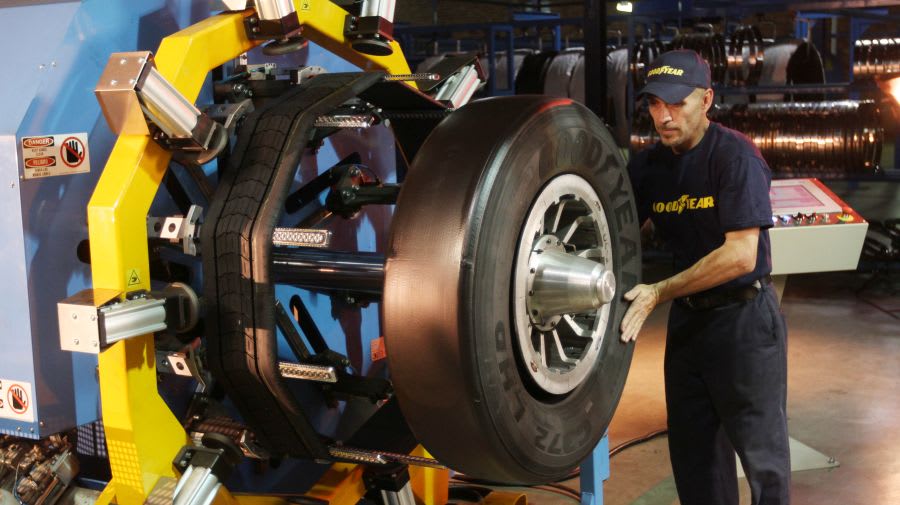
Goodyear UniCircle treads are spliceless and positioned onto casings using laser-guided technology.
Photo: Goodyear
7 min to read
Retreading is the process in which new tread rubber is bonded to a refurbished tire body, or a casing. The retread process is not new — it was invented in the early 1900s. But the process has evolved with technology, and is a reliable source for quality tires at a lower price point.
Today, it is widely used by fleets of all sizes, but especially those with 1,000 or more units.
“There is a reason up to 90% of large fleets practice retreading – it’s smart, sustainable business,” said LaTres Jarrett, director of marketing, Bandag, Bridgestone Americas Tire Operations.
But how do you choose the right retread? Experts share their tips on the top factors to consider.
Define the Fleet Application
The process of choosing a retread is almost identical to choosing a new tire, according to Helmut Keller, Continental’s head of product management for Commercial Vehicle Tires in the Americas region.
“The customer needs to identify which wheel position the retread will be placed in and what application the retread will be used in,” he said. “For example, if the fleet is in an off-road construction application and needs a drive tire, it might select a drive retread with and chip- and chunk-resistant compound.”
Mahesh Kavaturu, marketing manager for Goodyear, agreed that the first step to choosing the right tire is determining your fleet’s needs. This can depend on your fleet’s vocation, designed return on new tire investment, how vehicles are used, and the driving conditions those vehicles may face.
“Different trucks and applications require different treads. Equipping a truck with the wrong tread design can lead to sub-optimal performance. The importance of consulting with a qualified retread expert cannot be understated,” Kavaturu said.
New technology allows fleets to find a product that’s tailored to their needs. One example is the ability to cut sipes, or the slits that make up a tread pattern, after the manufacturing process, which is called microsiping.
“For example, a winter retread pattern might have micro-sipe technology to ensure traction or a long-haul pattern might have a fuel-efficient tread compound technology to ensure low rolling resistance,” Keller said.
Know How It’s Done
Jarett with Bridgestone noted that awareness of the process is important to understanding what a retread is and how effective it is.
“By understanding a manufacturer’s retread process from start to finish, fleets can feel confident in the final product,” she said.
Bandag, the business of Bridgestone dedicated to the research, development, and manufacturing of premium retread tires, goes through a robust manufacturing process.
“Bandag dealers utilize shearography, a highly advanced system utilizing more than 240 videos to uncover separations in the belt package, liner and bead areas, to ensure product quality and safety. Once a casing is approved for retreading, it goes through a 10-step process, including a final inspection before it’s returned to service,” Jarrett said.
Continental also uses shearography during its retread process, which it calls ContiLifeCycle.
“During the detailed ContiLifeCycle manufacturing process, the casing is thoroughly inspected to ensure that the retreaded tire will last through its next life,” Keller said. “Every Continental retread goes through a shearography inspection as well as pressure testing on the final product. This helps ensure fleets receive a safe and reliable product.”
Kavaturu with Goodyear noted that low rolling resistance is an important factor for many fleets, and a feature of Goodyear’s UniCircle Technology.
“In addition to offering low-rolling resistance, Goodyear UniCircle treads, which are spliceless and positioned onto casings using laser-guided technology, offer enhanced traction and resistance to tearing and chunking. By leveraging compounding technology and tread designs, Goodyear continues to make strides in developing retreads that deliver like-new performance.”
For added assurance during retreading, Goodyear offers GTRACS, an automated system that allows fleets to follow casings through the retreading process.
“GTRACS, which is available through the Goodyear Authorized Retreader network, uses bar codes to track the progress of a casing through the retread process. After a tire has been retreaded, GTRACS provides fleets with valuable data about their retreads in the form of easy-to-understand charts and graphs,” Kavaturu explained.
Look Past the Misconceptions
Despite these sophisticated processes, some fleet operators may still hold on to myths and misconceptions about retreads.
David Stevens, managing director for the Tire Retread & Repair Information Bureau (TRIB), said this is especially true among smaller fleets.
"If you have one or two trucks it’s harder to do testing and have a real, robust tire management program like these big fleets do. The reason that 90% of those large fleets with 1,000 of more trucks are using retreads at such a high percentage is that they know it makes economic sense for them,” Stevens said.
Learning about the retread process is helpful, but seeing it in action can add another level of understanding. That’s why TRIB offers a video tour of a retread plant on its website.
“One of the best ways to convert people to understanding the benefits of retreading is when they go through a retread plant tour and they see how technologically sophisticated the process is,” Stevens explained.
Work With the Dealer
When choosing the right tire, it helps to consult the experts. Jarrett with Bridgestone recommends that fleets work with a dealer partner to develop a custom tire and retread program tailored to their specific business goals and objectives.
She also noted that fleets should ensure their dealer has certifications and processes to ensure a good product.
“Fleets should look for partners who utilize ISO 9001:2008-certified tread rubber and have multiple inspection points to verify that a casing is suitable for retreading,” Jarrett explained.
Keller with Continental agreed that the dealer can offer valuable guidance. But fleets should make sure they are asked the right questions. Some of these questions include:
Are you looking for fuel-efficiency?
Are you looking for high mileage?
Will the vehicle be used on-road, off-road, or both?
What are the routes going to be like?
“After asking these questions it should be easier to narrow down product options to select the right tire for the customer,” Keller said.
Stevens with TRIB agreed, noting that the relationship between a fleet and a retreader is important. “It’s really about working to understand the types of vehicles and the types of tires they need and matching them,” he said.
Maintain, Maintain, Maintain
Like any other tire, retreads are not maintenance-free. To reap the full value of a tire, fleets should ensure that tire is regularly inspected and operating at peak performance.
“Advanced retread technology is not a substitute for proactive tire maintenance. Routine inspections are also an integral part of every fleet’s tire management program,” Jarrett with Bridgestone said. “Like new tires, retreads should be checked before and after each haul to ensure proper inflation pressure, tread wear and detect any tire damage sooner rather than later. Fleets that practice proper tire care and maintenance help to ensure their casings can be retreaded multiple times, maximizing their tire investment.”
Although inflation is an important factor in any tire maintenance program, it is especially important for retreads. Continental offers a digital tire monitoring platform to view tire pressure and temperature information of the entire fleet.
“Proper air pressure is the No. 1 way to improve retreadability and tire performance, whether the tire is on its first life or its fourth life,” said Keller of Continental. “Proper tire inflation can provide up to 25% longer tread life and 30% longer casing life, making retreads even more cost-effective.”
In addition, retreading does not have to be a one-time process.
“It’s important to remember that a premium tire casing can and should be retreaded more than once. Many fleets leave money on the table because they pull a casing out of service too soon,” Jarrett with Bridgestone noted. “Retreading a premium tire two times can keep a tire on the road up to 500% longer than an ultra-low-cost, single-use tire.”
Continental offers similar coverage.
“On most tires, Continental offers a warranty of seven years or three retreads, whichever comes first. This means that tire can have up to four lives, if properly maintained, inspected and serviced,” said Keller.
Subscribe to Our Newsletter
More Maintenance
Les Schwab Expands Commercial Tire Footprint Into Arizona
Les Schwab Tires has expanded into Arizona with two commercial tire locations in Phoenix and Tucson, strengthening its fleet service footprint in the Southwest.
Read More →
Volvo Trucks’ 'Lock and Leave' Software Updates Go Live Across North America
Unattended over-the-air software updates are now available in Volvo trucks across the U.S. and Canada. The new capability lets trucks stay current with the latest software without interrupting operations or requiring a dealership visit.
Read More →
Why Technician Appreciation Can’t Be a Once-a-Year Thought
For fleets trying to keep skilled technicians, recognition cannot begin and end with Technician Appreciation Week. Learn what year-round appreciation really looks like and why the everyday technician experience matters just as much as pay when fleets are trying to keep good people.
Read More →
How Faster Driver Reporting Can Keep Small Truck Problems Small
When minor damage, warning lights, or equipment issues are reported late, small problems can quickly become bigger maintenance headaches. Conversational AI can help shorten the path from what a driver notices in the field to the person who can act on it.
Read More →
BendPak’s Ranger Wheel Service Equipment Achieves North American Safety Certification
BendPak’s full line of Ranger tire changers and wheel balancers has been ETL certified to UL and CSA standards to improve operator safety.
Read More →
Isuzu & U.S. Department of Labor Celebrate Milestone for Veterans Apprenticeship Program
The Isuzu Veterans Apprenticeship Program (IVAP) signing ceremony highlighted Isuzu’s long-term commitment to veterans, Isuzu dealers, and the skilled workforce supporting its customers and the commercial transportation industry.
Read More →
Polyvance Introduces New Peterbilt 567 Hood Strut Mount Repair Kit
Polyvance has launched a repair solution for Peterbilt 567 hood struts, helping truck owners and repair facilities avoid costly hood replacements.
Read More →
Cox Automotive Celebrates Technical Excellence at 2026 Top Tech Finals
The top technicians from Cox Fleet and Manheim tested their skills in Nashville, Tennessee, at Cox Automotive’s 2026 Top Tech Finals. The overall winners will advance to compete at the American Trucking Association’s TMC SuperTech competition.
Read More →
Grote Industries Appoints Vice President of North American Operations
Grote Industries has appointed Patrick Smith as vice president of North American operations as it celebrates 125 years of innovation and manufacturing excellence. He has more than 20 years of manufacturing leadership experience.
Read More →
Winter Fleet Prep: Expert Tips to Keep Vehicles Running Smoothly
Cold weather can expose weak batteries, tires, fuel systems, and maintenance gaps fast. Use this winter fleet checklist to prepare trucks and drivers before temperatures drop.
Read More →