




Safety in Mind: ADA Systems Complicate Fleet Vehicle Maintenance
How to Navigate Intersections Safely
From roundabouts and red lights to four-way stops, fleet drivers face a plethora of potentially dangerous situations. An expert shares insights on how to be prepared for tricky traffic situations and boost safety while behind the wheel.
by Judie Nuskey
April 20, 2023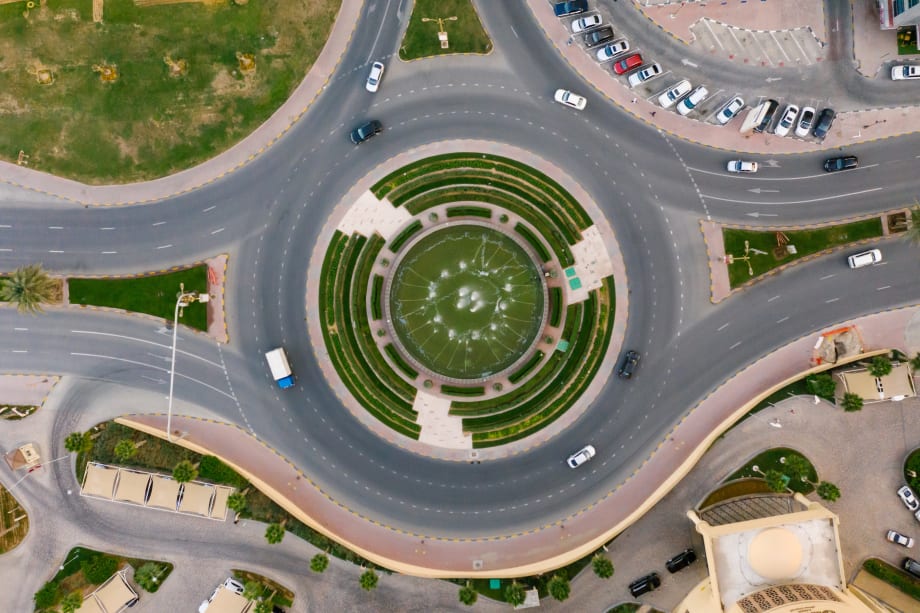
Sideswipe crashes often happen in rotary or roundabout intersections because drivers are unfamiliar with best driving practices in a roundabout scenario.
Photo: pexels.com/Mikhail Nilov
5 min to read
Even the most seasoned commercial drivers can benefit from helpful reminders about road safety. One area that merits continued focus concerns ways to handle tricky traffic situations. The following offers tips and advice on the subject that fleet managers can share with their drivers.
Four-Way Stop: Confusion Causes Collisions
“Most four-way stops are marked this way due to heavy traffic in all directions or poor visibility,” said Brian Hollo, a retired Illinois State Police captain, former police chief of Murphysboro, Illinois, and an Advanced Driver Training Services instructor. Often, crashes happen here because drivers don’t observe all the potential danger zones. “The driver may fixate on what seems to be the area of biggest concern and not pay enough attention to the other lanes of traffic,” he explained. For example, it’s common to focus on the vehicle to the left because you realize a side-angle collision can be severe for you as the driver. As a result, you might not notice that the driver to the right is proceeding.
Other times motorists are at a standstill at a four-way stop because multiple vehicles arrive at the same time or no one is sure who has the right of way. Making eye contact and staying patient is always safe practices in these situations. For an easy rule of thumb on the right of way at a four-way stop, consider this tip from the National Highway Traffic Safety Administration (NHTSA):
First to stop = first to go.
Farthest right goes first.
Or straight traffic goes first.
Roundabouts: Slow Down, Choose the Proper Lane
Roundabouts are circular intersections where vehicles travel counterclockwise around a raised center island. They’re designed to reduce intersection crashes by reducing vehicle speeds and by reducing or eliminating the points of potential conflict between vehicles (i.e., the points at which vehicles and/or pedestrians converge, merge, cross each other, or queue in a line).
Hollo says a lack of familiarity with how roundabouts work is one of the biggest contributors to crashes there. “The first time I encountered one I pulled over to watch traffic within the roundabout prior to entering it,” he said.
“Sideswipe crashes tend to happen in rotary or roundabout intersections, and they’re mostly due to drivers being unfamiliar with roundabout concepts like lane usage, right of way, who to yield to, and when to yield,” Hollo noted.
To avoid crashes in roundabouts, Hollo advises the following.
For all types of roundabouts: Slow down as you approach, watch for pedestrians in the crosswalk or elsewhere as you enter or exit, stay in your lane, and use your turn signal before exiting.
For multi-lane roundabouts: Choose a lane before entering. Stay in the right lane if you’re traveling straight or to the right, and choose the left lane if you’re traveling straight or to the left.
For single-lane roundabouts: Look to your left as you near the yield sign or dashed yield line at the entrance, and yield to traffic already in the circle. Once you see a gap in traffic, enter the circle and proceed to your exit.
Be Aware of Stopping Too Far In
Most intersections have a horizontal white line (sometimes called a “stop line”) to indicate where you should stop if you’re the first vehicle in line. If you stop past this line, you’ll be too far into the intersection and could be hit by vehicles making turns across your lane. Another issue with being too far past the “stop line” is if you are rear-ended, you may be pushed into the intersection and hit again (right in the driver-side area).
Be Cautious about Stopping Too Close
If there are other vehicles ahead of you at a stop, avoid driving right up to the rear of the vehicle in front of you. You should be far enough back to see the rear tires of the vehicle in contact with the road. That leaves you room to pull forward — creating an escape route — to avoid being rear-ended if a vehicle heading toward you from behind doesn’t seem prepared to stop. Having that extra space (if you are rear-ended) may also avoid your car being pushed into the vehicle in front of you. Remember, if your car is pushed into the car in front of you, your insurance will probably need to cover that damage.
Take Red Lights Seriously
One of the most dangerous and severe incidents at an intersection is a crash caused when a driver runs a red light. Red light runners cause hundreds of deaths and tens of thousands of injuries a year. Yet a phone survey by the AAA Foundation for Traffic Safety found that 94% of drivers believe it’s unacceptable to travel through a red light if they can stop safely. So why do these crashes still occur?
The driver misjudges how long the light has been yellow, sometimes due to distraction.
The driver is in a hurry and accelerates to speed through a light that’s been yellow for a while or has just turned red.
The driver has poor depth perception and misjudges how far away the intersection is and how long it will take to travel through it.
The Insurance Institute for Highway Safety (IIHS) found that large cities using red light cameras saw their rate of fatal crashes caused by red light running drop by 21%, with side-impact crashes declining more.
With or without cameras as a deterrent, it’s vital that you avoid running a red light for your own safety and the safety of those around you. Always scan well ahead when approaching an intersection, so you know whether the traffic signal has recently changed color. If you did not see the light change green — also called a “stale green light” — then as you approach the intersection make sure your foot is “hovering over the brake pedal.” If the light turns yellow, it will allow you to stop safely much quicker.
Finally, never speed up in attempt to “beat the light.” Proper scanning helps you stay informed of where the light is in the cycle so you can make a safe decision about whether to stop or proceed through a yellow light.
Judie Nuskey is the director of Operations at Advanced Driver Training Services and assists corporations in creating custom driver training programs to lower (or keep low) their crash rates.
Originally posted on Automotive Fleet
Subscribe to Our Newsletter
More Small Fleet


Developing Budget-Friendly Driver Safety Programs
From driver training and safety meetings to one-on-one coaching and incentive programs, several small fleets share how they have developed a safety culture with their drivers using low- to no-cost resources.
Read More →
Sponsored•March 9, 2026
Boosting Last-Mile Fleet Uptime, Safety, and Value with AI Vehicle Inspections
AI-powered inspections are transforming last-mile fleets by replacing manual checks with highly accurate automated scans that detect defects in seconds. By giving fleet operations visibility into the daily condition of their vehicles, you can identify trends over the vehicle’s lifecycle that enable improved procurement decisions, route management, driver training and accountability.
Read More →
Five Ways Seat Belts Help Prevent Injuries
There are five ways seat belts protect occupants from injuries, according to the Tennessee Department of Safety and Homeland Security.
Read More →
Sponsored•January 14, 2026
It’s here: The 2026 Fleet Technology Trends Report
What does AI mean for fleets? Get the answer — and learn other top tech trends.
Read More →
Small Fleets, Big Impact: How Independent Drivers Power Wreaths Across America
Check out how small fleets and independent drivers power Wreaths Across America each December and why their impact matters more than ever.
Read More →
VMS Survey Finds 65% of Small Fleet Managers Run Operations Alone
A new VMS survey shows small fleet managers are stretched thin, with most handling operations solo and eager to adopt digital tools for relief.
Read More →
Tips for Driving Safely on Halloween Night
This video features a reminder from the Connecticut Department of Transportation (DOT) and the Connecticut Police Chiefs Association, urging drivers to prioritize safety this Halloween.
Read More →
AI, Access, and Uptime: VMS’s Next Chapter with David Prusinski
VMS’s new Co-CEO, David Prusinski, shares how an AI-first approach will give small fleets and repair shops the tools to compete like big players.
Read More →
Fleet Managers Share Winter Prep Tips: It's Never Too Early!
Three fleets share best practices to prep vehicles for winter and prevent downtime when the cold sets in.
Read More →