




How to Calculate Optimal Replacement Cycles
A variety of approaches can be used, each with their own advantages and disadvantages that must be considered.

Data from an economic lifecycle analysis can be viewed as a chart to assist fleet managers in determining the best time to replcae a vehicle. Source: Chatham Consulting
Medium-duty trucks encompass a broad spectrum of fleet applications: They can include some pickups, delivery trucks, ambulances, and even small buses.
There are many different techniques that can be used to calculate replacement cycles for medium-duty trucks, with advantages and disadvantages associated with each. There also can be non-economic factors involved that may influence or even dictate replacement cycles. Examples include meeting air quality standards to reduce tailpipe emissions or disposing school buses before they reach the retirement age mandated by school boards.
For the purpose of this article, a medium-duty truck has a GVWR from 10,001 pounds to 19,500 pounds. This equates to U.S. Department of Transportation (DOT) Vehicle Inventory and Use Survey (VIUS) Class 3 (10,001-14,000 pounds), Class 4 (14,001-16,000 pounds), and Class 5 (16,001-19,500 pounds).
Establishing replacement cycles for medium-duty trucks is both an art and science. It involves judgment, prediction, forecasts, and assumptions on one hand, and analysis of available data on the other. When financial resources are limited, the effort will focus more on prioritizing which one of many vehicle candidates should be replaced.
However, for organizations that lease their fleet units, the cycle decision has already been made — it is the term of the lease. Ideally, the lease term is set at the expected economic life of the vehicle. Leasing analysis is a financial and fleet management issue requiring joint expertise from finance, fleet management, and the leasing company.
The Fundamental Questions
Before replacing a unit, a few fundamental questions must be asked.
Is the vehicle being fully used?
Does it have the proper specification?
If a vehicle is not being fully used, why replace it at all? Perhaps it should be reassigned to a more intensive application.
Furthermore, if the vehicle seems to have frequent suspension related repairs, a dual wheel vehicle with a greater GVWR may be a more suitable specification than the existing one.
Approaches to Replacement
The following are three approaches that may be used in determining when to replace a vehicle:
Conduct an economic lifecycle analysis to estimate the optimum replacement point that results in the lowest total overall cost over the vehicle’s life.
Replace at an established age and/or mileage criteria.
Replace when the cost to repair exceeds a threshold amount.
1. Economic Lifecycle Analysis
An economic lifecycle analysis is a management tool to analyze total ownership and operating costs throughout a vehicle’s life to estimate the optimum point in time or usage to replace the vehicle.
While this approach is quite flexible and comprehensive, it requires extensive amounts of data and can be complicated to implement, since it involves quantifying many parameters like downtime, obsolescence, and other cost factors.
It is also predicated on the assumption that future maintenance costs can be forecasted based on analysis of historical maintenance costs. Often, consultants may be needed to help fleet managers with the process.
The economic lifecycle approach can be used to both set up guidelines by vehicle class before units go into service; and after they have been in service evaluate whether individual vehicles should remain in service for an additional year. It also can be used to evaluate:
Alternative vehicle designs or makes by assessing whether vehicles with higher capital costs have sufficiently lower operating expenses to justify acquiring them.
The economics of whether a unit should be rebuilt.
Figure 1 illustrates an idealized representation of lifecycle costs for a medium vehicle that has an initial cost of $60,000. Note how certain costs such as maintenance and repair expense increase over time or usage, and other costs such as depreciation expense decline. (Fuel expenses are not being shown for simplicity.) The optimum life coincides where the EUAC (Equivalent Uniform Annualized Cost) reaches a minimum, which in this example is year nine. Its computation involves present worth arithmetic.
The typical parameters used in economic life cycle analysis consist of: vehicle purchase cost, cost of money or interest rate, maintenance and repair expenses, amount of miles traveled or hours used per year, downtime costs, fuel expenses, annual depreciation expenses, obsolescence costs, and salvage value.
The total lifecycle cost, or EUAC curve, often does not appear as a nicely shaped “U” curve often seen in textbooks. Instead, it typically is a much flatter or asymptotic curve, as illustrated in Figure 1.
In this situation, the curve declines fairly rapidly in its early years and then very slowly before reaching a minimum, if at all. Then, some judgment must be applied to interpret the results.
Fleet managers should focus on the trending in maintenance and repair costs and note where they rise sharply to set the recommended cycle before that point is reached.
2. Focusing on Age and/or Mileage
This is a common method used in many public and private fleet operations, such as eight years/100,000 miles. It is simple to use and objective.
This method’s chief disadvantage is that, by relying on age or mileage criteria alone, variations in vehicle condition within the class are not accounted for. Some units within the same vehicle class may be more reliable and less costly to operate than others in the class. Thus, less reliable vehicles could inadvertently be kept in service longer than they should be and incur costly repairs. Other vehicles may be removed from service sooner than they should be even though they may have several years of service life left before incurring major repairs.
The best practice approach is to treat units that reach their target age or mileage criteria as “candidates” for replacement.
These best practice fleets will also monitor the maintenance and repair costs by individual vehicle to see if the vehicle’s costs significantly exceed the average maintenance and repair costs within its vehicle class.
Many modern fleet management software programs automate this process by identifying those units meeting age and mileage criteria and having maintenance and repair expenses exceeding the average of their class. Sometimes the software will compute a weighted total “score” to rank the replacement candidates in order of priority for replacement.
3. Exceeding a Threshold Cost
The intent of replacing a vehicle when its repair costs exceed a threshold amount is to replace it before a major repair occurs. Examination of historical trends in repair costs over time should reveal at what point they start to increase significantly.
The Naval Facilities Engineering Command (NAVFAC) has developed such an approach by publishing factors that relate the maximum amount that should be spent on a repair given the present age and life expectancy of the unit. The factors, expressed in percentage points, are multiplied by the cost of the original vehicle to establish the maximum amount that should be spent on its repair at that point in time. If the repair costs more than this amount, the vehicle should be replaced.
As shown above, a 30 percent threshold is reached just before year six, an ideal time to review the vehicle for replacement before major repairs are needed. Source: Chatham Consulting
4. Exceeding Value of the Vehicle
Unfortunately, there are many instances where a fleet organization spends more money repairing a vehicle than it is worth, sometimes without realizing it. They are, in effect, trading operating dollars for capital dollars. In some cases they may have little choice if their capital budgets are highly constrained or reduced. But, best practice fleets will document and then explain to financial management the impact of reduced capital spending on their need for more repair (i.e., operating funds) without which will result in a degradation of vehicle availability.
This situation is further exacerbated if fleets do not use fully burdened labor rates in pricing their labor and therefore underestimate their internal maintenance and repair expense. Occasions exist where a fleet manager will simply divide 2,080 hours per year into their mechanic’s annual wages.
These fleets should recognize that need to deduct non-productive time like vacations, holidays, and sick time, and then add in the costs of shop overheads like supervision and facility costs. They will find that their mechanics are only able to charge 1,350 hours, or 65 percent, of their time to direct work, and that their labor rate is $75 to $95 per hour — not $20 per hour.
5. Cost of Repair vs. Residual Value
Even if a fleet organization monitors their maintenance and repair expenses, if they wait until the expenses become so high to be greater than the vehicle is worth, it is too late. They are performing reactive repairs which are expensive. Instead, a more proactive approach, as described below, should be used.
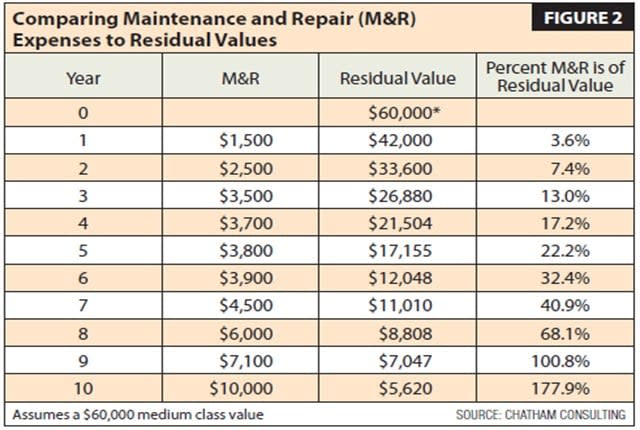
In this approach that we use, an informed decision is made on whether to repair, rebuild, sell, scrap, or cannibalize a vehicle based on the costs of the repair and the residual or market value of the vehicle. Any vehicle or equipment unit with a maintenance cost that is 30 percent or more of the vehicle’s residual value should be assessed for replacement.
As illustrated in Figure 2, the 30-percent threshold that is reached just before year six provides sufficient time to evaluate the vehicle’s condition and begin to plan for its replacement before major repairs are needed in years eight through 10.
An assessment report (matrix) should be completed of those units that reach the 30-percent threshold. Digital pictures should be taken of the four sides and roof of the vehicle, and any exceptional items should be noted.
Units with the lowest matrix scores should be annotated with a summary of cumulative operating expenses and their estimated replacement costs. The results can be used to guide decisions during the budget preparation process on whether to repair, rebuild, or scrap the unit. If a vehicle or component can be rebuilt at 50 percent of the cost for a new unit and be able to extend the life of the vehicle or component by 75 percent of that of a new unit, it is worthwhile to rebuild. For accident repairs, allow expenditures up to 50 percent of the vehicle’s value.
In addition, the vehicle’s utilization should be evaluated and taken into account to determine whether to replace the unit at all. If the vehicle has consumed less than 500 gallons of fuel or been used less than 2,500 miles during the past 12 months, it should be evaluated whether it still is needed.
The Bottom Line
We have seen that there is a variety of approaches to calculate the optimal service months and replacement cycles. Each has its own set of advantages and disadvantages to consider. Some are easier to use than the others; however, they all require data on maintenance and repair expenses. Without this information, the organization may have little choice than to rely on some other fleet’s replacement guidelines.
The best approach to replacing medium-duty trucks:
Accounts for the organization’s specific needs.
Evaluates more than one factor.
Reviews vehicle condition.
Considers trade-offs of capital versus operating expenditures.
Examines whether as well as when to replace.
Considers leasing.
Applies good judgment.
Sal Bibona is president of Chatham Consulting, Inc., and can be reached at (973) 966-9262 or slb@chathamconsulting.com.
Originally posted on Automotive Fleet
More Vehicle Research
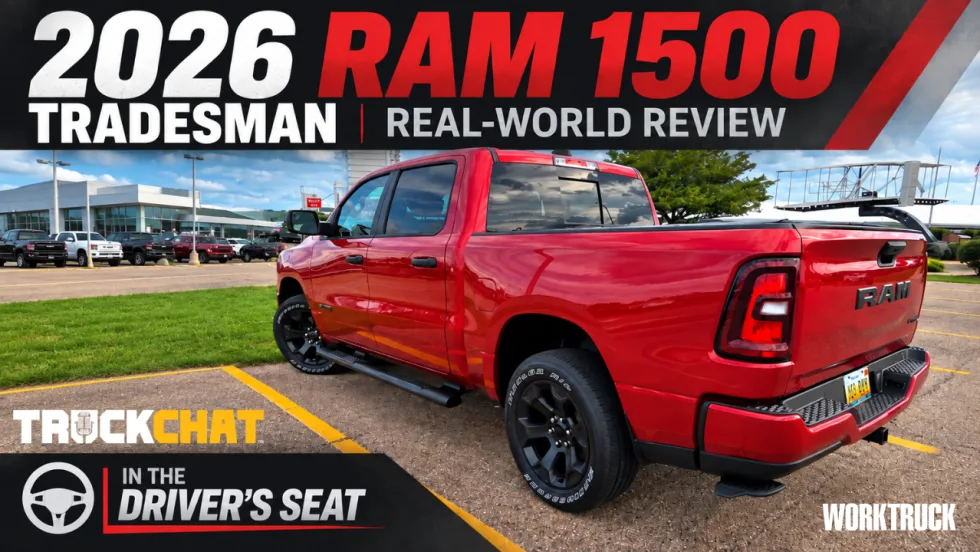
2026 Ram 1500 Tradesman Put to a Real-World Fleet Test
A few days behind the wheel of a 2026 Ram 1500 Tradesman turned into a test of visibility, parking, work-ready features, and even severe-weather driving.
Read More →
Isuzu N-Series Gas Fleet Guide: Specs, Capability and 2027 Model-Year Updates
Explore Isuzu Truck North America’s N-Series Gas fleet specs, engine performance, GVWR and payload capability, configurations, chassis dimensions, work-focused features, and 2027 model-year information.
Read More →
Chevrolet Silverado 1500 Fleet Guide Specs Capability and 2027 Model-Year Updates
The next-generation 2027 Chevrolet Silverado 1500 brings new V-8 engines, updated technology, expanded safety features, and a fleet-focused Work Truck. Here’s what commercial fleets need to know so far.
Read More →
Ram ProMaster City Fleet Guide Specs Cargo Capacity and 2027 Updates
Work Truck’s Ram ProMaster City Fleet Guide tracks the latest specifications, cargo capability, configurations, fleet technology, pricing, and model-year updates for Ram’s mid-size commercial van.
Read More →
Ford F-150 Fleet Guide Specs Capability and 2026 Model-Year Updates
Explore 2026 Ford F-150 fleet specs, engines, towing and payload capability, configurations, work features, technology, and model-year updates.
Read More →
TCI Now Sells & Supports Battle Motors’ Vocational Trucks
Midwest truck dealer Truck Centers, Inc. (TCI) has expanded its transportation solutions with sales and service support for Battle Motors’ heavy-duty vocational trucks at locations in locations in Indiana, Illinois, and Missouri
Read More →
Ram 1500 Fleet Guide Specs, Capability and 2027 Model-Year Updates
Explore always up-to-date Ram 1500 fleet specs, engines, towing and payload capability, configurations, technology, pricing updates, and model-year changes.
Read More →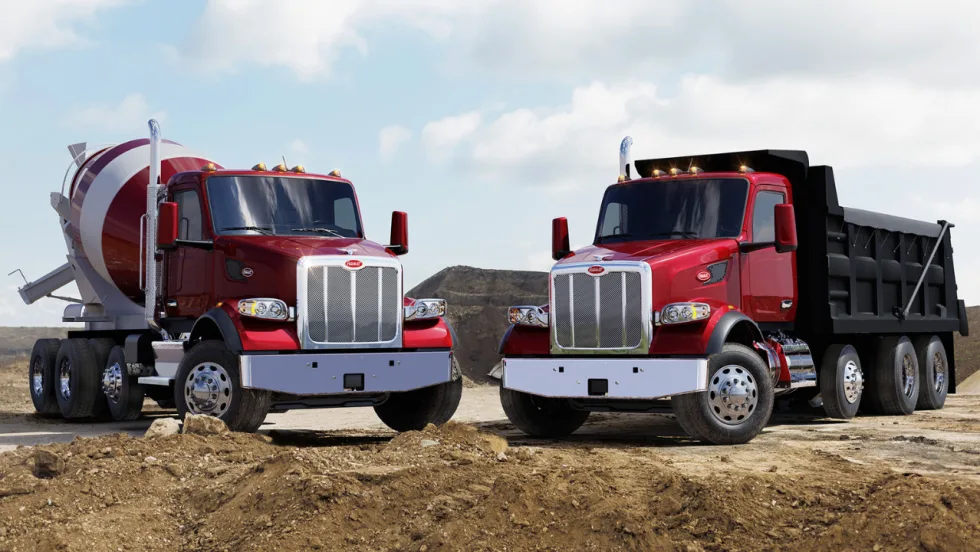
Peterbilt Trucks Equipped with Paccar TX-18 Pro Boost Efficiency for Maryland Fleet
Patuxent Companies is replacing aging trucks with the Peterbilt Model 567 and Model 589, specified with the Paccar TX-18 Pro 18-speed automated transmissions, and is reporting an 8% to 10% improvement in fuel economy.
Read More →
Stellar Expands into Fire Apparatus Market with Acquisition of Midwest Fire
Stellar Industries has acquired Midwest Fire, a custom fire apparatus manufacturer headquartered in Luverne, Minnesota, with nearly four decades of specialized apparatus experience.
Read More →
Recalls You Need to Know About in August 2026
If you have Altec, Chrysler, Ford, Heil, General Motors, International, Mack Trucks, Paccar, Rivian, Royal Truck, Toyota, US Truck Body, or Volvo Trucks vehicles in your fleet, you should check these important recalls issued by the National Highway Safety Administration.
Read More →