




Related: Digging into Work Truck Fleet Costs
How to Avoid Running a Truck Until its Wheels 'Fall Off'
Truck lifecycles can be calculated to the mile and the dollar. This can help fleets replace vehicles at the optimal moment.
by John Dolce
November 15, 2013
Truck lifecycles can be calculated to the mile and the dollar. This can help fleets replace vehicles at the optimal moment.
Photo: Work Truck
4 min to read
Depreciation is the largest fleet cost. In fact, when cumulative maintenance cost (parts and labor) equal the original purchase price (no interest included), that is the threshold, the watershed moment, when a truck’s wheels will economically “fall off.”
This moment is completely predictable and consistent. And, interestingly this predictability has been with us since the earliest days of the automotive industry, a general benchmark that states when the cumulative maintenance cost (parts and labor) is equal to the original purchase price of the truck, that’s the moment that’s predicted when the wheels are going to economically fall off.
Measuring Cost
For our purposes, we’ll use a benchmark of $18,500 of accumulated maintenance as the moment when the wheels are going to economically fall off.
The accompanying chart, “$18,500 Light-Duty Truck,” illustrates the predictability of the process, showing that in year eight the wheels will economically “fall off.”
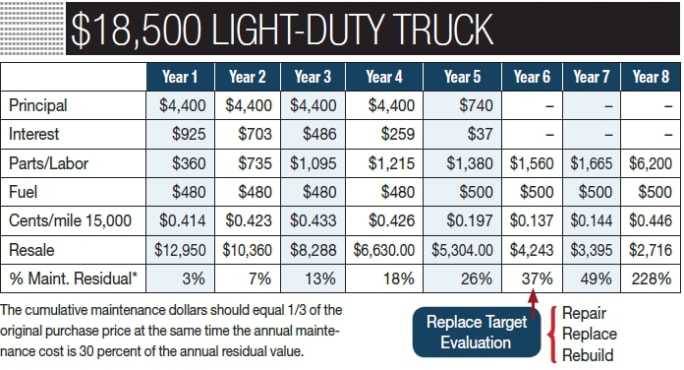
The predictability of the process shows that in year eight the wheels will economically “fall off."
Photo: Work Truck
Since it’s a predictable value, it makes sense to replace the truck sometime in year seven — just before the wheels fall off (forget resale value in this scenario).
Also, note that in operating year five, six, and seven, the truck is cheaper to operate than in years one through four. The reason: There’s no depreciation cost.
Now, the key to maximizing operational life is to stretch out years five through seven with good regular maintenance, and configure the vehicle to do its work within its capability or spec. In year eight, the wheels will economically fall off.
Timing Is Everything
When should the clock be started to begin measuring the accumulation of time toward the choice to proactively repair, replace, rebuild, sell (resale), scrap (liability), or remove instead of replacing a vehicle? I believe the measurement should begin when the maintenance cost for the previous 12 months is 30% of the vehicle’s residual value (year six in the chart).
At that time, the fleet is already in the next year (year seven) and 49% of the residual value, because next year (year eight in this example) the wheels will economically fall off. Maintenance will be 228% of the vehicle’s residual value. Also, the 228% additional maintenance costs will have other consequences, namely the headaches associated with a less reliable vehicle.
As the chart “$70,000 Vocational Chassis + Equipment” illustrates, the same process can be used no matter the equipment type. The only difference is the timing of the 30% tipping point, which occurs at the seven-year mark.
So, to be proactive, for either capital or operating funding, use 30% of the residual value (maintenance costs instead of resale costs) as the optimal time to decide whether to continue to repair, rebuild, replace, sell, or scrap the vehicle in question.
Interestingly, there is a 30% maintenance cost over the residual value. Conveniently, the cumulative maintenance cost at the same point (year six) is 30% of the original purchase price. The 30% benchmark is ideal because it usually gives the fleet a year or two at least to plan for replacement. The numbers take the emotion out of the equation. It’s a black and white equation.
There’s a caveat to this. Anytime within the first six years, the truck is in an accident and it takes more than 50% of its residual value, an analysis should be done to see if it’s worth fixing. In most cases, it won’t be worth fixing.
A Predictable Process
The truck lifecycle process is predictable and cost-effective. It is the fleet manager’s responsibility to fund the repairs, replacements, and rebuild actions, with the appropriate funding, a year ahead for the next capital or operating budget.
Now, the choice to rebuild makes sense if the fleet can safely spend ½ the cost of the new replacement vehicle and get ⅔ to ¾ the life of a new vehicle. The key to making this another cost-effective alternative as long as the vocational vehicle is configured correctly by the manufacturer to do the job it is supposed to do.
For the $18,500 unit example, a new replacement is $24,000. If the fleet can afford to spend $12,000 to rebuild the unit instead of replacing it after seven years, and get an additional five years of life from it, then this option is a cost-effective alternative to consider.
Subscribe to Our Newsletter
More Vehicle Research
2026 Ram 1500 Tradesman Put to a Real-World Fleet Test
A few days behind the wheel of a 2026 Ram 1500 Tradesman turned into a test of visibility, parking, work-ready features, and even severe-weather driving.
Read More →
Isuzu N-Series Gas Fleet Guide: Specs, Capability and 2027 Model-Year Updates
Explore Isuzu Truck North America’s N-Series Gas fleet specs, engine performance, GVWR and payload capability, configurations, chassis dimensions, work-focused features, and 2027 model-year information.
Read More →
Chevrolet Silverado 1500 Fleet Guide Specs Capability and 2027 Model-Year Updates
The next-generation 2027 Chevrolet Silverado 1500 brings new V-8 engines, updated technology, expanded safety features, and a fleet-focused Work Truck. Here’s what commercial fleets need to know so far.
Read More →
Ram ProMaster City Fleet Guide Specs Cargo Capacity and 2027 Updates
Work Truck’s Ram ProMaster City Fleet Guide tracks the latest specifications, cargo capability, configurations, fleet technology, pricing, and model-year updates for Ram’s mid-size commercial van.
Read More →
Ford F-150 Fleet Guide Specs Capability and 2026 Model-Year Updates
Explore 2026 Ford F-150 fleet specs, engines, towing and payload capability, configurations, work features, technology, and model-year updates.
Read More →
TCI Now Sells & Supports Battle Motors’ Vocational Trucks
Midwest truck dealer Truck Centers, Inc. (TCI) has expanded its transportation solutions with sales and service support for Battle Motors’ heavy-duty vocational trucks at locations in locations in Indiana, Illinois, and Missouri
Read More →
Ram 1500 Fleet Guide Specs, Capability and 2027 Model-Year Updates
Explore always up-to-date Ram 1500 fleet specs, engines, towing and payload capability, configurations, technology, pricing updates, and model-year changes.
Read More →
Peterbilt Trucks Equipped with Paccar TX-18 Pro Boost Efficiency for Maryland Fleet
Patuxent Companies is replacing aging trucks with the Peterbilt Model 567 and Model 589, specified with the Paccar TX-18 Pro 18-speed automated transmissions, and is reporting an 8% to 10% improvement in fuel economy.
Read More →
Stellar Expands into Fire Apparatus Market with Acquisition of Midwest Fire
Stellar Industries has acquired Midwest Fire, a custom fire apparatus manufacturer headquartered in Luverne, Minnesota, with nearly four decades of specialized apparatus experience.
Read More →
Recalls You Need to Know About in August 2026
If you have Altec, Chrysler, Ford, Heil, General Motors, International, Mack Trucks, Paccar, Rivian, Royal Truck, Toyota, US Truck Body, or Volvo Trucks vehicles in your fleet, you should check these important recalls issued by the National Highway Safety Administration.
Read More →