





Related: How Does a Chevy Bolt Turn into an Electric Cargo Van?
Can a Three-Wheeled EV Catch on in Fleet?
At $18,500 and with negligible operating costs, ElectraMeccanica’s Solo should make some delivery and service fleets think about which applications might be suitable to shift from four wheels.
October 19, 2020
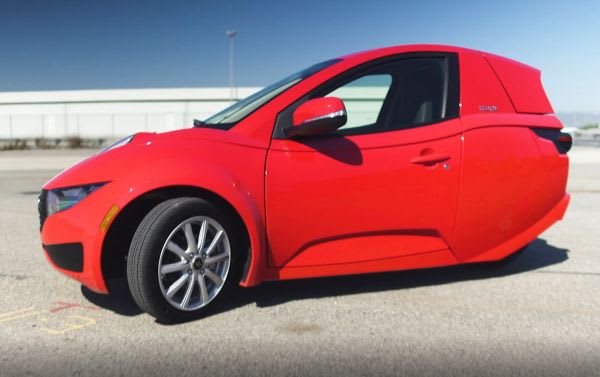
Bobit Business Media fleet editor Chris Brown took the first all-electric ElectraMeccanica Solo, hot off the production line, for a debut test drive. Check out the test drive video within.
Screen grab courtesy of ElectraMeccanica.
5 min to read
As I pulled into the parking lot for a test drive of the ElectraMeccanica Solo, I couldn’t help but think, sheepishly: I drove here in my three-row, 4x4 SUV by myself. It’s a hybrid SUV, mind you, but I’m clearly not yet part of the movement to fit the travel need to the transportation type.
The electric ElectraMeccanica Solo, however, fits this new trend.
Solo is a three-wheel, single-occupant electric vehicle. It’s classified as a motorcycle, though a standard passenger vehicle license will put you behind its steering wheel legally in 40 states. The highway-ready Solo gets up to 100 miles on a charge and tops out at 80 mph.
“(Solo) fits in the space between passenger vehicles and micromobility,” said Paul Rivera, ElectraMeccanica’s CEO at the event.
Fleet Uses
The first-generation Solo was hatched in 2015 in proof-of-concept quantities and it was initially intended as a commuter runabout, Rivera said. Rivera joined the company in 2019 and set about making design changes that broadened its applications.
He widened the front track, added a rollbar, and engineered greater side impact protection and crumple zones. Driving amenities were added such as air conditioning, power windows and mirrors, remote keyless entry, Bluetooth and USB, a heated seat, and a rearview backup camera.
Under the motorcycle classification Solo doesn’t have to be NHTSA crash tested nor is it required to have airbags, though Rivera said he intends to add airbags and an anti-lock brake system (ABS) to the next model.
Along with power steering, the latest generation of Solo also has torque-limiting steering control. This may seem unnecessary for a 17.3 kWh battery that generates a modest 60 hp and 103 lb.-ft. of torque, but we’ll get to that.
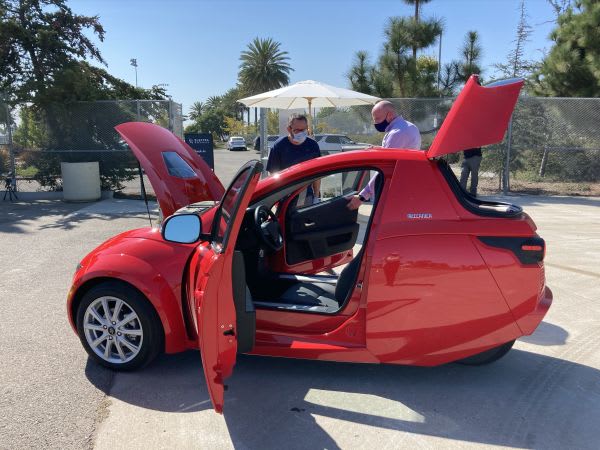
Photo by Chris Brown.
Solo can be spec’d with a cargo box that offers 5 cubic feet of space and about 60 lbs. of payload. In that ground between passenger vehicles and micromobility, where could Solo fit in fleet applications?
Rivera sees Solo in campus or parking lot security functions, food and pharmaceutical delivery, and sales and service applications with limited payload needs. Rivera expects fleet operators will give practical use input into the next model’s design.
With its small footprint (10.2 feet in length) and zero emissions status, Solo is suited for urban environments, particularly with the growing movement to curtail carbon emissions in many cities. Rivera sees Solo in shared mobility scenarios in strategically placed pods.
Three-wheeled electric vehicles have splashed into the market but never really caught on. What’s different now? “We’re no longer trying to educate on EVs, we can thank Elon (Musk) for that,” Rivera said. “At the same time, we’re not trying to compete with Tesla.”
For EVs, advances in battery technology are a double-edged sword. While upgrades in density and range are essential, older technology is quickly obsolete. Solo, however, is designed for specific uses within a range and price point. “We’re not going for 300-mile range. Our value proposition is completely different,” he added.
For fleets, Solo will have competition from Arcimoto’s three-wheeled Deliverator, which offers a substantially larger 350-pound carrying capacity and over 20 cubic feet of cargo space. Of course, the Deliverator will never double as a commuter car.
At $18,500 and with negligible operating costs, Solo should make fleets think about which applications might be suitable to shift from the traditional four wheels.
Production
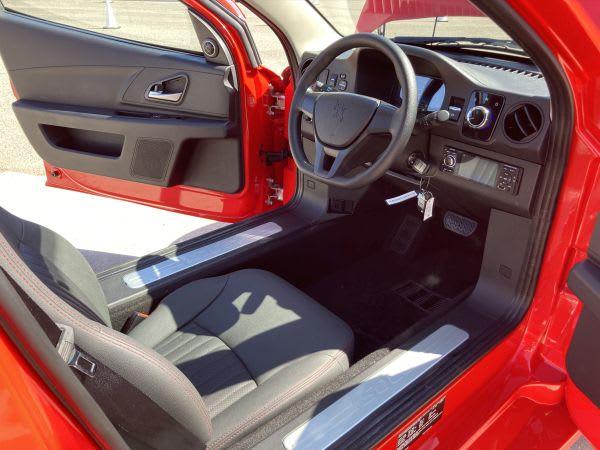
Photo by Chris Brown.
ElectraMeccanica, a public company, produces vehicles through Zongshen Industrial Group in Chongqing, China. First orders should hit the streets by the end of this year. Duly noted, being in production is now a differentiator from vaporware announcements of other electric tech upstarts.
The Chinese plant has the capacity to pump out 20,000 units per year, though Rivera is realistic about first-year output. “Going from no production to production takes time to ramp up,” he said.
Zongshen’s plant will continue to produce Solo for international markets and produce kits for final assembly in the U.S. ElectraMeccanica is planning to open a 250,000-sq.-ft. facility in either Tennessee or Arizona. The final site winner should be announced before Thanksgiving, Rivera said.
Sales are direct to buyer, and will be limited in 2021 to California, Arizona, and Oregon as the Vancouver-based company grows its sales and service support network. ElectraMeccanica has hired a dedicated fleet sales manager. Rivera has orders from a major food franchise chain and a delivery company but won’t yet reveal names.
The Drive
Our Solo model was the first off the production line in China. Solo’s double doors allow ingress from either side. Entering felt like climbing in a glider cockpit, though the single-seat cabin didn’t necessarily feel claustrophobic.
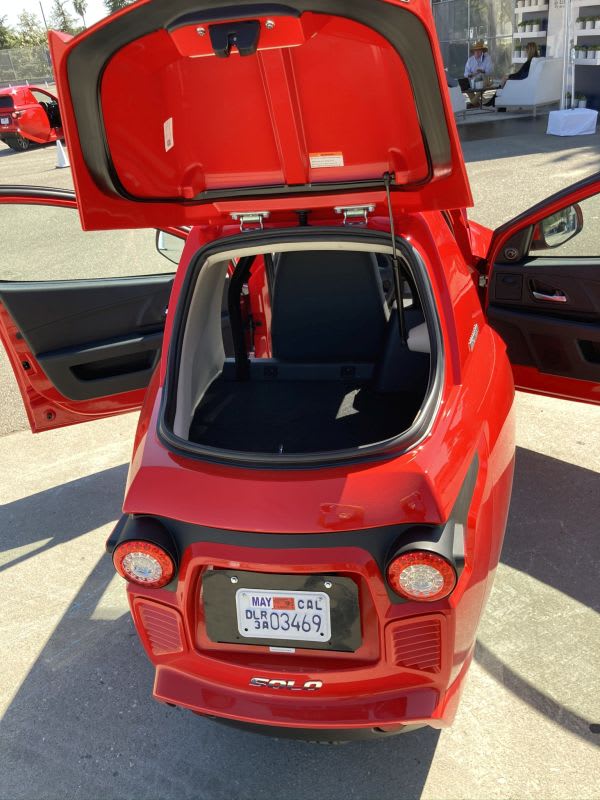
Photo by Chris Brown.
Solo gets to 60 mph within 10 seconds, unremarkable on paper (the Chevy Bolt does it in 7 seconds). But Solo still delivers that off-the-line immediacy electric motors are known for. About that torque limiter, I was actually grateful for it.
As I got more confident with speed in the cone course, I yanked Solo into some sharp turns to see if I could skid the tires or throw it off balance, but the three-wheeler stayed firmly planted. Check out the video of my drive here.
Our parking lot drive could not replicate street driving, however. I would’ve liked to experience Solo on city streets and the highway to assess my comfort level on uneven road surfaces and amidst “normal-sized vehicles.”
One can imagine pulling up next to an F-150 Raptor to see who wins the race to the next traffic light, though the Raptor would have the edge if it’s hauling air. It may not be possible to crane one’s neck upward from the Solo’s cockpit to see the Raptor driver’s expression anyway.
What is guaranteed: The Raptor spews a lot of carbon, while the Solo emits none at all.
Originally posted on Automotive Fleet
Subscribe to Our Newsletter
More Small Fleet


Developing Budget-Friendly Driver Safety Programs
From driver training and safety meetings to one-on-one coaching and incentive programs, several small fleets share how they have developed a safety culture with their drivers using low- to no-cost resources.
Read More →
Sponsored•March 9, 2026
Boosting Last-Mile Fleet Uptime, Safety, and Value with AI Vehicle Inspections
AI-powered inspections are transforming last-mile fleets by replacing manual checks with highly accurate automated scans that detect defects in seconds. By giving fleet operations visibility into the daily condition of their vehicles, you can identify trends over the vehicle’s lifecycle that enable improved procurement decisions, route management, driver training and accountability.
Read More →
Five Ways Seat Belts Help Prevent Injuries
There are five ways seat belts protect occupants from injuries, according to the Tennessee Department of Safety and Homeland Security.
Read More →
Sponsored•January 14, 2026
It’s here: The 2026 Fleet Technology Trends Report
What does AI mean for fleets? Get the answer — and learn other top tech trends.
Read More →
Small Fleets, Big Impact: How Independent Drivers Power Wreaths Across America
Check out how small fleets and independent drivers power Wreaths Across America each December and why their impact matters more than ever.
Read More →
VMS Survey Finds 65% of Small Fleet Managers Run Operations Alone
A new VMS survey shows small fleet managers are stretched thin, with most handling operations solo and eager to adopt digital tools for relief.
Read More →
Tips for Driving Safely on Halloween Night
This video features a reminder from the Connecticut Department of Transportation (DOT) and the Connecticut Police Chiefs Association, urging drivers to prioritize safety this Halloween.
Read More →
AI, Access, and Uptime: VMS’s Next Chapter with David Prusinski
VMS’s new Co-CEO, David Prusinski, shares how an AI-first approach will give small fleets and repair shops the tools to compete like big players.
Read More →
Fleet Managers Share Winter Prep Tips: It's Never Too Early!
Three fleets share best practices to prep vehicles for winter and prevent downtime when the cold sets in.
Read More →