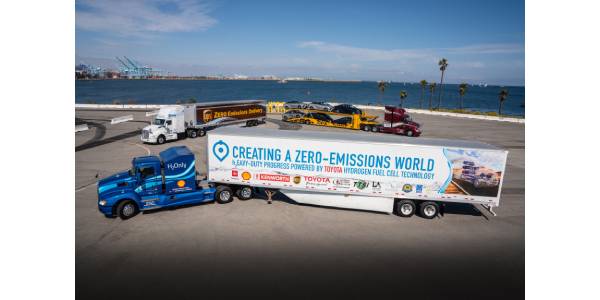
Toyota, Kenworth, the Port of Los Angeles, and the California Air Resources Board (CARB) took a big step toward zero-emission trucking on April 22, 2019 when they unveiled the first of Toyota and Kenworth’s jointly developed fuel cell electric heavy-duty trucks (FCET). The unveiling was before a crowd of media, government officials and industry and community leaders during a special event held at the Port of Los Angeles.
Photo: Toyota
California has ranked among the leading states that are helping public and private sector fleets transition to electric and zero emission vehicles.
Ad Loading...
Those efforts include regulations to ensure the vehicles are available and incorporated into fleets, incentives to make the move to cleaner technologies more feasible, and education/outreach activities to raise fleets’ awareness of the benefits of zero-emission vehicles and how to make the switch, said Hannah Goldsmith, the lead advisor in Zero Emission Vehicle Market Development at California Governor's Office of Business and Economic Development (GO-Biz).
Ad Loading...
So far, transit agencies in California have been at the forefront of the transition to zero-emission vehicles. SunLine Transit Agency in Thousand Palms, California, for example, began operating hydrogen fuel cell vehicles in 2000 and has since incorporated many hydrogen fuel-cell and battery-electric buses into its fleet. SunLine has also committed to transition its entire fleet to zero-emission technology by 2035, five years ahead of the requirement in the California Air Resource Board’s Innovative Clean Transit Regulation.
With its reputation of being on the forefront of clean and zero-emission vehicles, California’s state fleet and many private companies have been increasing their deployment of zero-emission vehicles as well.
Incentive Programs
Here is a brief overview and links of programs fleet managers in California can take advantage of:
The Hybrid and Zero-Emission Truck and Bus Voucher Incentive Project (HVIP), which aims to accelerate the adoption of cleaner, more-efficient trucks and buses, and its companion program, the Clean Off-Road Equipment Incentive Project (CORE), which helps deploy zero-emission off-road freight equipment. Both programs are funded through the California Climate Investments, allocated by the California Air Resources Board and administered by CALSTART. Governor Gavin Newsom’s proposed January budget seeks to allocate $315 million over the next year to clean truck, bus, and off-road equipment programs like these.
The California Air Resources Board’s Low Carbon Fuel Standard incentivizes the use of cleaner fuels, like electricity and hydrogen, through a market mechanism. Fleets that charge their electric trucks or buses are eligible for EV fleet charging credits, which can then be sold to yield revenue for the fleet. Transit agencies enrolled in the LCFS program are estimated to see about $10,000 of credit revenue/year per battery-electric transit bus (see, e.g., CARB presentation, slide 12).
The California Energy Commission’s Clean Transportation Program funds many medium- and heavy-duty ZEV and infrastructure projects. This includes a first-of-its-kind joint funding solicitation from the Commission and CARB for a large-scale deployment of zero-emission Class 8 trucks and the infrastructure to support these vehicles (with each agency contributing $20 million).
Hannah Goldsmith, the lead advisor in Zero Emission Vehicle Market Development at California Governor's Office of Business and Economic Development (GO-Biz), brings together resources for fleet operations transitioning to electric and zero-emission vehicles.
Photo: CA GO-Biz
Fleet Resources
Fleet managers can visit the following websites to search the full landscape of grant, financing, and other types of programs related to ZEVs as well:
Home - California Grants Portal: A resource to help Californians and businesses find grant and other funding programs related to ZEVs and beyond.
Incentive Search | DriveClean (ca.gov): This one is primarily geared towards light-duty ZEVs and includes a variety of opportunities from the state and other entities.
Beyond incentives, the state is also working to provide better and more organized resources to fleets to aid in the transition to zero-emission vehicles and equipment. For example, GO-Biz has two guidebooks that fleets can leverage to better understand the installation and permitting process when putting in charging and hydrogen stations (found here, under ZEV Readiness). GO-Biz also provide one-on-one assistance to fleets and charging/hydrogen station installers to help them navigate issues that may arise in the installation and permitting process.
State Targets and Regulations
Governor Newsom’s Executive Order N-79-20 from September 2020 sets in place the following targets applicable to California’s transportation sector:
100% of California sales of new passenger cars and trucks to be zero-emission by 2035. The order also set targets to transition all drayage trucks to zero-emission by 2035, all off-road equipment to zero-emission where feasible by 2035, and the remainder of medium- and heavy-duty vehicles to zero-emission where feasible by 2045. The California Air Resources Board, as directed by the executive order, is working to update and enact regulations to ensure these targets are achieved along with underlying air quality and climate change goals.
“This suite of regulations will help the state achieve its zero-emission medium- and heavy-duty targets and additional regulations, incentives, partnerships, and other opportunities will help get us the rest of the way,” Goldsmith said. “Ultimately, fleets need to see the business case and value added of transitioning to zero-emission technologies and these programs and policies are intended to help get us there.”
The ZEV Market Development Strategy organizes the goals of state agencies and highlights the critical roles of private stakeholders in achieving the state’s ZEV vision.
CA Fleet Goals
With one of the largest state fleets in the U.S., California also has set ambitious goals for its vehicles, setting an example for private sector and other public sector fleets. The state itself has a decentralized fleet of about 50,000 vehicles used by dozens of agencies.
As of 2019, about 8.4% of the state’s overall fleet was made up of battery electric and hydrogen fuel cell vehicles (counting only pure ZEVs, not including plug-in hybrids), though fleet purchases made in 2020 continued to accelerate the replacement of the state’s internal combustion engine vehicles with ZEVs.
Among the statutory targets:
Ad Loading...
AB 739 (Chau, 2017) set in place certain requirements for incorporating increasing levels of zero-emission heavy-duty vehicles into the state fleet: starting with 15% at the end of 2025 and increasing to 30% by the end of 2030.
SB 498 (Skinner, 2017) requires the Department of General Services, starting no later than the 2024–25 fiscal year, to ensure that at least 50% of the light-duty vehicles purchased for the state vehicle fleet each year are zero-emission.
In addition to the statutory targets for transitioning the state fleet to increasing levels of zero-emission vehicles, the Department of General Services has in place ZEV first purchasing mandates applicable to all state agencies that purchase vehicles for the state fleet. These mandates prioritize pure zero-emission vehicles, i.e., battery electric and hydrogen fuel-cell vehicles, though allow for plug-in hybrids and other vehicles to be purchased if the purchasing agency can demonstrate why a pure ZEV cannot meet their transportation requirements (DGS Zero Emission Vehicle and Hybrid Electric Alternative Fuel Vehicle First Purchasing Mandates).
The state fleet’s progress with incorporating ZEVs can be tracked through metrics displayed on California’s Green Fleet website and in more detailed fashion through California’s Open Data Portal (both of these websites are being updated with more recent state fleet data).
New one-day registration gives fleet professionals the flexibility to attend Tuesday, Wednesday, or Thursday, with passes available for $199 through Sept. 18.
CALSTART has rebranded as Catalyst Mobility and will combine with Forth at the start of 2027. The new organization said it is poised to become one of the world's largest, strongest, and most impactful clean transportation nonprofits.
Together, the Port Authority of New York and New Jersey and CALSTART will electrify drayage and terminal operations serving the East Coast’s busiest container port. A pair of incentive programs totaling $45 million has launched to accelerate adoption of zero-emission drayage trucks and terminal tractors.
A single Xos Hub has surpassed one gigawatt-hour of energy across more than 33,600 charging sessions in the field, demonstrating performance that supports Xos' expansion across new products and markets.
Carrier Transicold’s first engineless multi-temperature TRU helps fresh- and frozen-food fleets add supplemental cold storage capacity during seasonal peaks.
Narro Trucks officially launched its operations on Aug. 20 and hosted a ride and drive to showcase its electric truck, which will be produced in Virginia.
Samsung SDI is taking full control of its Indiana battery plant with GM, marking a major shift from the EV-focused joint venture Charged Fleet first covered in 2023.
CALSTART will provide free technical assistance services to drayage fleets serving the Ports of Seattle and Tacoma and looking to transition to cleaner technologies and help decarbonize freight hubs.
Electric work truck upfits bring new compatibility questions. Learn how parts availability, OEM guidance, power demands, and route planning can affect fleet performance.
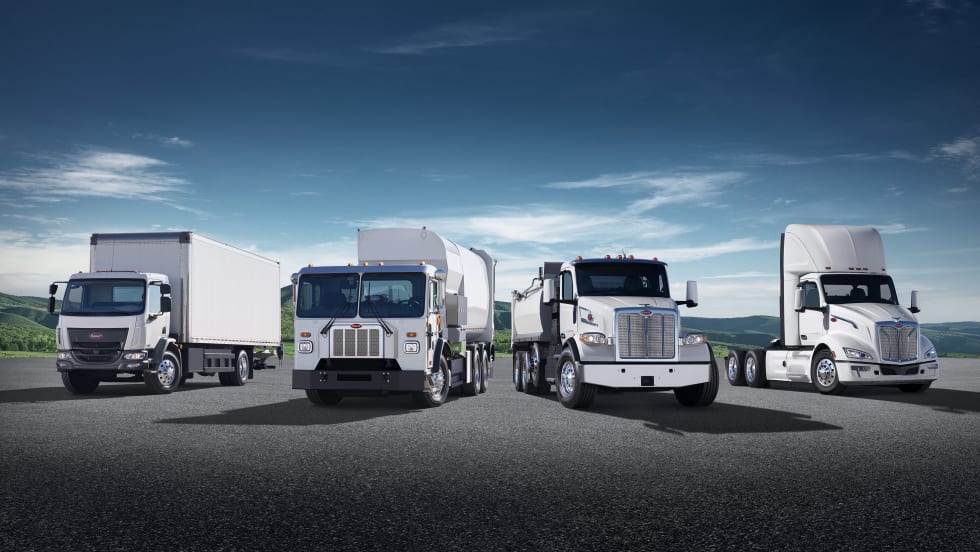
Peterbilt Motors Company’s cooperative purchasing agreement with Sourcewell and its Canadian partner, Canoe Procurement Group, now includes including Peterbilt's battery-electric vehicle lineup.