




Related: F-150 Truck with Aluminum Uses Structural Adhesives
Building Better Vehicles
Rather than welding components together, structural adhesives are becoming more common in custom upfit work vehicles.
by Bob Zweng & Tim Jackson, LORD Corp.
January 5, 2017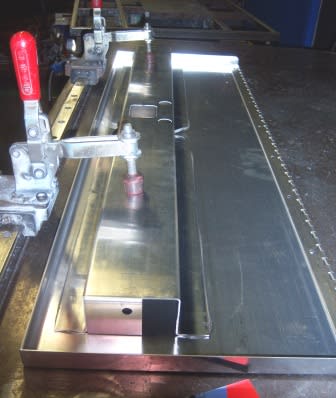
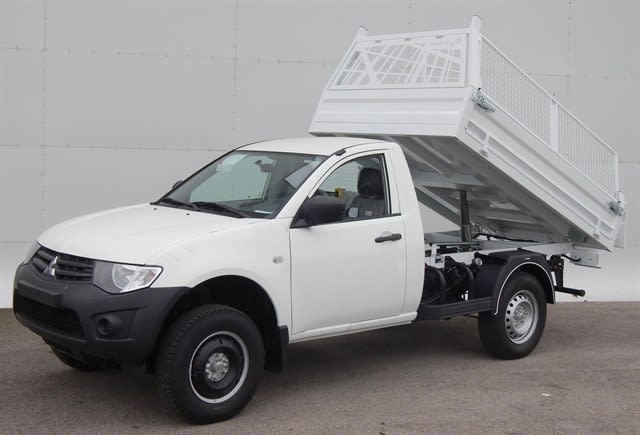
Truck toolbox lid-latch-support joined with a structural adhesive eliminates warpage and stress concentrations common with welding. (Photo courtesy of LORD Corp.)
5 min to read
Side panels and floor sections bonded with structural adhesives improve throughput, durability and appearance vs. all-welded design. (Photo courtesy of LORD Corp.)
Commercial vehicles (work trucks) are the “work horses” of the trucking industry. As opposed to OEM passenger cars and trucks, commercial vehicles are custom-designed to meet varied applications. These various applications include trucks built for firefighting and emergency services, utility operations, construction, trash collection, and more.
Building commercial vehicles involves a close collaboration between the truck chassis manufacturers, truck outfitters and/or converters, and product suppliers. According to the NTEA (The Association for the Work Truck Industry), the size of the work truck industry in the United States was $121.8 billion in 2014. Regarding commercial vehicles, the NTEA states, “their diverse applications, limited volume and nearly limitless body and equipment variations dictate” the need for custom building.”
Custom-Designed and Built
The custom work performed on these vehicles ranges from adding toolboxes and special side panels on smaller trucks to adding cranes and special doors to larger vehicles. Some customers ask for high-end touches, such as teakwood and chrome finishes. Other commercial vehicle manufacturers specialize in building and customizing limousines and party buses.
Commercial vehicle outfitters primarily work with a truck flatbed or a truck cabin chassis purchased directly from the OEM. The vehicle is then custom-built from scratch to the customer’s specifications. The goal of the commercial vehicle builder is to make the inside of the truck look as good as the outside and to make the back of the truck look as good as the OEM-truck front cabin. One such method employed to do this is to use structural adhesives as an alternative to welding.
Adhesives vs. Welding
Structural adhesives offer many advantages over welding such as enhanced strength properties, reduced corrosion, time and labor savings, and cost efficiencies. As a joining technique, welding has historically been the choice because “it’s the way it’s always been done.” But, once educated on the benefits of using structural adhesives, many commercial vehicle builders are favorable to making the switch.
As an example, at one commercial builder, workers were reluctant to use structural adhesives. The workers did not believe that vehicle doors could be bonded together well enough to eliminate problems with “fit-and-finish.”
To prove the efficacy of structural adhesives over welding, several trial applications were performed on vehicle doors. The results proved that the structural adhesives were strong enough to not only bond the doors, but they also improved cycle times, reduced warranty problems, and eliminated concerns with corrosion and leakage. That was 10 years ago, and the company has since explored more opportunities for using adhesives in vehicle building.
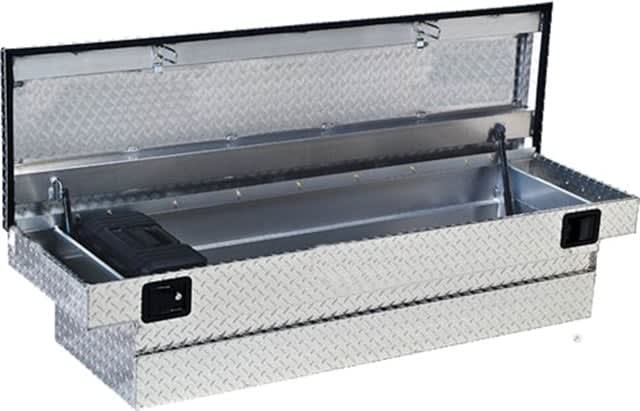
Welds on truck tool box are unsightly and can cause significant imperfections. (Photo courtesy of LORD Corp.)
A Prime Example
Another application example proves that it is less expensive to use structural adhesives. A company that designs and builds truck-mounted electric and hydraulic cranes, crane bodies, and crane control technologies, was using a primer and welding to manufacture commercial vehicles. By using a two-part epoxy, the company was able to eliminate a production step and the primer cost. Now, work can be done directly on bare metal. The time savings allowed the company to produce more equipment.
Furthermore, by using structural adhesives, the company was able to build a better-looking vehicle. The welding procedure required 15 welds across a beam on the side panel. With structural adhesives, only two to six beads of adhesive were needed to bond the side panel. Not only was the bonding process faster, but it eliminated the warping that occurred from the welding heat. Overall, the vehicles now have a nice, crisp finish on the outside, which is especially pleasing to the customer.
Making the Switch
Even though welding can be a costly and time-consuming joining method, switching over to adhesives does require changing the entire production process. However, issues arising with the switch to adhesives can often be minimized by collaborating with an adhesives supplier that offers assistance on making assembly line changes.
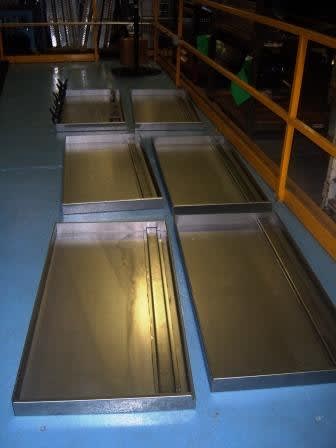
Truck Toolbox lids, bonded with adhesives, are ready for powder coat processing.(Photo courtesy of LORD Corp.)
While a welding operation requires skilled labor, welding equipment, and special safety gear, adhesives can be applied by less-experienced workers using a glue gun and standard shop safety procedures.
For instance, a manufacturer of service vehicles and material handling systems was having issues with quarter-panel cracking and corrosion that developed around the wheel well.
During the production process, welders spent about 45-minutes making 36 plug welds around each wheel well. When the company switched to using structural adhesives, not only did it save time (it took only about five minutes to bond with the adhesives), but other improvements occurred – there was no stress cracking or corrosion, the overall appearance was better, and costs were cut. Structural adhesives offered the advantages of sealing-and-bonding in one step, and also provided additional noise and vibration reductions. The finishing process was likewise simplified. Workers no longer had to spend time before the painting process grinding and filling the welds.
In another application, the time-saving benefit of adhesives also proved to be advantageous. The company specializes in building custom party vans and limousines, was using a cross-bonding adhesive to join Sheet Molded Compound (SMC) panels to limousine vans and rooftops. The workers can use the adhesive without needing any surface preparation on the metal or SMC surface - a time-saving step. Because of the success with the cross-bonding product, the company is looking into using weld bonding adhesives to further reduce labor costs, along with seam sealing and sound deadening products to protect against corrosion and improve noise-vibration-harshness (NVH).
Using structural adhesives as an alternative to welding can save time and money for the commercial vehicle builder looking for aesthetically pleasing results that can help to increase customer satisfaction. Collaborating with an adhesives supplier that can offer production assistance and product knowledge can help to ease the transition from welding.
About the Authors
Bob Zweng is the Central Regional sales manager for LORD Corporation and Tim Jackson is the regional manager for LORD Corporation. Visit LORD Corporation's website for more information on the use of structural adhesives in vehicle upfitting.
Subscribe to Our Newsletter
More Upfitting
Multitasking: Vanair’s Air N Arc 330 Diesel 60 CFM All-In-One Power System
The Air N Arc 330 Diesel 60 CFM from Vanair consolidates a welder, generator, rotary screw air compressor, battery booster, battery charger, and EV charger into a single 750-pound enclosure driven by one 24.8-horsepower Kubota diesel engine.
Read More →
Buyers Products Awarded Sourcewell Cooperative Purchasing Contract for Snow & Ice Equipment
Buyers Products has been awarded a Sourcewell contract for a wide range of winter maintenance equipment and accessories, including snowplows, municipal plow systems, wing plows, spreaders, and more.
Read More →
Hilltip Introduces the SnowStriker SFT Flex Expandable Box Plow
Hilltip’s new SnowStriker SFT Flex expandable box plow features hydraulically extendable sections that allow operators to adapt the clearing width to changing conditions and applications on the go.
Read More →
Harbinger Part of Effort to Deliver Autonomous Logistics Capabilities for U.S. Army
American Rheinmetall received an 18-month U.S. Army contract to deliver autonomous, hybrid-powered uncrewed ground vehicles. Harbinger is providing the truck platform for those vehicles.
Read More →
Thinking Outside of the Box: Choosing the Right Truck Body for Your Fleet
Choosing the right truck body can have a major impact on loading efficiency, cargo protection, downtime, and long-term operating costs. Here’s how dry vans, platforms, and curtainsiders compare, plus what fleets should consider before spec’ing their next truck.
Read More →
Fourth Annual Upfit Package of the Year Awards Open for 2027 Entries: One Month Left!
Think your upfit deserves industry recognition? Enter the 2027 Work Truck Upfit Package of the Year Awards before the Sept. 30 deadline. There is less than a month left to get your submissions in!
Read More →
Reading Truck Equipment & Masterack Unite as One of North America's Largest Commercial Vehicle Upfit Networks
Reading Truck Equipment and Masterack have integrated operations to create one of North America's largest and most comprehensive commercial vehicle upfit organizations.
Read More →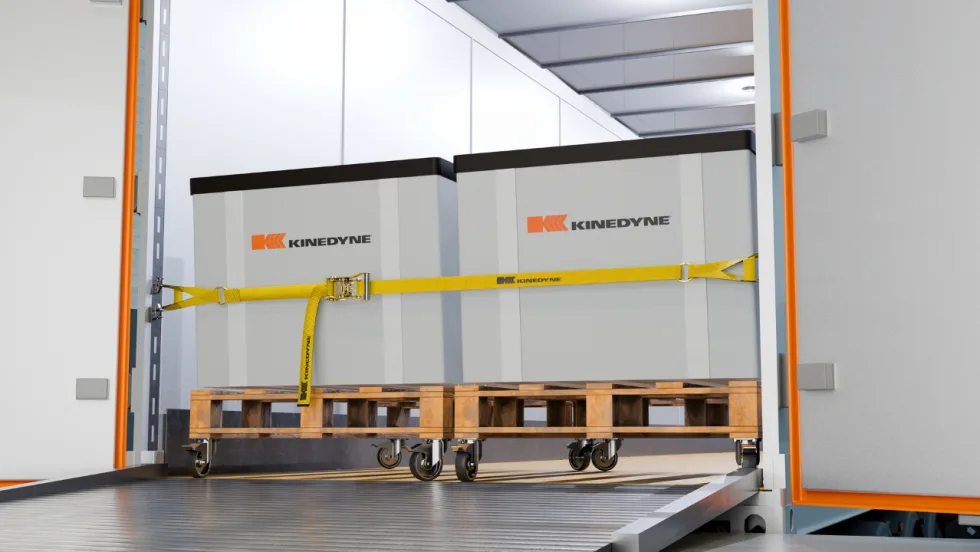
Kinedyne Launches Heavy Duty Logistic Shoring Strap
Kinedyne’s new Heavy Duty Logistic Shoring Strap features a patent-pending four-point design to deliver greater cargo stability, increased strength, and easier handling for rolling and shifting freight.
Read More →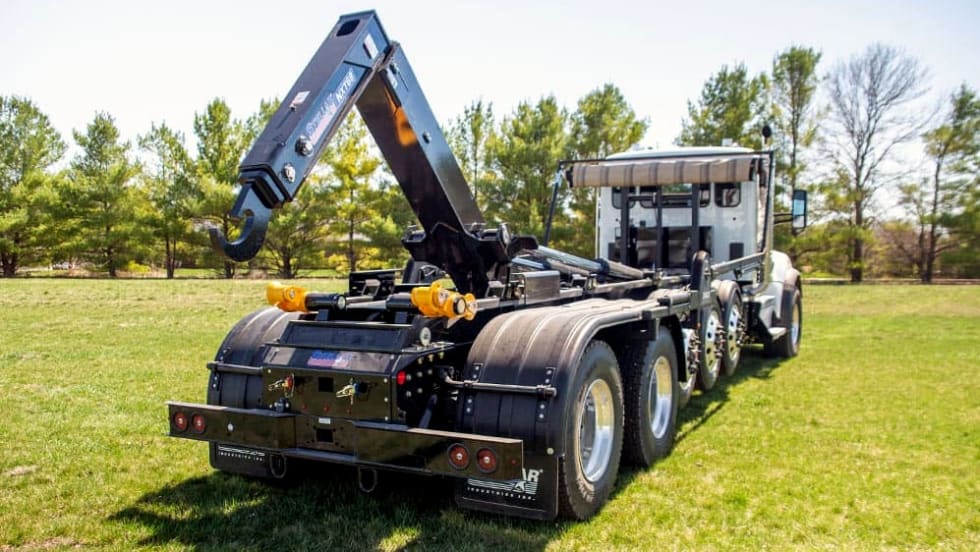
Hooklift Bumper Design from Stellar Showcases Strength & Versatility
Stellar Industries’ new bumper for the NZT Series Hooklifts come in two capacity options: the 20K, designed for Class 3 – 6 chassis with a 20,000-pound pull capacity, and the 90K, built for Class 7 and 8 chassis with a 90,000-pound pull capacity.
Read More →
Maxon Lift Awarded the Wabash Platinum Award for Supply Chain Performance
Maxon Lift, a liftgate manufacturer since 1957, received the Wabash Platinum Award for supply chain performance in 2025. Each year, Wabash presents awards to top suppliers for excellence in supply chain performance.
Read More →