




2007 Fleet Car & Truck of the Year Awards
For the second straight year, commercial fleet managers select the Ford F-150 as Fleet Truck of the Year. The truck is noted for performance, functionality, durability and safety.
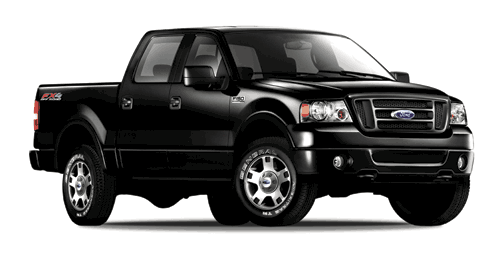
Ford F-150 Repeats as Fleet Truck of the Year
Photo: Ford
Renowned for its ruggedness, durability, gritty performance and dependability, the 2007 Ford F-150 upheld its reputation among fleet industry professionals as it brought home Fleet Truck of the Year honors for the second straight year.
Sponsored by Automotive Fleet and Business Fleet magazines, this year's annual Fleet Truck of the Year competition featured 38 domestic and import-badged 2007-MY light trucks. Qualified fleet buyers voted online.
"The F-150 is the best-selling under-8,500-lb. GVW pickup in both the commercial and government sectors," said John Ruppert, general manager, commercial and government operations, Ford.
The F-150 has won North American, Texas, and Motor Trend Truck of the Year, and was recognized by J.D. Power & Associates as the highest-ranked light-duty full-sized pickup in initial quality.
F-150 Gets the Job Done
The F-150 provides best-in-class towing at up to 10,500 lbs., with a maximum payload capacity of 3,050 lbs. "Our pickups are used primarily off highway over rough terrain," said Robin Robinson, key supplier manager for Federal Way, Wash.-based Weyerhaeuser Co., a forest products company with 2,500 total vehicles, of which 1,000 are F-150s.
"The F-150 continues to perform well under all conditions and can run in excess of 125,000 miles before replacement, which is about every five years."
The F-150 also maintains a competitive fuel economy, achieving up to 15/20 mpg city/highway, depending on engine and drivetrain. The 2007 F-150 is powered by either a 4.2L V-6 202-hp or 4.6L Triton V-8 248-hp engine in both 4x2 and 4x4 capacities.
The F-150 also offers a 5.4L three-valve Triton V-8 300-hp engine with variable cam timing and electronic throttle control, also available as an E-85 option. The V-6 has either a five-speed manual or four-speed automatic, while the V-8 is equipped with a four-speed automatic overdrive transmission.
Promoting Passenger Safety
Hydroformed front frame rails designed to collapse on impact helped the F-150 earn the National Highway Traffic Safety Administration's (NHSTA) Five-Star frontal crash rating.
"Our employee satisfaction survey results show the F-150 continues to be the favorite among our crews, citing among other features, structural integrity, comfort, and its large size," said Robinson.
One year after the completely redesigned 2006 Chevrolet Impala captured the Fleet Car of the Year award, the 2007 Impala again was chosen the industry's most popular car in the annual award program sponsored by Automotive Fleet and Business Fleet magazines.
"Repeating as Car of the Year is a great reflection on the GM men and women who design, build and sell the Impala," said Brian McVeigh, general manager of GM Fleet & Commercial Operations. "But just as important, sales of Impalas to our commercial and fleet customers translate into more than 32,000 jobs for people in North America. Every fleet manager who buys Impalas can feel good about that."
Fleet-Friendly Features Offered
Chief among the Impala's fleet-popular attributes are safety features, interior roominess, engine selection and the driving experience, according to Rob Minton, communications manager for GM Fleet & Commercial Operations.
"In addition to the flexibility of eight-seat configurations, a feature that sets Impala apart from competitors is the flip-and-fold seat."
A standard feature on the LTZ and SS models and available on the LT version, the rear seats fold flat into the floor, providing 18.6 cubic feet of cargo room. With an interior volume of 123.1 cubic feet, the Impala offers a "big-car roominess in a midsize car, any way you want to measure it," noted Minton.
Fuel Saving Technology
New for 2007, a 3.9L V-6 engine features GM's first application of Active Fuel Management on a six-cylinder engine. Active Fuel Management seamlessly allows the vehicle to run on half its cylinders in low-demand situations, improving fuel economy by up to 8 percent.
The 3.9L engine is standard on the LTZ and available on the LT, while the 3.5L V-6 is standard on Impala LS and LT models. A FlexFuel version of the 3.5L engine is compatible with E-85 ethanol.
Features Enhance Safety
The Impala offers several safety and security features, including front dual-stage and side-curtain airbags, a strengthened safety cage that absorbs impact upon collision and the ABS brake system with Electronic Brake Force Distribution.
The 2007 Impala received Five-Star ratings from the National Highway Traffic Safety Administration for frontal- and side-impact crashes. New in 2007, the tire-pressure monitoring system is standard on all Impala models.
The 2007 Impala is equipped with OnStar capability, and also new this year is the available 7.0 Generation OnStar with Turn-by-Turn navigation, which provides audio route directions to the driver.
The General Motors Advanced Automatic Crash Notification system, another OnStar service, is also available on the 2007 Impala.
More Small Fleet


Developing Budget-Friendly Driver Safety Programs
From driver training and safety meetings to one-on-one coaching and incentive programs, several small fleets share how they have developed a safety culture with their drivers using low- to no-cost resources.
Read More →
Boosting Last-Mile Fleet Uptime, Safety, and Value with AI Vehicle Inspections
AI-powered inspections are transforming last-mile fleets by replacing manual checks with highly accurate automated scans that detect defects in seconds. By giving fleet operations visibility into the daily condition of their vehicles, you can identify trends over the vehicle’s lifecycle that enable improved procurement decisions, route management, driver training and accountability.
Read More →
Five Ways Seat Belts Help Prevent Injuries
There are five ways seat belts protect occupants from injuries, according to the Tennessee Department of Safety and Homeland Security.
Read More →
It’s here: The 2026 Fleet Technology Trends Report
What does AI mean for fleets? Get the answer — and learn other top tech trends.
Read More →
Small Fleets, Big Impact: How Independent Drivers Power Wreaths Across America
Check out how small fleets and independent drivers power Wreaths Across America each December and why their impact matters more than ever.
Read More →
VMS Survey Finds 65% of Small Fleet Managers Run Operations Alone
A new VMS survey shows small fleet managers are stretched thin, with most handling operations solo and eager to adopt digital tools for relief.
Read More →
Tips for Driving Safely on Halloween Night
This video features a reminder from the Connecticut Department of Transportation (DOT) and the Connecticut Police Chiefs Association, urging drivers to prioritize safety this Halloween.
Read More →
AI, Access, and Uptime: VMS’s Next Chapter with David Prusinski
VMS’s new Co-CEO, David Prusinski, shares how an AI-first approach will give small fleets and repair shops the tools to compete like big players.
Read More →
Fleet Managers Share Winter Prep Tips: It's Never Too Early!
Three fleets share best practices to prep vehicles for winter and prevent downtime when the cold sets in.
Read More →