




Large Pickups Falter in Back Seat Safety
Here are the vehicles that all passed the IIHS updated side crash test but rated poorly when it came to rating back seat safety.

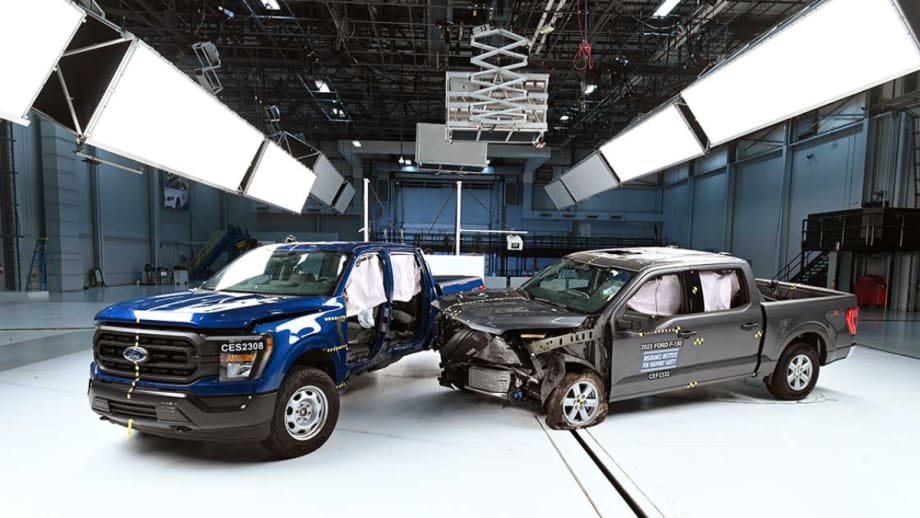
IIHS launched the updated moderate overlap front test last year after research showed that in newer vehicles the risk of a fatal injury is now higher for belted occupants in the second row than for those in front.
Photo: IIHS
Four large pickups offer strong protection in side crashes but fall short when it comes to protecting passengers in the back seat, according to the Insurance Institute for Highway Safety’s (IIHS) updated side crash test.
The Ram 1500 crew cab, Ford F-150 crew cab, and Toyota Tundra crew cab — all 2023 models — earn good ratings in the IIHS' updated side crash test, while the 2023 Chevrolet Silverado 1500 crew cab is rated acceptable. However, in the updated moderate overlap front crash test, which now emphasizes back seat safety, only the Tundra manages a marginal rating. The F-150, Ram 1500, and Silverado are rated poor.
“Like most other vehicle classes, large pickups don’t perform as well in the new moderate overlap evaluation as they do in the updated side test, which is now a requirement for our TOP SAFETY PICK awards,” said IIHS President David Harkey in a recent news release.
IIHS launched the updated moderate overlap front test last year after research showed that in newer vehicles the risk of a fatal injury is now higher for belted occupants in the second row than for those in front.
This is not because the second row has become less safe, rather, the front seat has become safer because of improved airbags and advanced seat belts that are rarely available in the back.
Even with these developments, the back seat remains the safest place for children, who can be injured by an inflating front airbag, and the rating does not apply to children secured properly in child safety seats. In the updated test, a second dummy is positioned in the second row behind the driver.
The driver dummy is the size of an average adult man. The rear dummy is the size of a small woman or 12-year-old child. IIHS researchers also developed new metrics that focus on the injuries most frequently seen in backseat passengers.
Good Rating Criteria
For a vehicle to earn a good rating, there can’t be an excessive risk of injury to the head, neck, chest, or thigh, as recorded by the second-row dummy.
The dummy should remain correctly positioned during the crash without “submarining,” or sliding forward beneath the lap belt, which increases the risk of abdominal injuries. The head should also remain a safe distance from the front seatback and the rest of the vehicle interior, and the shoulder belt should remain on the shoulder, where it is most effective. A pressure sensor on the rear dummy’s torso is used to check the shoulder belt position during the crash.
As in the original test, the structure of the occupant compartment must maintain adequate survival space for the driver, and measurements taken from the driver dummy shouldn’t show an excessive risk of injuries.
All four pickups provided good protection in the front seat. However, the restraint systems in the rear were inadequate.
“Submarining was a problem for all four pickups, and belt forces were too high in all but the Tundra,” Harkey said.
Measurements taken from the rear dummy indicated that chest injuries and head or neck injuries would be likely in the F-150 and Ram 1500. The risk of those injuries was somewhat lower but still excessive in the Silverado. For the Tundra, the risk of chest injuries was also too high due to poor belt positioning, but the risk of head or neck injuries was only slightly elevated.
The updated side test was introduced to address higher-speed crashes that are still causing fatalities, even in vehicles that excelled in the original evaluation.
Like its predecessor, the updated test uses two dummies, a driver and a rear passenger. However, it uses a heavier barrier traveling at a higher speed to simulate the striking vehicle. The updated test replaced the original in the criteria for the TOP SAFETY PICK awards in 2023.
In this test, the good-rated F-150, Ram 1500, and Tundra provided solid protection in front and back, though the occupant compartment of the F-150 was compromised slightly by the impact. There was an elevated risk of chest injury to the rear passenger in the acceptable-rated Silverado.
Originally posted on Automotive Fleet
More Small Fleet


Developing Budget-Friendly Driver Safety Programs
From driver training and safety meetings to one-on-one coaching and incentive programs, several small fleets share how they have developed a safety culture with their drivers using low- to no-cost resources.
Read More →
Boosting Last-Mile Fleet Uptime, Safety, and Value with AI Vehicle Inspections
AI-powered inspections are transforming last-mile fleets by replacing manual checks with highly accurate automated scans that detect defects in seconds. By giving fleet operations visibility into the daily condition of their vehicles, you can identify trends over the vehicle’s lifecycle that enable improved procurement decisions, route management, driver training and accountability.
Read More →
Five Ways Seat Belts Help Prevent Injuries
There are five ways seat belts protect occupants from injuries, according to the Tennessee Department of Safety and Homeland Security.
Read More →
It’s here: The 2026 Fleet Technology Trends Report
What does AI mean for fleets? Get the answer — and learn other top tech trends.
Read More →
Small Fleets, Big Impact: How Independent Drivers Power Wreaths Across America
Check out how small fleets and independent drivers power Wreaths Across America each December and why their impact matters more than ever.
Read More →
VMS Survey Finds 65% of Small Fleet Managers Run Operations Alone
A new VMS survey shows small fleet managers are stretched thin, with most handling operations solo and eager to adopt digital tools for relief.
Read More →
Tips for Driving Safely on Halloween Night
This video features a reminder from the Connecticut Department of Transportation (DOT) and the Connecticut Police Chiefs Association, urging drivers to prioritize safety this Halloween.
Read More →
AI, Access, and Uptime: VMS’s Next Chapter with David Prusinski
VMS’s new Co-CEO, David Prusinski, shares how an AI-first approach will give small fleets and repair shops the tools to compete like big players.
Read More →
Fleet Managers Share Winter Prep Tips: It's Never Too Early!
Three fleets share best practices to prep vehicles for winter and prevent downtime when the cold sets in.
Read More →