Bollinger Motors Pursues Solid, Practical EV Lineup
Amid a wild west industry phase, the electric truck start-up is taking a measured, strategic approach to developing vehicles for the medium-duty fleet markets.
Bollinger Motors founder and CEO Robert Bollinger launched his company in 2015 to pursue a lifelong passion that evolved from him drawing cars as a boy growing up. Six years later, he's ready to tap into a robust EV market full of products and customer demand.
Photo: Bollinger Motors
7 min to read
Electric vehicles bring the advantages of simpler designs and ease of use when compared to their internal combustion engine counterparts.
Ad Loading...
One manufacturer maximizing this concept is Bollinger Motors, an electric truck and chassis platform start-up targeting the medium-duty fleet truck market.
Ad Loading...
Its vehicles are sure to stand out. The Bollinger approach to design emphasizes a simple, practical, understated theme and structures, which can accommodate power and durability. Some media observers compare them to Hummers.
“We keep the craftsmanship simple and minimal because so much has to go into the battery and powertrain, so we don’t have a lot of luxury appointments in our trucks,” said Robert Bollinger, CEO of electric truck company Bollinger Motors, in his first interview with Charged Fleet.
One of Bollinger Motors' key products for the commercial truck market is the B2 Chass-E Cab, an electric Class 3 rear-wheel drive cab and chassis platform that can be adapted to various fleet applications by upfitters and aftermarket manufacturers. The cab comes in two and four door versions.
Photo: Bollinger Motors
Fleet Market Options for Class 3
For the commercial truck market, Bollinger is offering two flexible base products:
The B2 Chass-E Cab, an electric Class 3 rear-wheel drive cab and chassis platform that can be adapted to various fleet applications by upfitters and aftermarket manufacturers. The cab comes in two and four door versions.
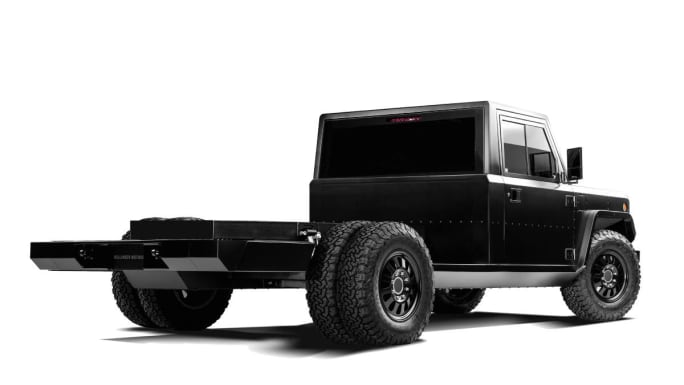
The electric Chass-E, a Class 3 electric “glider” platform that can be sold to other OEMs or to clients with highly specialized uses, such as airports that require luggage transporters. The final chassis product does not have a VIN number, so it is not classified as a truck.
The Class 3 category covers the 10,001 to 14,000 GVWR range and can carry 3,000 to 5,000 pounds, depending on the final weight of the specialized truck. It is most adaptable to extreme duty work trucks and durable consumer truck versions, including some in Class 4. In Class 4, the payload can increase up to 8,000 pounds.
Ad Loading...
Rear wheel drive electric vehicles can be rated for more power which makes them ideal for fleet loads. Most fleet vehicles do not need AWD and adjustable suspension, since RWD trucks provide a solid-rear axle that can hold more weight.
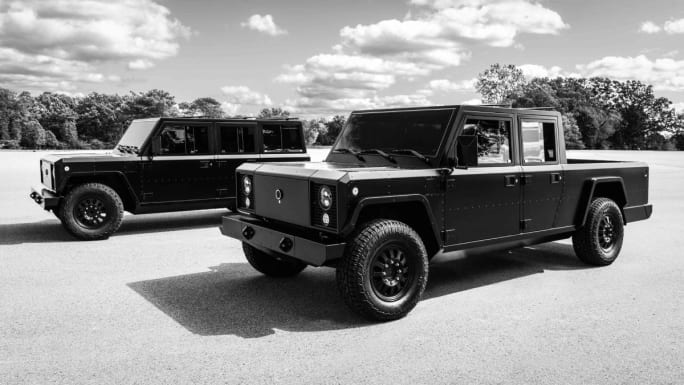
For the consumer retail market, Bollinger Motors is known for its flagship Bollinger B1 utility truck and B2 pickup truck models, which are both all-wheel drive, high-performance vehicles. They can sell commercially as well, such as for firefighting and mining fleets that must travel rough terrain.
Photo: Bollinger Motors
On the retail consumer front, Bollinger Motors is known for its Bollinger B1 utility truck and B2 pickup truck models, which are both all-wheel drive, high-performance vehicles, but can sell commercially as well. For example, the models are well-suited to firefighting and mining fleets that must travel rough terrain.
The company has letters of intent from fleets and pre-orders with deposits down from consumer customers. Bollinger Motors plans to begin producing its first wave of vehicles in late 2022 and into early 2023.
Robert Bollinger clarified his models are not competing in the last-mile delivery class of vehicles, where the market often just needs Class 2 and 2B vans. Instead, Bollinger Motors trucks are better suited for regional trucking, also known as depot-to-depot or depot-to-store delivery, which serves as the transportation link between last-mile home delivery and long-distance interstate trucking.
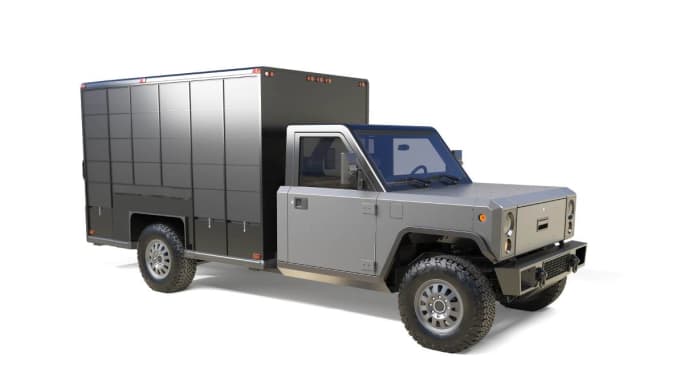
Some typical uses of the Chass-E Cab would be food and beverage transportation and deliveries, such as Red Bull delivering its drinks to a 7-Eleven convenience store, Bollinger explained. The cab truck can handle a refrigerated back-end box and still carry full payloads expected by fleet owners.
Ad Loading...
“It’s up to the client to figure out the size of the box,” Bollinger said. The company is talking with prospective upfitters about becoming preferred suppliers who would work with the outsourced Chass-E Cab to make the final truck.
FAST FACTS: Bollinger Motors
Type: Electric truck start-up
Founded: 2015
Location: Oak Park, MI
Owner and founder: Robert Bollinger
First vehicle production: 2022
Products:
Bollinger B1: Utility truck
Bollinger B2: Pickup truck
B2 Chass-E Cab: Class 3 Chassis Cab (upfitter and aftermarket ready)
The Chass-E Cab batteries can support a range of 200+ miles, and 70-100 miles under any load, weather, or roadway conditions. The 70–100-mile range is the duty cycle sweet-spot for delivery trucks, according to accumulated fleet usage data.
“Our battery packs are built more for power than for range,” Bollinger said. “What’s needed in commercial trucks is power to accommodate the stopping and acceleration needed to move heavy weights," he added. For the commercial side, Bollinger is developing 700-volt lithium-ion battery packs.
Bollinger vehicles use patented technology based on 12 different patents that are either granted or pending. Those include a pass-through from the passenger space into the frunk space that can store long objects and equipment. It also has patents pending for EV controls, battery packs, and structural high beams for cross vehicle strength, Bollinger said. The company also has bought some patents, including one for vehicle-to-vehicle charging.
Bollinger pointed out his vehicles are distinct from more conventional electric pickup trucks such as the Ford F150 Lightning, which ranks in a lower weight category and does not provide as much power and torque as the Bollinger vehicles.
Ad Loading...
Bollinger Motors so far has developed alpha and beta versions of its vehicles and platforms and plans to announce manufacturing, sales, and distribution partners in coming months. The company does not plan to build or acquire its own factory, opting instead to work through contracted manufacturing operations.
Focused Finances
Robert Bollinger has solely been financing the company up until last year when it started allowing funds from outside investors. There are no immediate plans to take the company public, and Bollinger says the company has enough funding for development and will be raising additional funds for production and sales.
As an EV entrepreneur, Bollinger has been closely watching the track records of successful companies like Tesla and troubled start-ups such as Lordstown Motors. His strategy is to avoid start-up pitfalls by being focused on a niche and not over-promising and over-extending.
“We’ve always been very clear about the way we operate, where we are, and what we are doing,” he said. “We make a low-volume niche product. A lot of companies say they are going to make a $30,000 EV with 200,000 of them at first, but how is that possible? We do not go down that path."
“We are very honest with ourselves and see no reason to pretend anything,” he added.
Ad Loading...
By aiming for smaller numbers and volume in a distinct targeted market, Bollinger Motors does need to acquire or build its own production plant at great expense, he said.
Bollinger chassis platforms can be adapted to an array of truck configurations and use cases, such as this beverage truck.
Photo: Bollinger Motors
“We’re going to a third party and trying to be as lean as possible. Our capital needs are lot less than other companies and we don’t need billions to get there.”
Bollinger Motors’ consumer vehicles will be priced in the low $100,000s because they will be low-volume, highly capable, quality models. Its commercial vehicle chassis will have lower complexity, shared components with the consumer ones, and greater economies of scale, Bollinger said.
That helps it get to a better price point for the commercial market. Priced around $70,000, the electric chassis models will be cheaper with stronger ROI over 10 years, he added.
Bollinger predicts his company will run financially like “a real business” with cash profits within one and a half years of first production.
Ad Loading...
Bollinger Motors will roll out the beta versions early next year so fleet operations can test them out. That will help the manufacturer continue to fine tune its final produced product. It does not have any production estimates yet to share publicly.
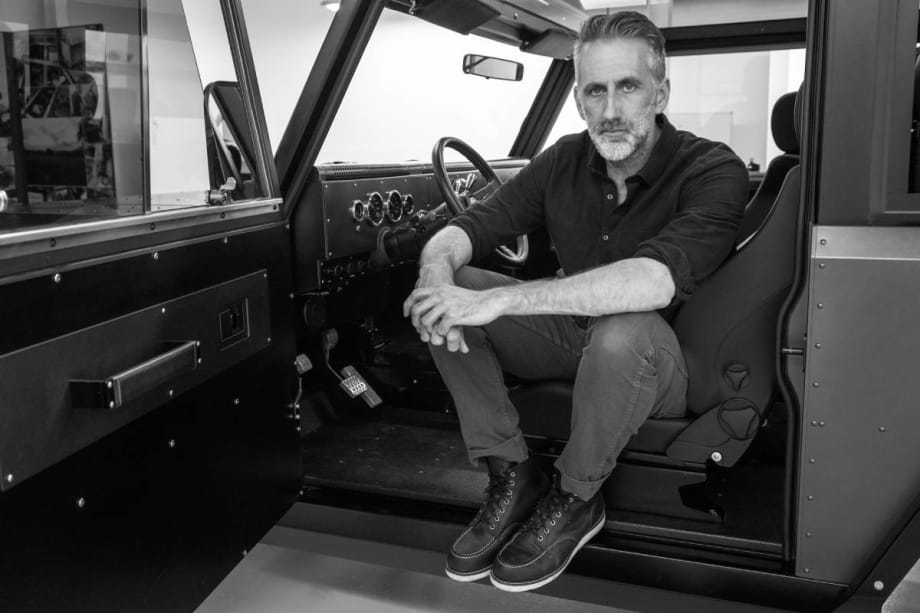
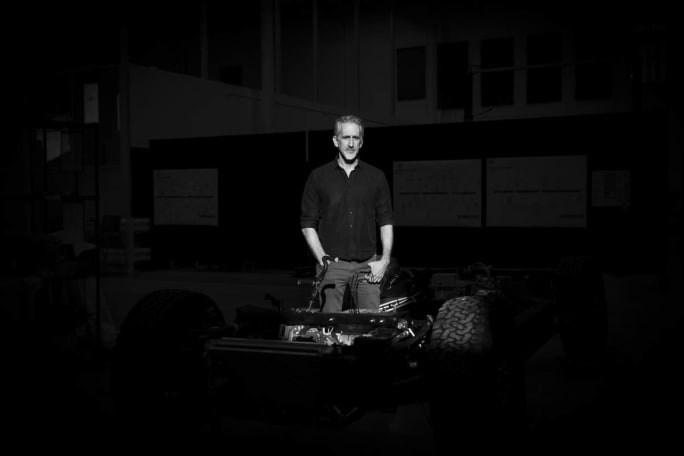
Robert Bollinger with the electric Chass-E, a Class 3 electric “glider” platform that can be sold to other OEMs or to clients with highly specialized uses, such as airports that require luggage transporters.
Photo: Bollinger Motors
Varied Career Informs EV Development
Robert Bollinger’s career background is about as bespoke as the vehicles his company will produce. The founding of Bollinger Motors in 2015 started the sequel to a lifelong passion that evolved from him drawing cars as a boy growing up. Bollinger attended Carnegie Mellon University where he learned how to become an industrial designer, a discipline that melded his creative bent for vehicle design with engineering.
At the time he graduated, the auto manufacturers he interviewed with were not that interested in hiring industrial designers, so he moved to New York City to launch an advertising and marketing career. He later helped a friend run a hair care company as COO and partner, and in 2013 the sale of the company provided the seed money for Bollinger to pursue his childhood dreams.
During his time in New York, Bollinger added a detour into agriculture. He bought a farm in 2010 in the Catskill Mountains of New York where he moved full-time to run the operation. He raised grass fed beef from 33 head of cattle and got used to two-to-three-foot snows in the winters. His rural vocation sparked the ideas that eventually fed Bollinger Motors.
“I had a pickup truck and was trying to plow,” he recalled. “All the weight is in front. I needed an all-purpose work-play truck with equal weight distribution and AWD for mud, snow, off-road travel, and farming.”
Ad Loading...
So, he took his earnings from the company sale, and started Bollinger Motors in an old diesel repair shop in the Catskills. After debuting the first prototype, the 2-door B1, he moved to the Detroit area to be near suppliers and engineers. He also derived start-up funds from the sale of Tesla stock shares he had invested in a few years before.
Despite fewer available options for electric motors and battery packs in 2015 compared to today, the team built its first truck and has worked through three levels of fully working prototypes and three generations of battery packs designed and made in house.
Bollinger sees a robust future EV market full of products and customer demand. “Every building has electricity coming into it. There’s electric in your house. Electric vehicles make sense on every level.”
New one-day registration gives fleet professionals the flexibility to attend Tuesday, Wednesday, or Thursday, with passes available for $199 through Sept. 18.
CALSTART has rebranded as Catalyst Mobility and will combine with Forth at the start of 2027. The new organization said it is poised to become one of the world's largest, strongest, and most impactful clean transportation nonprofits.
Together, the Port Authority of New York and New Jersey and CALSTART will electrify drayage and terminal operations serving the East Coast’s busiest container port. A pair of incentive programs totaling $45 million has launched to accelerate adoption of zero-emission drayage trucks and terminal tractors.
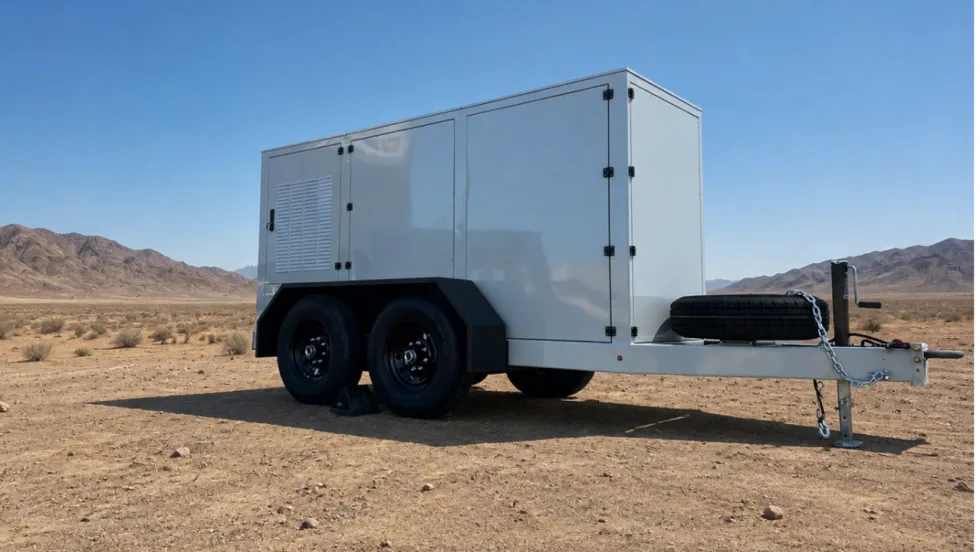
A single Xos Hub has surpassed one gigawatt-hour of energy across more than 33,600 charging sessions in the field, demonstrating performance that supports Xos' expansion across new products and markets.
Carrier Transicold’s first engineless multi-temperature TRU helps fresh- and frozen-food fleets add supplemental cold storage capacity during seasonal peaks.
Narro Trucks officially launched its operations on Aug. 20 and hosted a ride and drive to showcase its electric truck, which will be produced in Virginia.
Samsung SDI is taking full control of its Indiana battery plant with GM, marking a major shift from the EV-focused joint venture Charged Fleet first covered in 2023.
CALSTART will provide free technical assistance services to drayage fleets serving the Ports of Seattle and Tacoma and looking to transition to cleaner technologies and help decarbonize freight hubs.
Electric work truck upfits bring new compatibility questions. Learn how parts availability, OEM guidance, power demands, and route planning can affect fleet performance.
Peterbilt Motors Company’s cooperative purchasing agreement with Sourcewell and its Canadian partner, Canoe Procurement Group, now includes including Peterbilt's battery-electric vehicle lineup.