





Read More: 2023 Mazda CX-50 Aces Evaluations, Earns Top Safety Pick+
Two Mazda Cars Lead the Way in Small Car Side-Impact Safety
Seven out of 11 small cars scored good or acceptable ratings while four models were rated poor in the Insurance Institute for Highway Safety’s new side-impact test.
November 11, 2022
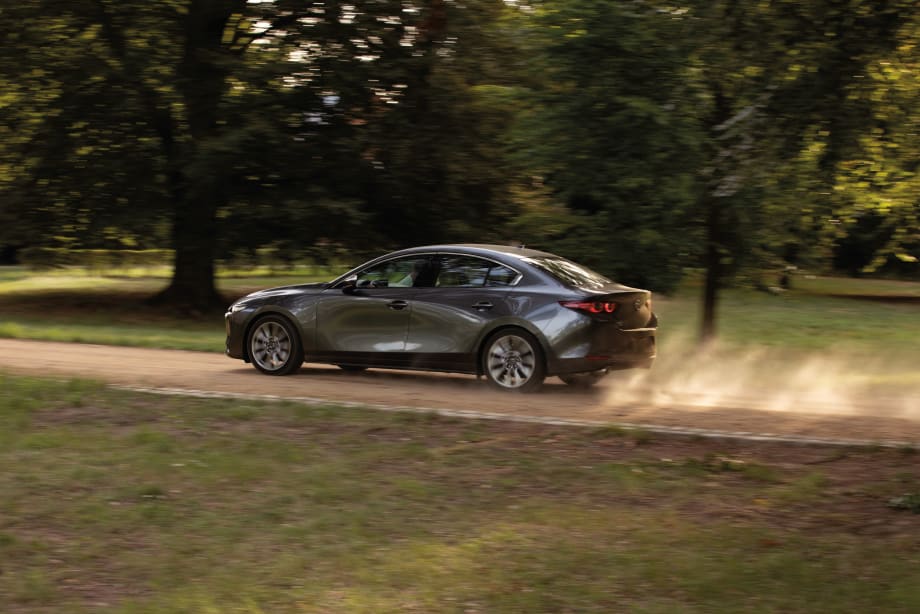
Two Mazda vehicles rolled away with the highest performance scores on a new, rigorous side-impact crash test from IIHS.
Photo: Mazda
3 min to read
Eleven small cars that scored good ratings in the Insurance Institute for Highway Safety’s (IIHS) original side crash test were just put through the paces of its new, more rigorous side-impact test, and the results were mixed. While seven out of 11 cars scored good or acceptable ratings, four models regressed to poor ratings.
Only two vehicles, both from Mazda — the Mazda 3 sedan and Mazda 3 hatchback — earned good ratings, achieving the highest performance of the bunch. Five others —the Nissan Sentra, Toyota Corolla sedan, Toyota Corolla hatchback, Honda Civic sedan, and Honda Civic hatchback — rolled away with acceptable ratings.
But the Kia Forte, Subaru Crosstrek, and the Subaru Impreza sedan and wagon did not withstand the demands of the new crashworthiness evaluation, and therefore, garnered poor ratings.
IHS developed the updated side crash test after research showed that many of the real-world side impacts that still account for nearly 25% of passenger vehicle occupant fatalities are more severe than the original evaluation.
The new side crash test uses a heavier barrier traveling at a higher speed to simulate the striking vehicle. The new barrier weighs 4,200 pounds — close to the weight of today’s midsize SUVs — and strikes the test vehicle at 37 mph, compared with a 3,300-pound barrier traveling at 31 mph in the original evaluation.
IIHS notes that the structure and safety cage of the good-rated Mazda 3 vehicles held up well in the new test. Moreover, the head-protecting airbags for both the driver and rear passenger prevented the dummies’ heads from hitting the hard surfaces of the vehicle interior. As a result, there was a low risk of most injury types. However, there was a moderate risk of injuries to the driver’s torso and pelvis.
The structure and safety cage also held up reasonably well in all five acceptable-rated vehicles, though the impact of the barrier caused a small amount of intrusion into the occupant compartment. In some of the five models, the head-protecting airbags also prevented the dummies’ heads from striking the hard surfaces of the door and windowsill. However, in the Sentra, the driver dummy's head moved downward past the side curtain airbag to hit the windowsill.
Unfortunately the dummies in the poor-rated vehicles showed far more potential for injury. For example, in the Forte, measurements taken from the driver dummy indicated a high risk of injuries to the torso and pelvis and a relatively high risk of a head or neck injury.
As for the Crosstrek — whose test also applies to the Impreza sedan and Impreza wagon — there was more substantial intrusion of the B-pillar and interior door panels into the occupant compartment, encroaching on the survival space and contributing to a relatively high risk of torso injuries for the driver and rear passenger.
Originally posted on Automotive Fleet
More Small Fleet


Developing Budget-Friendly Driver Safety Programs
From driver training and safety meetings to one-on-one coaching and incentive programs, several small fleets share how they have developed a safety culture with their drivers using low- to no-cost resources.
Read More →
Sponsored•March 9, 2026
Boosting Last-Mile Fleet Uptime, Safety, and Value with AI Vehicle Inspections
AI-powered inspections are transforming last-mile fleets by replacing manual checks with highly accurate automated scans that detect defects in seconds. By giving fleet operations visibility into the daily condition of their vehicles, you can identify trends over the vehicle’s lifecycle that enable improved procurement decisions, route management, driver training and accountability.
Read More →
Five Ways Seat Belts Help Prevent Injuries
There are five ways seat belts protect occupants from injuries, according to the Tennessee Department of Safety and Homeland Security.
Read More →
Sponsored•January 14, 2026
It’s here: The 2026 Fleet Technology Trends Report
What does AI mean for fleets? Get the answer — and learn other top tech trends.
Read More →
Small Fleets, Big Impact: How Independent Drivers Power Wreaths Across America
Check out how small fleets and independent drivers power Wreaths Across America each December and why their impact matters more than ever.
Read More →
VMS Survey Finds 65% of Small Fleet Managers Run Operations Alone
A new VMS survey shows small fleet managers are stretched thin, with most handling operations solo and eager to adopt digital tools for relief.
Read More →
Tips for Driving Safely on Halloween Night
This video features a reminder from the Connecticut Department of Transportation (DOT) and the Connecticut Police Chiefs Association, urging drivers to prioritize safety this Halloween.
Read More →
AI, Access, and Uptime: VMS’s Next Chapter with David Prusinski
VMS’s new Co-CEO, David Prusinski, shares how an AI-first approach will give small fleets and repair shops the tools to compete like big players.
Read More →
Fleet Managers Share Winter Prep Tips: It's Never Too Early!
Three fleets share best practices to prep vehicles for winter and prevent downtime when the cold sets in.
Read More →