





Related: Advanced Safety Tech Could Reduce Fatalities by 29%
Traffic Fatalities Now Eighth Global Death Cause
Road traffic deaths continue to rise globally, climbing to 1.35 million in 2016 and are now the leading cause of death eighth leading cause of death for people of all ages.
December 11, 2018
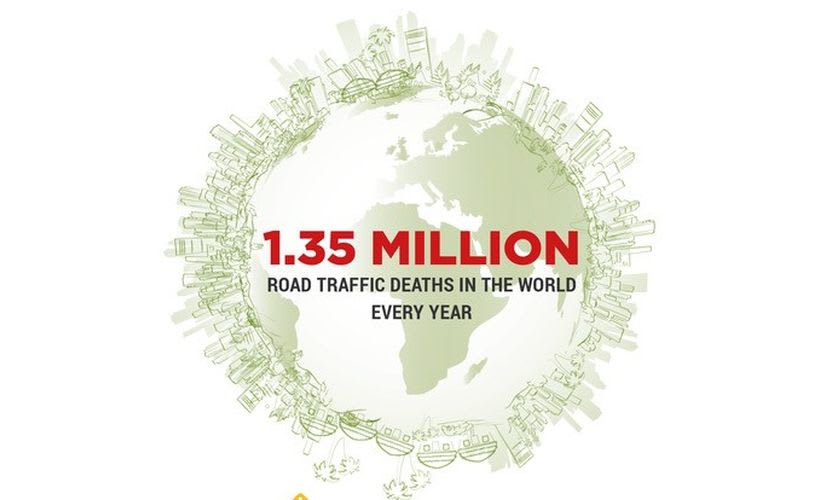
About 1.35 million people died in traffic accidents in 2016 around the globe.
Graphic courtesy of WHO.
2 min to read
Road traffic deaths continue to rise globally climbing to 1.35 million in 2016 and are now the eighth leading cause of death for people of all ages and the leading cause among children and young people ages 5-29, according to a new report by the World Health Organization (WGO).
On the upside, the report notes that legislative measures around issues like drinking and driving, speeding, and seat belt use have contributed to reductions in roadway fatalities in some 48 middle- and high-income countries.
However, not a single low-income country has experienced a reduction in lost lives—largely due to a lack of legislative safety measures.
The risk of road traffic fatalities changes depending on geographic location. For example, people in low-income countries face a three-time higher risk than those in high-income countries.
While the global rate of road traffic death is 18.2 per 100,000 population, there is significant variation across the world's regions. Africa has the highest fatality rate with 26.6 deaths per 100,000 people, followed by Southeast Asia with 20.7 lost lives.
Eastern Mediterranean and Western Pacific regions have rates comparable to the global rate, with 18 and 16.9 deaths per 100,000 people, respectively. The lowest fatality rates are in the Americas (15.6) and Europe (9.3).
The report emphasizes that in three of six regions — Americas, Europe and Western Pacific — fatality rates have steadily decreased since 2013.
According to the report, 54% of all road traffic fatalities are among vulnerable road users, that is, pedestrians, cyclists, and motorcyclists.
Globally, pedestrians and cyclists comprise 26% of all deaths, and another 28% are those using motorized two- and three-wheelers.
Car occupants make up the largest single group of deaths (29%) and the remaining 17% of fatalities are unidentified road users.
The report also evaluates which countries have implemented legislation to meet best practices on five key risk factors. The findings include:
46 countries representing 3 billion people have laws setting speed limits that align with best practice;
45 countries presently have drink-driving laws that support best practice;
49 countries currently have laws on motorcycle helmet use that align with best practice;
105 countries representing 5.3 billion people currently have laws on seat-belt use that align with best practice;
33 countries currently have laws on the use of child restraint systems that support best practice.
Originally posted on Automotive Fleet
More Small Fleet


Developing Budget-Friendly Driver Safety Programs
From driver training and safety meetings to one-on-one coaching and incentive programs, several small fleets share how they have developed a safety culture with their drivers using low- to no-cost resources.
Read More →
Sponsored•March 9, 2026
Boosting Last-Mile Fleet Uptime, Safety, and Value with AI Vehicle Inspections
AI-powered inspections are transforming last-mile fleets by replacing manual checks with highly accurate automated scans that detect defects in seconds. By giving fleet operations visibility into the daily condition of their vehicles, you can identify trends over the vehicle’s lifecycle that enable improved procurement decisions, route management, driver training and accountability.
Read More →
Five Ways Seat Belts Help Prevent Injuries
There are five ways seat belts protect occupants from injuries, according to the Tennessee Department of Safety and Homeland Security.
Read More →
Sponsored•January 14, 2026
It’s here: The 2026 Fleet Technology Trends Report
What does AI mean for fleets? Get the answer — and learn other top tech trends.
Read More →
Small Fleets, Big Impact: How Independent Drivers Power Wreaths Across America
Check out how small fleets and independent drivers power Wreaths Across America each December and why their impact matters more than ever.
Read More →
VMS Survey Finds 65% of Small Fleet Managers Run Operations Alone
A new VMS survey shows small fleet managers are stretched thin, with most handling operations solo and eager to adopt digital tools for relief.
Read More →
Tips for Driving Safely on Halloween Night
This video features a reminder from the Connecticut Department of Transportation (DOT) and the Connecticut Police Chiefs Association, urging drivers to prioritize safety this Halloween.
Read More →
AI, Access, and Uptime: VMS’s Next Chapter with David Prusinski
VMS’s new Co-CEO, David Prusinski, shares how an AI-first approach will give small fleets and repair shops the tools to compete like big players.
Read More →
Fleet Managers Share Winter Prep Tips: It's Never Too Early!
Three fleets share best practices to prep vehicles for winter and prevent downtime when the cold sets in.
Read More →