




Toyota, Feds Settle Unintended Acceleration Case for $1.2B
The U.S. Department of Justice agrees to defer prosecution and dismiss its case as long as Toyota complies with all agreement terms, which include submitting to an independent monitor.
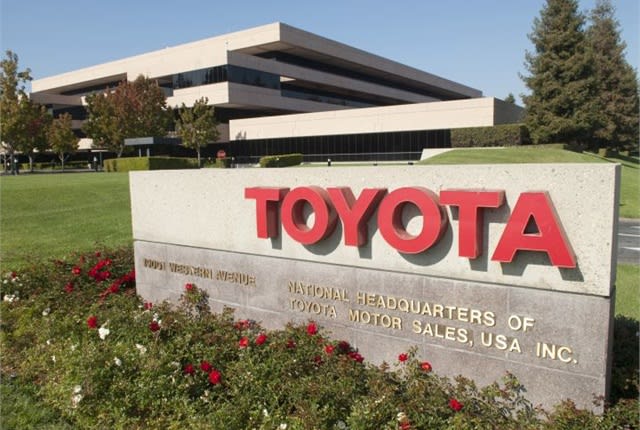
Photo courtesy of Toyota.
Photo courtesy of Toyota.
As part of a legal settlement with the U.S. Department of Justice, Toyota has agreed to pay a $1.2 billion penalty and acknowledge that in 2009 and 2010 the company misled the public and federal regulators about vehicles susceptible to "sticky pedal" — a problem in which accelerators get stuck in partially depressed levels — and floor mat entrapment.
In turn, the Department of Justice agreed to defer prosecution and dismiss its case against the automaker, as long as Toyota complies with terms of the agreement that include submitting to an independent monitor who will review the company's policies and procedures for safety communications, internal sharing of vehicle accident information, and preparation and sharing of certain technical reports.
"Rather than promptly disclosing and correcting safety issues about which they were aware, Toyota made misleading public statements to consumers and gave inaccurate facts to members of Congress," said Attorney General Eric Holder.
In 2009 and 2010, Toyota recalled millions of Toyota and Lexus vehicles to address claims of unintended acceleration. The federal probe focused on the company’s communications and decisions associated with those recalls.
"Under the terms of the criminal information filed today, Toyota will also be charged with wire fraud," Holder said in a press conference Wednesday morning. "The department will defer prosecution of Toyota for three years — provided that Toyota complies with the agreement in every respect and continues to fully cooperate with federal authorities."
The $1.2 billion penalty represents the largest fine imposed on an automaker.
"This is appropriate given the extent of the deception carried out by Toyota in this case," Holder said of the fine. "Put simply, Toyota's conduct was shameful. It showed a blatant disregard for systems and laws designed to look after the safety of consumers."
In a statement released by Toyota, Christopher P. Reynolds, chief legal officer for Toyota Motor North America, said the recalls and resultant investigation have led to fundamental changes within the company.
"We have made fundamental changes across our global operations to become a more responsive company – listening better to our customers' needs and proactively taking action to serve them," Reynolds said. "Specifically, we have taken a number of steps that have enabled us to enhance quality control, respond more quickly to customer concerns, strengthen regional autonomy and speed decision-making."
Toyota cited the following measures the company has taken since the recalls:
Launching rapid-response teams to investigate customer concerns quickly.
Committing $50 million in 2011 to launch Toyota's Collaborative Safety Research Center in Ann Arbor, Mich., to partner with more than 16 universities and institutions across North America on safety advances that will be shared to benefit the auto industry and society.
Expanding its network of field quality offices to improve customer responsiveness.
Enhancing regional autonomy, including naming the first American CEO of Toyota’s North American Region as well as chief quality officers for North America and other principal regions — all of whom have direct lines to President Akio Toyoda.
Improving its quality control process.
Extending the new vehicle development cycle by four weeks to help ensure reliability and safety.
With the settlement, Toyota hopes to take "a major step toward putting this unfortunate chapter behind us," Reynolds said.
Originally posted on Automotive Fleet
More Small Fleet


Developing Budget-Friendly Driver Safety Programs
From driver training and safety meetings to one-on-one coaching and incentive programs, several small fleets share how they have developed a safety culture with their drivers using low- to no-cost resources.
Read More →
Boosting Last-Mile Fleet Uptime, Safety, and Value with AI Vehicle Inspections
AI-powered inspections are transforming last-mile fleets by replacing manual checks with highly accurate automated scans that detect defects in seconds. By giving fleet operations visibility into the daily condition of their vehicles, you can identify trends over the vehicle’s lifecycle that enable improved procurement decisions, route management, driver training and accountability.
Read More →
Five Ways Seat Belts Help Prevent Injuries
There are five ways seat belts protect occupants from injuries, according to the Tennessee Department of Safety and Homeland Security.
Read More →
It’s here: The 2026 Fleet Technology Trends Report
What does AI mean for fleets? Get the answer — and learn other top tech trends.
Read More →
Small Fleets, Big Impact: How Independent Drivers Power Wreaths Across America
Check out how small fleets and independent drivers power Wreaths Across America each December and why their impact matters more than ever.
Read More →
VMS Survey Finds 65% of Small Fleet Managers Run Operations Alone
A new VMS survey shows small fleet managers are stretched thin, with most handling operations solo and eager to adopt digital tools for relief.
Read More →
Tips for Driving Safely on Halloween Night
This video features a reminder from the Connecticut Department of Transportation (DOT) and the Connecticut Police Chiefs Association, urging drivers to prioritize safety this Halloween.
Read More →
AI, Access, and Uptime: VMS’s Next Chapter with David Prusinski
VMS’s new Co-CEO, David Prusinski, shares how an AI-first approach will give small fleets and repair shops the tools to compete like big players.
Read More →
Fleet Managers Share Winter Prep Tips: It's Never Too Early!
Three fleets share best practices to prep vehicles for winter and prevent downtime when the cold sets in.
Read More →