




Toyota Details Plans for Next Generation Prius, Plug-In Prius, and Fuel Cell Vehicle
Between now and the end of 2015, Toyota plans to introduce 15 new or redesigned hybrid vehicles globally and its first commercially available hydrogen fuel cell vehicle.
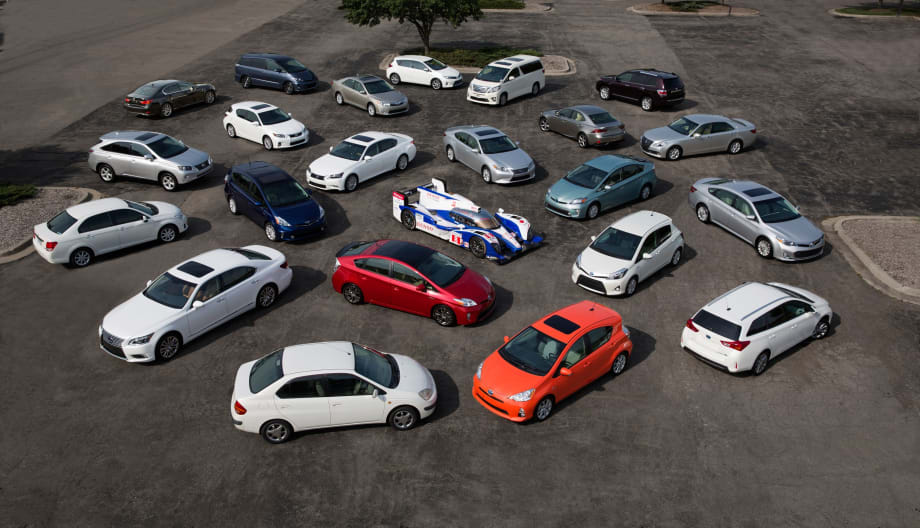
Toyota brought its hybrid vehicles from around the world to its Hybrid World Tour in Ypsilanti, Mich. Photo courtesy Toyota.
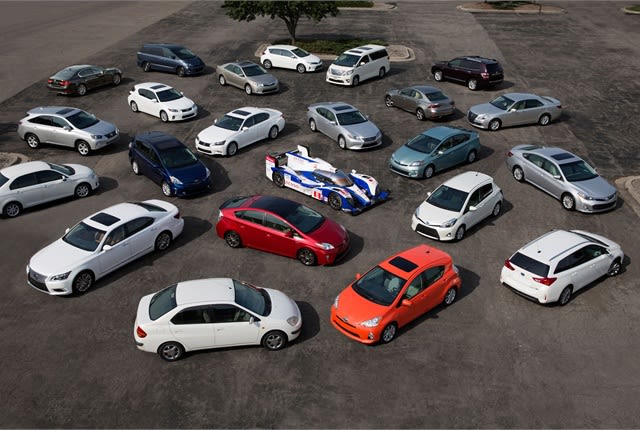
Toyota brought its hybrid vehicles from around the world to its Hybrid World Tour in Ypsilanti, Mich. Photo courtesy Toyota.
Between now and the end of 2015, Toyota plans to introduce 15 new or redesigned hybrid vehicles globally and its first commercially available hydrogen fuel cell vehicle.
Toyota executives gathered Wednesday, Aug. 28, 2013 at the Toyota 2013 Toyota Hybrid World Tour in Ypsilanti, Mich., to announce Toyota's alternative-fuel mobility strategy. They provided details on the next-generation Prius hybrid, the next-gen Prius Plug-In Hybrid (PHV), and Toyota's planned commercially available fuel cell vehicle.
Satoshi Ogiso, managing officer, Toyota Motor Corp., said the next-generation PHV is being developed in parallel with the standard Prius model. Looking to the future, Toyota plans to build hybrid powertrains with improved fuel economy in a more compact package that is lighter in weight and lower in cost. Between now and the end of 2015, Toyota plans to introduce 15 new or redesigned hybrid vehicles globally.
The next-generation Prius will utilize the automaker’s Toyota New Global Architecture (TNGA), which features a lower center of gravity and increased structural rigidity, according to the Ogiso. Toyota stated the new architecture will contribute to improved driving dynamics. Ogiso added that the next-gen Prius will feature improved aerodynamics, a roomier interior, and significant refinements in design, layout, and ease of operation.
Toyota is developing improved batteries with higher energy density for the next-generation Prius hybrid. Specifically, Toyota is researching and developing nickel-metal hydride and lithium-ion battery technologies for the vehicle and plans to use them “where appropriate,” Ogiso said. The automaker is also developing new battery technologies that use non-lithium chemistries, such as magnesium and other low-valence materials.
The Toyota Prius became the cornerstone of a broad range of Toyota vehicles with its "simple two motors, a planetary gear set, and its highly complicated software," Ogiso said. And, in its three generations, the Prius’ mpg has improved on average by about 10 percent, each generation.
Regarding the planned next-generation Prius PHV, Ogiso said the automaker is developing wireless vehicle charging technology to improve ease of use. The system uses inductive charging to produce resonance between an on-floor coil and a coil on the vehicle.
Toyota also provided new details on its first commercially available hydrogen fuel cell vehicle, which the company stated will go on sale in global markets in 2015. Toyota plans to show a new mid-size four-door sedan concept at the Tokyo Motor Show in November and then in North America at the 2014 Consumer Electronics Show in Las Vegas in January. Toyota's hydrogen fuel cell stack is currently developing 3 kw per liter of power density, Ogiso said. Toyota’s Bob Carter, senior vice president, automotive operations, Toyota Motor Corp., said that the hydrogen fuel cell will utilize core hybrid technology and will be a primary element of Toyota’s future mobility strategy.
With the total hybrid marketshare making up 4 percent of vehicle sales, according to Toyota, the company has successfully penetrated the market, having sold more than 5 million hybrids globally, according to Carter. And, Carter said the automaker’s goal is to sell 5 million more hybrids in the U.S. alone by 2016. He added that Toyota accounts for more than 60 percent of U.S. hybrid sales and 70 percent of the nearly 3 million hybrids on U.S. roads today.
Originally posted on Automotive Fleet
More Small Fleet


Developing Budget-Friendly Driver Safety Programs
From driver training and safety meetings to one-on-one coaching and incentive programs, several small fleets share how they have developed a safety culture with their drivers using low- to no-cost resources.
Read More →
Boosting Last-Mile Fleet Uptime, Safety, and Value with AI Vehicle Inspections
AI-powered inspections are transforming last-mile fleets by replacing manual checks with highly accurate automated scans that detect defects in seconds. By giving fleet operations visibility into the daily condition of their vehicles, you can identify trends over the vehicle’s lifecycle that enable improved procurement decisions, route management, driver training and accountability.
Read More →
Five Ways Seat Belts Help Prevent Injuries
There are five ways seat belts protect occupants from injuries, according to the Tennessee Department of Safety and Homeland Security.
Read More →
It’s here: The 2026 Fleet Technology Trends Report
What does AI mean for fleets? Get the answer — and learn other top tech trends.
Read More →
Small Fleets, Big Impact: How Independent Drivers Power Wreaths Across America
Check out how small fleets and independent drivers power Wreaths Across America each December and why their impact matters more than ever.
Read More →
VMS Survey Finds 65% of Small Fleet Managers Run Operations Alone
A new VMS survey shows small fleet managers are stretched thin, with most handling operations solo and eager to adopt digital tools for relief.
Read More →
Tips for Driving Safely on Halloween Night
This video features a reminder from the Connecticut Department of Transportation (DOT) and the Connecticut Police Chiefs Association, urging drivers to prioritize safety this Halloween.
Read More →
AI, Access, and Uptime: VMS’s Next Chapter with David Prusinski
VMS’s new Co-CEO, David Prusinski, shares how an AI-first approach will give small fleets and repair shops the tools to compete like big players.
Read More →
Fleet Managers Share Winter Prep Tips: It's Never Too Early!
Three fleets share best practices to prep vehicles for winter and prevent downtime when the cold sets in.
Read More →