




Related: GM Acquires Stake in Nikola, Will Produce Badger Pickup
Nikola Hits Back at Hindenburg Report
While Nikola says it has working prototypes of the Nikola Tre battery-electric semi, it doesn’t deny that an early prototype of its hydrogen-electric powered semi-truck was not driving under its own power in a 2017 video.
by Staff
September 14, 2020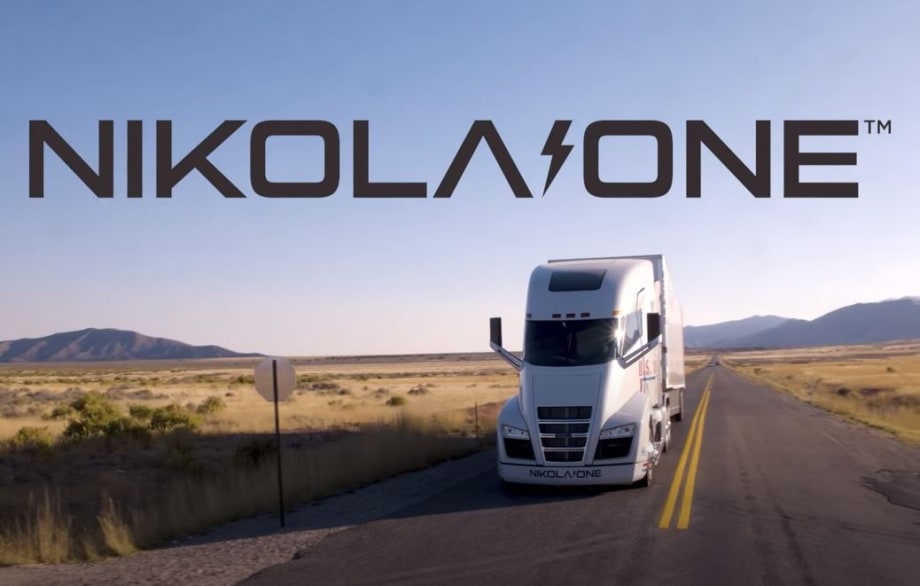
Nikola said at the time the video was made that investors “knew the technical capability of the Nikola One."
Screen grab via YouTube.
3 min to read
Nikola Corporation today issued a press statement commenting on a report published September 10 by Hindenburg Research, a short seller that accuses Nikola of fraud in its portrayal of its battery-electric and hydrogen fuel cell technology.
In the statement, Nikola asserted that the “opportunistic timing of the report” was designed to provide a false impression to investors and to “negatively manipulate the market to financially benefit short sellers, including Hindenburg itself.”
Nikola, which went public this June with a $26.3 billion evaluation, saw a more than 30% plunge in its stock price after the Hindenburg report. Nikola announced an agreement last week with General Motors in which GM will produce its Badger battery-electric pickup. Nikola said it is cooperating with the U.S. Securities and Exchange Commission (SEC) on these issues.
Regarding the specific Hindenburg accusations:
Nikola addressed development of the Nikola Tre battery-electric semi, created in collaboration with IVECO through a joint venture established in 2019 for the short-haul trucking sector.
The Hindenburg report cites a July 2020 podcast in which Nikola founder and CEO Trevor Milton said five of the trucks were “coming off the assembly line right now in Ulm Germany,” though a spokesperson for Bosch, the manufacturing partner building the trucks, confirmed this month that “they haven’t made any trucks yet,” according to Hindenburg.
Nikola said it still expects the Nikola Tre semi-truck to be ready for production and available to customers by the fourth quarter of 2021.
Bosch responded with a statement of its own: “Specific instances in the [Hindenburg] report quoting a Bosch employee were taken out of context” and “The employee spoke only about Bosch’s own plans for the IAA industry show and H2Haul project for the European Union.”
Nikola stated that the five trucks are currently being built and commissioned in Ulm, Germany, and are pre-production builds.

Photo courtesy of Nikola.
The Hindenburg report analyzes a video in which Milton claims that Nikola has developed proprietary inverter tech. The video shows an inverter with tape on it, which it claims hides the specs for an off-the-shelf inverter.
“At no time did Nikola state that the inverter on the prototype truck shown in the video was the Company’s or would be used in production,” Nikola responded.
“Nikola has been designing, engineering and working on its own inverters for quite some time. The Company does use third-party parts in prototype vehicles, some of which may be subsequently swapped out for its own parts in production. This is common practice among vehicle manufacturers and Nikola often blocks supplier names from the view of media and competitors.”
The Hindenburg report takes Nikola to task for overstating agreements with Anheuser Busch and Republic Services, when in fact those companies are not obligated to purchase any vehicles.
Nikola did not respond to the contracts themselves but stated that the Nikola Two hydrogen-electric powered semi-truck is expected to have a prototype delivered by the end of 2021 and a production version in the second half of 2023.
Nikola said the gearbox, batteries, inverters, suspension, brakes, steering, and other systems were all functional. However, Nikola said it decided to switch to development of Nikola Two, and that prototypes for the Two are self-propelled and have been “frequently demonstrated.”
Nikola does not dispute one of the report’s most explosive claims — that the Nikola One was in fact not driving under its own propulsion in the 2017 “Future of Transportation” video, filmed for a Phillips commercial.
Nikola said, “It was never described as ‘under its own propulsion’ or ‘powertrain driven.’”
Nikola said investors at the time “knew the technical capability of the Nikola One” at the time of their investment. “The fact is, Nikola has real working hydrogen fuel-cell powered semi-trucks,” according to the statement.
Originally posted on Automotive Fleet
More Green Fleet

Fleet Forward Conference Introduces One-Day Passes for 2026
New one-day registration gives fleet professionals the flexibility to attend Tuesday, Wednesday, or Thursday, with passes available for $199 through Sept. 18.
Read More →
CALSTART Rebrands as Catalyst Mobility, Will Combine with Forth in 2027
CALSTART has rebranded as Catalyst Mobility and will combine with Forth at the start of 2027. The new organization said it is poised to become one of the world's largest, strongest, and most impactful clean transportation nonprofits.
Read More →
Electric Truck and Charging Programs to Boost Sustainability at NY & NJ Ports
Together, the Port Authority of New York and New Jersey and CALSTART will electrify drayage and terminal operations serving the East Coast’s busiest container port. A pair of incentive programs totaling $45 million has launched to accelerate adoption of zero-emission drayage trucks and terminal tractors.
Read More →
Xos Hub Surpasses One Gigawatt-Hour of Energy Delivered in the Field
A single Xos Hub has surpassed one gigawatt-hour of energy across more than 33,600 charging sessions in the field, demonstrating performance that supports Xos' expansion across new products and markets.
Read More →
Carrier Transicold Launches All-Electric Vector 8200 TRU for Diesel-Free On-Site Cold Storage
Carrier Transicold’s first engineless multi-temperature TRU helps fresh- and frozen-food fleets add supplemental cold storage capacity during seasonal peaks.
Read More →
Narro Trucks Introduces Electric Utility Vehicle
Narro Trucks officially launched its operations on Aug. 20 and hosted a ride and drive to showcase its electric truck, which will be produced in Virginia.
Read More →
Samsung SDI Takes Full Control of GM Battery JV as Indiana Plant Pivots to Energy Storage
Samsung SDI is taking full control of its Indiana battery plant with GM, marking a major shift from the EV-focused joint venture Charged Fleet first covered in 2023.
Read More →
NWSA Taps CALSTART to Administer Zero-Emission Drayage Assistance Program
CALSTART will provide free technical assistance services to drayage fleets serving the Ports of Seattle and Tacoma and looking to transition to cleaner technologies and help decarbonize freight hubs.
Read More →
EV Fleet Reality Check: What Operators Wish They Knew Before Electrifying Their Work Vans
Electric work truck upfits bring new compatibility questions. Learn how parts availability, OEM guidance, power demands, and route planning can affect fleet performance.
Read More →
Peterbilt Expands Sourcewell Partnership with Electric Vehicle Lineup
Peterbilt Motors Company’s cooperative purchasing agreement with Sourcewell and its Canadian partner, Canoe Procurement Group, now includes including Peterbilt's battery-electric vehicle lineup.
Read More →