




Legal Hurdles of Self-Driving Cars Studied by NHTSA
A NHTSA report identifies instances where current federal safety standards might hinder future development and deployment of autonomous vehicles.
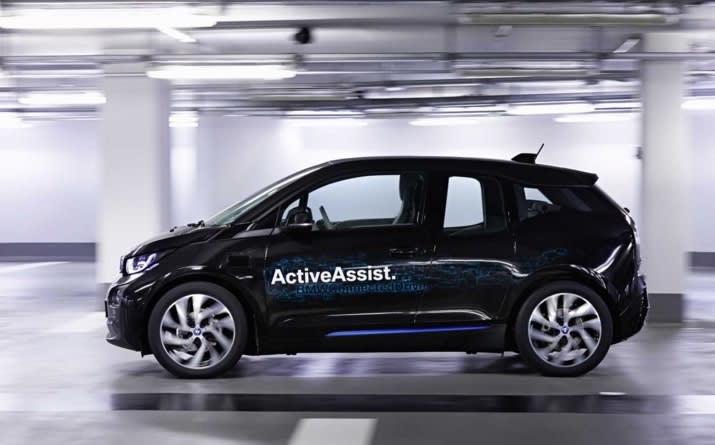
Photo of BMW i3 self-driving car courtesy of BMW.

Photo of BMW i3 self-driving car courtesy of BMW.
The National Highway Traffic Safety Administration has released a study aimed at identifying potential legal barriers that today’s federal vehicle safety standards might pose to the introduction of self-driving cars.
The report, prepared by the U.S. Department of Transportation’s Volpe National Transportation Systems Center, identifies key challenges to full deployment of autonomous vehicles as well as current safety standards requiring further review. The study stresses the need to develop standards that help ensure safe vehicle operation but don’t create hurdles that could stifle future innovation.
“Many standards, as currently written, are based on assumptions of conventional vehicle designs and thus pose challenges for certain design concepts, particularly for 'driverless' concepts where human occupants have no way of driving the vehicle,” the report noted. Examples include safety standards addressing steering wheels and brake pedals.
NHTSA will also hold a pair of public meetings this spring to gather input as the agency develops safety guidelines for autonomous vehicle technology. The first meeting will be held April 8 in Washington, D.C. The second meeting is set for California.
Federal regulators are well aware that self-driving vehicle developers are in need of operational guidance. The report notes that in the past NHTSA has released safety guideline interpretations to BMW of North America and Google in response to questions about specific requirements in the context of automated vehicles.
“We are witnessing a revolution in auto technology that has the potential to save thousands of lives,” said Transportation Secretary Anthony Foxx. “In order to achieve that potential, we need to establish guidelines for manufacturers that clearly outline how we expect automated vehicles to function — not only safely, but more safely — on our roads.”
These operational guidelines represent one of five NHTSA initiatives Foxx announced in January at the North American International Auto Show in Detroit. The other four are:
President Obama’s budget proposal for a 10-year, $3.9 billion investment in advancing autonomous vehicle technology, including large deployment pilots in communities around the country.
Working with states to develop model state policy.
Using NHTSA’s existing authority to interpret current regulations, and offer limited exemptions from those regulations, in pursuit of advances that could increase safety.
Determining what new regulatory tools and authorities might be required to meet NHTSA’s safety mission in an era of rapidly changing technology.
“The Volpe Center report is a great first look at the current standards, and it highlights the need for the actions Secretary Foxx outlined in January,” said NHTSA Administrator Mark Rosekind. “It also shows there are few current restrictions on some automated vehicle concepts, which highlights the need to establish clear expectations for their safe operation. At the same time, for other vehicle designs, the agency has more work to do to ensure the safety of new innovations, and we look forward to learning more from stakeholders as we start that work.”
Originally posted on Automotive Fleet
More Small Fleet


Developing Budget-Friendly Driver Safety Programs
From driver training and safety meetings to one-on-one coaching and incentive programs, several small fleets share how they have developed a safety culture with their drivers using low- to no-cost resources.
Read More →
Boosting Last-Mile Fleet Uptime, Safety, and Value with AI Vehicle Inspections
AI-powered inspections are transforming last-mile fleets by replacing manual checks with highly accurate automated scans that detect defects in seconds. By giving fleet operations visibility into the daily condition of their vehicles, you can identify trends over the vehicle’s lifecycle that enable improved procurement decisions, route management, driver training and accountability.
Read More →
Five Ways Seat Belts Help Prevent Injuries
There are five ways seat belts protect occupants from injuries, according to the Tennessee Department of Safety and Homeland Security.
Read More →
It’s here: The 2026 Fleet Technology Trends Report
What does AI mean for fleets? Get the answer — and learn other top tech trends.
Read More →
Small Fleets, Big Impact: How Independent Drivers Power Wreaths Across America
Check out how small fleets and independent drivers power Wreaths Across America each December and why their impact matters more than ever.
Read More →
VMS Survey Finds 65% of Small Fleet Managers Run Operations Alone
A new VMS survey shows small fleet managers are stretched thin, with most handling operations solo and eager to adopt digital tools for relief.
Read More →
Tips for Driving Safely on Halloween Night
This video features a reminder from the Connecticut Department of Transportation (DOT) and the Connecticut Police Chiefs Association, urging drivers to prioritize safety this Halloween.
Read More →
AI, Access, and Uptime: VMS’s Next Chapter with David Prusinski
VMS’s new Co-CEO, David Prusinski, shares how an AI-first approach will give small fleets and repair shops the tools to compete like big players.
Read More →
Fleet Managers Share Winter Prep Tips: It's Never Too Early!
Three fleets share best practices to prep vehicles for winter and prevent downtime when the cold sets in.
Read More →