




JD Power: Truck Owners Switching to Smaller Vehicles
Rising gas prices begin to sway new-vehicle owners toward smaller versions of trucks and utility vehicles.
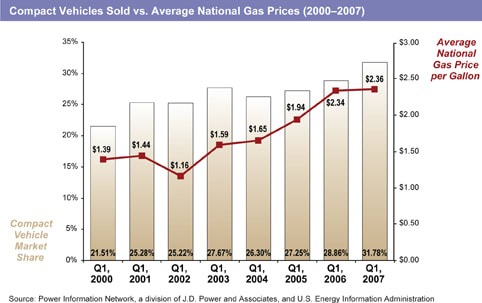
Rising gasoline prices have some owners of large and midsize trucks trading to smaller vehicles, according to real-time retail transaction data from the Power Information Network (PIN), a division of J.D. Power and Associates. Gasoline prices have surged more than 20 cents in recent weeks to a record nationwide average of $3.10 per gallon, surpassing the previous record of $3.07 per gallon set in September 2005, according to the U.S. Energy Information Administration. As gas prices rise, owner loyalty in the large pickup and midsize and large utility vehicle segments drops, according to PIN data gathered between February and April 2007. Owner loyalty is measured by the percent of owners in any given segment who trade for another vehicle in the same segment. “We’re seeing a broad, long-term—but gradual—movement to smaller vehicles,” says Tom Libby, senior director of industry analysis at PIN. “For example, during periods of high gas prices over the past two years, we’ve seen movement from larger to smaller SUVs. However, the total SUV pie remains largely intact.” While rising gas prices are having a negative effect on large vehicle segments, owner loyalty has increased for small cars. Additionally, sales of small vehicles, including cars and light trucks, as a percentage of total new-vehicle retail sales, have risen from 26.3 percent in the first quarter of 2004 to 31.8 percent in the first quarter of 2007. Furthermore, PIN data shows that higher gas prices have had only a moderate impact on repeat purchases of midsize crossovers. The fact that several new midsize crossovers have just entered the market likely has softened the impact of rising gas prices on the segment, Libby said. Not every new-vehicle segment has been affected by rising gas prices. For example, PIN findings show that owner loyalty for large and midsize cars, small crossovers and small SUVs has remained relatively unchanged in recent months. Libby notes that all of these trends are consistent with the patterns observed in spring 2006 when gas prices also rose. Increased demand for smaller vehicles, coupled with higher gas prices, has also given four-cylinder engines a boost in powertrain market share. Four-cylinder engines, as a percentage of total retail sales, have increased from 27.5 percent in April 2004 to 35.7 percent in April 2007. While vehicles powered by four-cylinder engines are receiving a lift from rising gas prices, so are new vehicles powered by hybrid-electric engines. Hybrid vehicle sales have shown a strong correlation to gas prices. For more than two years, hybrid sales have increased as gas prices have risen and have decreased as gas prices have fallen.
More Small Fleet


Developing Budget-Friendly Driver Safety Programs
From driver training and safety meetings to one-on-one coaching and incentive programs, several small fleets share how they have developed a safety culture with their drivers using low- to no-cost resources.
Read More →
Boosting Last-Mile Fleet Uptime, Safety, and Value with AI Vehicle Inspections
AI-powered inspections are transforming last-mile fleets by replacing manual checks with highly accurate automated scans that detect defects in seconds. By giving fleet operations visibility into the daily condition of their vehicles, you can identify trends over the vehicle’s lifecycle that enable improved procurement decisions, route management, driver training and accountability.
Read More →
Five Ways Seat Belts Help Prevent Injuries
There are five ways seat belts protect occupants from injuries, according to the Tennessee Department of Safety and Homeland Security.
Read More →
It’s here: The 2026 Fleet Technology Trends Report
What does AI mean for fleets? Get the answer — and learn other top tech trends.
Read More →
Small Fleets, Big Impact: How Independent Drivers Power Wreaths Across America
Check out how small fleets and independent drivers power Wreaths Across America each December and why their impact matters more than ever.
Read More →
VMS Survey Finds 65% of Small Fleet Managers Run Operations Alone
A new VMS survey shows small fleet managers are stretched thin, with most handling operations solo and eager to adopt digital tools for relief.
Read More →
Tips for Driving Safely on Halloween Night
This video features a reminder from the Connecticut Department of Transportation (DOT) and the Connecticut Police Chiefs Association, urging drivers to prioritize safety this Halloween.
Read More →
AI, Access, and Uptime: VMS’s Next Chapter with David Prusinski
VMS’s new Co-CEO, David Prusinski, shares how an AI-first approach will give small fleets and repair shops the tools to compete like big players.
Read More →
Fleet Managers Share Winter Prep Tips: It's Never Too Early!
Three fleets share best practices to prep vehicles for winter and prevent downtime when the cold sets in.
Read More →