





Read More: 5 Things to Know When Selecting Charging Solutions for Work Truck Fleets
International Consortium Rolls Out EV Battery Swapping Initiative in Tokyo
Mitsubishi Fuso and Mitsubishi Motors are providing battery-swappable commercial electric vehicles for a multi-year battery-swapping pilot in Tokyo.
June 10, 2025
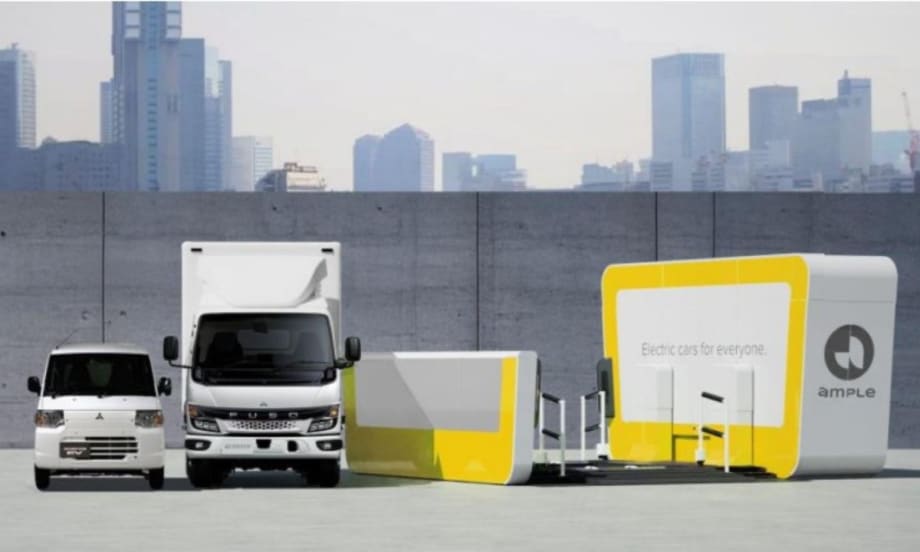
Mitsubishi Fuso and Mitsubishi Motors are providing battery-swappable commercial electric vehicles for a multi-year battery-swapping pilot in Tokyo.
Photo: Mitsubishi Fuso Truck and Bus Corporation
2 min to read
Mitsubishi Fuso Truck and Bus Corporation, Mitsubishi Motors Corporation, Ample Inc., and Yamato Transport Co., Ltd. announced a multi-year pilot program beginning September 2025 to deploy more than 150 battery-swappable commercial electric vehicles (EVs) and 14 modular battery swapping stations across Tokyo, Japan.
The Tokyo effort follows a smaller battery swapping pilot in Kyoto last year.
The project will deploy swappable EVs, including Mitsubishi Fuso’s eCanter light-duty truck and Mitsubishi Motors' Minicab EV to serve commercial delivery fleets. Yamato Transport, Japan’s largest shipping and logistics group and a leader in electrification, will be the initiative’s first major customer and will focus on last-mile applications.
The American battery swapping company Ample will provide battery swapping technology for the participating EV platforms and will install and operate swapping stations.
The project is supported by the Tokyo Metropolitan Environment Public Corporation through its "Technology Development Support Project for Promoting New Energy." The effort directly supports Japan’s ambitious economy-wide climate goal to cut greenhouse gas emissions by 46% from 2013 levels by 2030, achieving carbon neutrality by 2050.
The transportation sector accounted for roughly 19% of the country's total CO₂ emissions as of 2022, making commercial fleet electrification a strategic priority in Japan's decarbonization efforts.
A foundational goal of the effort is to minimize vehicle downtime during charging. The Tokyo consortium targets battery swapping times of just 5 minutes. Unlike conventional charging or refueling, battery swapping is fully automated—drivers never need to exit their vehicles.
Ample's compact, rapidly deployable stations provide a practical solution for high-utilization fleets in dense urban environments like Tokyo. Future deployments of swapping stations may also provide grid services, such as storing renewable energy, further strengthening their contribution to reducing greenhouse gas emissions.
The current initiative expands upon earlier collaboration between participants. Yamato Transport’s efforts to commercialize EV battery swapping for fleets stretch back as far as 2022.
Battery-Swapping Pilot in Kyoto
In 2024, Yamato Transport, MFTBC, and Ample ran a successful commercial delivery pilot alongside battery-swapping taxis in Kyoto. The demonstration validated the system’s operational benefits and the ability of Ample's platform to operate simultaneously across different vehicle types and brands.
The Tokyo effort not only increases operational scale but also expands the number of automotive participants to include Mitsubishi Motors, a pioneer in the commercial EV segment.
The partnership’s goal is to demonstrate how battery swapping can support the real-world demands of commercial EV operators and to establish a backbone for commercial battery swapping in Japan’s largest city. The project remains open to additional automakers, fleets, and logistics operators.
More Green Fleet

Fleet Forward Conference Introduces One-Day Passes for 2026
New one-day registration gives fleet professionals the flexibility to attend Tuesday, Wednesday, or Thursday, with passes available for $199 through Sept. 18.
Read More →
CALSTART Rebrands as Catalyst Mobility, Will Combine with Forth in 2027
CALSTART has rebranded as Catalyst Mobility and will combine with Forth at the start of 2027. The new organization said it is poised to become one of the world's largest, strongest, and most impactful clean transportation nonprofits.
Read More →
Electric Truck and Charging Programs to Boost Sustainability at NY & NJ Ports
Together, the Port Authority of New York and New Jersey and CALSTART will electrify drayage and terminal operations serving the East Coast’s busiest container port. A pair of incentive programs totaling $45 million has launched to accelerate adoption of zero-emission drayage trucks and terminal tractors.
Read More →
Xos Hub Surpasses One Gigawatt-Hour of Energy Delivered in the Field
A single Xos Hub has surpassed one gigawatt-hour of energy across more than 33,600 charging sessions in the field, demonstrating performance that supports Xos' expansion across new products and markets.
Read More →
Carrier Transicold Launches All-Electric Vector 8200 TRU for Diesel-Free On-Site Cold Storage
Carrier Transicold’s first engineless multi-temperature TRU helps fresh- and frozen-food fleets add supplemental cold storage capacity during seasonal peaks.
Read More →
Narro Trucks Introduces Electric Utility Vehicle
Narro Trucks officially launched its operations on Aug. 20 and hosted a ride and drive to showcase its electric truck, which will be produced in Virginia.
Read More →
Samsung SDI Takes Full Control of GM Battery JV as Indiana Plant Pivots to Energy Storage
Samsung SDI is taking full control of its Indiana battery plant with GM, marking a major shift from the EV-focused joint venture Charged Fleet first covered in 2023.
Read More →
NWSA Taps CALSTART to Administer Zero-Emission Drayage Assistance Program
CALSTART will provide free technical assistance services to drayage fleets serving the Ports of Seattle and Tacoma and looking to transition to cleaner technologies and help decarbonize freight hubs.
Read More →
EV Fleet Reality Check: What Operators Wish They Knew Before Electrifying Their Work Vans
Electric work truck upfits bring new compatibility questions. Learn how parts availability, OEM guidance, power demands, and route planning can affect fleet performance.
Read More →
Peterbilt Expands Sourcewell Partnership with Electric Vehicle Lineup
Peterbilt Motors Company’s cooperative purchasing agreement with Sourcewell and its Canadian partner, Canoe Procurement Group, now includes including Peterbilt's battery-electric vehicle lineup.
Read More →