




Related: Which EVs Have the Lowest Total Cost of Ownership for Fleets?
Hybrids Top List of Greenest Vehicles
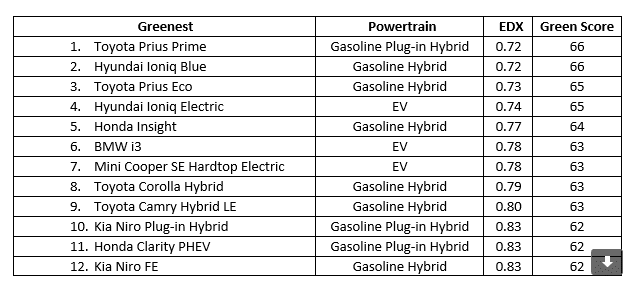
These high-scoring hybrids include the Toyota Prius Prime, three others by Toyota, four by Hyundai-Kia, and one by Honda.
by Staff
January 23, 2020
Photo via NoyaFields/Flickr.
4 min to read
After several years of all-electric cars dominating the annual Greenest vehicles list, 2020 brings a resurgence of the hybrid, whether plug-in or gasoline only. With slightly higher scores, hybrids account for nine of the 12 greenest vehicles in the 23rdGreenerCars’ ratings, released today by the American Council for an Energy-Efficient Economy.
These high-scoring hybrids include the Toyota Prius Prime, three others by Toyota, four by Hyundai-Kia, and one by Honda.
The auto industry, despite slowing sales, labor disputes, trade wars, and regulatory unrest, is producing more of the most technologically advanced and fuel efficient vehicles ever offered. This is great news for consumers, who continue to have plenty of options to buy a greener, more efficient vehicle.
While electric vehicles (EVs) get a lot of buzz, the top-scoring 2020 car reflects impressive improvements to the internal combustion engine that reduce tailpipe emissions and fuel consumption. Stronger tailpipe emission standards and lower emissions from the production and distribution of gasoline have also helped nudge hybrids to the top of the list.
Screenshot via ACEEE.
The 2020 Greenest List features the most environmentally friendly cars now available. Each car is given a Green Score based on an environmental damage index (EDX), which reflects the cost to human health from air pollution associated with vehicle manufacturing, the production and distribution of fuel or electricity, and vehicle tailpipes.
Scores for many battery or EVs dropped slightly from last year. For some, this is a result of an update to the GreenerCars scoring model that calculates emissions from manufacturing different types of battery chemistries. Others, including the Hyundai Ionic Electric and Kia Soul Electric, come with substantially larger batteries and a considerable boost in driving range for 2020 that increase emissions from manufacturing and recycling and also slightly increase per-mile energy consumption.
Still, the greenest list has become increasingly competitive over time. We score vehicles on an even playing field that uses average emissions across the country, but the emissions associated with a particular vehicle can depend on many factors. One of the most significant impacts for EVs is the fuel used to generate electricity where the vehicle is charged, both today and in the future. Our analysis uses US government projections, which include slower growth in renewable energy generation than many other forecasts. For those considering whether a particular EV would fare better for their particular area, check out the GreenerCars Electric Vehicle Emissions Calculator.
This marks the fifth consecutive year that the Greenest List contains no vehicle with solely an internal combustion engine. Even a small degree of electrification can greatly improve fuel economy and power, giving automakers an important tool to maintain the power that consumers expect, while allowing electric motors to help engines operate as efficiently as possible.
GreenerCars.org also identifies practical options in each class among widely available automatic transmission gasoline-powered models. The Greener Choices list includes conventional vehicles and traditional hybrids, but excludes plug-in hybrids and pure battery EVs given the limited availability of charging stations.
Screenshot via ACEEE.
Many of these vehicles return to the Greener Choices list from prior years, indicating both their popularity with consumers and the ability of the automaker to design and sell greener vehicles. While a number of models are hybrids, most are standard gasoline-fueled vehicles that achieve better fuel economy today compared to some hybrid options of just 10 years ago.
GreenerCars.org also provides a Meanest List, as usual made up of gasoline-powered large SUVs, pickup trucks, and European luxury cars that are the least friendly to the environment. The Jeep Grand Cherokee Trackhawk takes the first (or last) position for a second year, with the rest of the list populated by regulars from prior years.
Changes to this year’s methodology include updates to estimates of vehicle lifetime miles travelled for electric vehicles, emissions associated with the production of gasoline and diesel fuels, and refinements to estimates of emissions from the manufacturing and recycling of battery electric vehicles.
Green Scores of the 1,100-plus model year 2020 vehicles are available for free in the GreenerCars.org interactive database, along with each configuration’s fuel economy, health-related pollution impacts, and greenhouse gas emissions.
Originally posted on Automotive Fleet
More Small Fleet


Developing Budget-Friendly Driver Safety Programs
From driver training and safety meetings to one-on-one coaching and incentive programs, several small fleets share how they have developed a safety culture with their drivers using low- to no-cost resources.
Read More →
Sponsored•March 9, 2026
Boosting Last-Mile Fleet Uptime, Safety, and Value with AI Vehicle Inspections
AI-powered inspections are transforming last-mile fleets by replacing manual checks with highly accurate automated scans that detect defects in seconds. By giving fleet operations visibility into the daily condition of their vehicles, you can identify trends over the vehicle’s lifecycle that enable improved procurement decisions, route management, driver training and accountability.
Read More →

Five Ways Seat Belts Help Prevent Injuries
There are five ways seat belts protect occupants from injuries, according to the Tennessee Department of Safety and Homeland Security.
Read More →
Sponsored•January 19, 2026
Basic Tracking vs Next Generation Fleet Technology
Fleet software is getting more sophisticated and effective than ever, tying big data models together to transform maintenance, safety, and the value of your existing tech stack. Fleet technology upgrades are undoubtedly an investment, but updated technology can offer a much higher return. Read how upgrading your fleet technology can increase the return on your investment.
Read More →
Sponsored•January 14, 2026
It’s here: The 2026 Fleet Technology Trends Report
What does AI mean for fleets? Get the answer — and learn other top tech trends.
Read More →
Small Fleets, Big Impact: How Independent Drivers Power Wreaths Across America
Check out how small fleets and independent drivers power Wreaths Across America each December and why their impact matters more than ever.
Read More →
VMS Survey Finds 65% of Small Fleet Managers Run Operations Alone
A new VMS survey shows small fleet managers are stretched thin, with most handling operations solo and eager to adopt digital tools for relief.
Read More →
Tips for Driving Safely on Halloween Night
This video features a reminder from the Connecticut Department of Transportation (DOT) and the Connecticut Police Chiefs Association, urging drivers to prioritize safety this Halloween.
Read More →
AI, Access, and Uptime: VMS’s Next Chapter with David Prusinski
VMS’s new Co-CEO, David Prusinski, shares how an AI-first approach will give small fleets and repair shops the tools to compete like big players.
Read More →