




GM Expands Availability of Safety Alert Seat
The safety feature vibrates the driver’s seat cushion when a crash risk is detected.
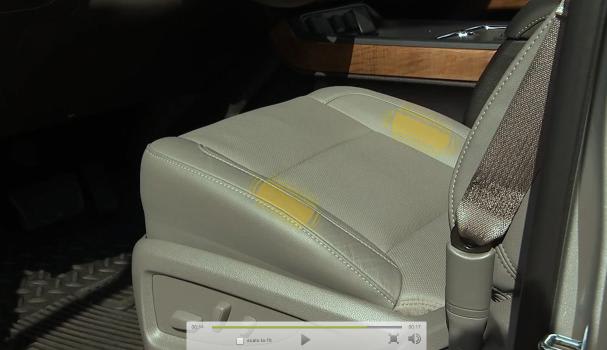
Chevrolet’s Safety Alert Seat uses haptics, a tactile feedback technology that re-creates the sense of touch by using left and/or right “tapping” vibration pulses to direct the driver to the location of a crash threat. Photo courtesy of General Motors.
In just two years, General Motors’ Safety Alert Seat has migrated from a luxury-exclusive feature to selected 2015 Chevrolet models – Silverado, Suburban and Tahoe.
The system works with other collision-avoidance warning technologies in the vehicle to vibrate the driver’s seat bottom cushion if a crash risk is detected.
Fans of the safety feature include Detroit-based investment adviser Angela Cusmano, who logs 25,000 miles a year driving to and from client meetings.
“I am a very safe driver, but there are times when I’ve misjudged how quickly I’m approaching the car ahead or I’ve begun to move a bit out of my lane, and that seat gets my attention,” explains Cusmano, managing partner of Dahring, Cusmano and Associates. “It is more subtle, and I love it.”
The Safety Alert Seat was designed to give drivers an alternative to auditory alerts such as beeps, as well as to give hearing-impaired drivers an opportunity to experience crash avoidance system alerts. About one in five Americans (48 million) suffers some degree of hearing loss, according to researchers from Johns Hopkins University.
Chevrolet’s Safety Alert Seat uses haptics, a tactile feedback technology that re-creates the sense of touch by using left and/or right “tapping” vibration pulses to direct the driver to the location of a crash threat. Similar technology is used in space and military applications.
“Using the tactile sense to communicate crash threat direction can help cut through the clutter of visual and auditory sensory information that drivers routinely experience,” said GM Active Safety Technical Fellow Raymond J. Kiefer.
The Safety Alert Seat, for example, works well in a vehicle equipped with a lane departure warning system. When the camera detects the vehicle is leaving a lane without an active turn signal in that direction, small motors generate a vibration pulse in the left or right seat bolster that directs the driver’s attention to the side of the lane encroachment.
Additionally, when a vehicle is equipped with forward collision alert technology and the system detects the driver may strike the vehicle ahead, both sides of the seat vibrate. Drivers always can select beeping alerts instead of seat vibrations.
“Safety technologies are only as effective as customers’ willingness and ability to use them,” said Kiefer. “If the Safety Alert Seat encourages our customers to receive crash-threat alerts or give hearing-impaired drivers an opportunity to experience such alerts, we think that’s good for them as well as other motorists.”
Originally posted on Automotive Fleet
More Small Fleet


Developing Budget-Friendly Driver Safety Programs
From driver training and safety meetings to one-on-one coaching and incentive programs, several small fleets share how they have developed a safety culture with their drivers using low- to no-cost resources.
Read More →
Boosting Last-Mile Fleet Uptime, Safety, and Value with AI Vehicle Inspections
AI-powered inspections are transforming last-mile fleets by replacing manual checks with highly accurate automated scans that detect defects in seconds. By giving fleet operations visibility into the daily condition of their vehicles, you can identify trends over the vehicle’s lifecycle that enable improved procurement decisions, route management, driver training and accountability.
Read More →
Five Ways Seat Belts Help Prevent Injuries
There are five ways seat belts protect occupants from injuries, according to the Tennessee Department of Safety and Homeland Security.
Read More →
It’s here: The 2026 Fleet Technology Trends Report
What does AI mean for fleets? Get the answer — and learn other top tech trends.
Read More →
Small Fleets, Big Impact: How Independent Drivers Power Wreaths Across America
Check out how small fleets and independent drivers power Wreaths Across America each December and why their impact matters more than ever.
Read More →
VMS Survey Finds 65% of Small Fleet Managers Run Operations Alone
A new VMS survey shows small fleet managers are stretched thin, with most handling operations solo and eager to adopt digital tools for relief.
Read More →
Tips for Driving Safely on Halloween Night
This video features a reminder from the Connecticut Department of Transportation (DOT) and the Connecticut Police Chiefs Association, urging drivers to prioritize safety this Halloween.
Read More →
AI, Access, and Uptime: VMS’s Next Chapter with David Prusinski
VMS’s new Co-CEO, David Prusinski, shares how an AI-first approach will give small fleets and repair shops the tools to compete like big players.
Read More →
Fleet Managers Share Winter Prep Tips: It's Never Too Early!
Three fleets share best practices to prep vehicles for winter and prevent downtime when the cold sets in.
Read More →