




Ford to Offer Hands-Free Driving on 2021 F-150, Mustang Mach-E
Ford’s BlueCruise system is an SAE Level 2 driver-assist technology similar to Tesla Autopilot. Yet unlike AutoPilot, Ford’s Hands-Free Mode does not require a driver’s hands to stay in contact with the steering wheel, unless prompted by vehicle alerts.

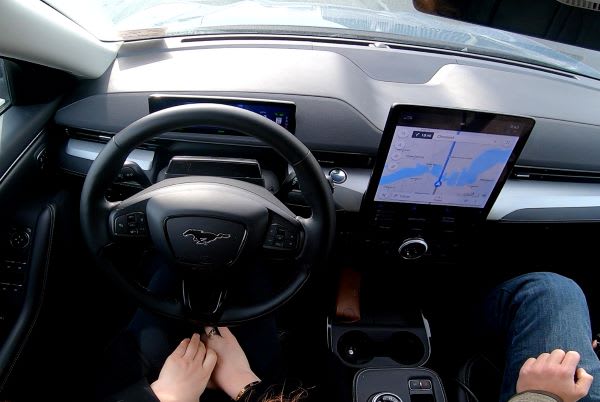
Ford is targeting to sell more than 100,000 vehicles equipped with BlueCruise in the first year.
Photo courtesy of Ford.
Ford will begin offering its new BlueCruise hands-free highway driving system, an SAE Level 2 driver-assist technology, to customers later this year.
The system will be offered via over-the-air software updates on 2021 F-150 and 2021 Mustang Mach-E models equipped with the available Ford Co-Pilot360 Active 2.0 Prep Package. Ford is targeting to sell more than 100,000 vehicles equipped with BlueCruise in the first year, the company said in a statement.
BlueCruise will launch after 500,000 miles of development testing, which included a journey completed by a fleet of 10 test vehicles — five F-150 pickups and five all-electric Mustang Mach-E SUVs — over more than 110,000 miles through 37 states and five Canadian provinces.
Ford is calling BlueCruise “the evolution of Ford Co-Pilot360 Technology.” The BlueCruise feature allows a driver to operate hands-free on prequalified sections of divided highways. The system uses camera and radar-sensing technologies in conjunction with Co-Pilot360’s Intelligent Adaptive Cruise Control with Stop-and-Go, Lane Centering and Speed Sign Recognition.
According to Ford, BlueCruise is similar to Tesla Autopilot. Yet unlike AutoPilot, Ford’s Hands-Free Mode does not require a driver’s hands to stay in contact with the steering wheel, unless prompted by vehicle alerts.
BlueCruise uses blue lighting on the digital instrument cluster to indicate when the vehicle is in a hands-free zone. A driver-facing camera in the instrument cluster monitors eye gaze and head position to help ensure the driver’s eyes remain on the road.
Those prequalified highway stretches are called Hands-Free Blue Zones. Ford’s GPS mapping system has identified Hands-Free Blue Zones in over 100,000 miles of highways across North America.
In addition to hands-free mode, equipped vehicles will also feature Lane Centering mode. Lane Centering works on most roads with lane lines and can help keep the vehicle centered in its lane. The function still requires drivers to keep their hands on the steering wheel.
In either mode, a visual prompt on the instrument cluster notifies drivers when they need to return their attention to the road or resume control of the vehicle.
Ford said more models will receive BlueCruise hands-free driving technology, while current owners will continue to receive over-the-air software updates.
Ford plans to include Lane Change Assist to let the vehicle change lanes with a tap of the turn signal indicator, and Predictive Speed Assist that will adjust vehicle speed for road curves, roundabouts, and more.
Originally posted on Automotive Fleet
More Small Fleet


Developing Budget-Friendly Driver Safety Programs
From driver training and safety meetings to one-on-one coaching and incentive programs, several small fleets share how they have developed a safety culture with their drivers using low- to no-cost resources.
Read More →
Boosting Last-Mile Fleet Uptime, Safety, and Value with AI Vehicle Inspections
AI-powered inspections are transforming last-mile fleets by replacing manual checks with highly accurate automated scans that detect defects in seconds. By giving fleet operations visibility into the daily condition of their vehicles, you can identify trends over the vehicle’s lifecycle that enable improved procurement decisions, route management, driver training and accountability.
Read More →
Five Ways Seat Belts Help Prevent Injuries
There are five ways seat belts protect occupants from injuries, according to the Tennessee Department of Safety and Homeland Security.
Read More →
It’s here: The 2026 Fleet Technology Trends Report
What does AI mean for fleets? Get the answer — and learn other top tech trends.
Read More →
Small Fleets, Big Impact: How Independent Drivers Power Wreaths Across America
Check out how small fleets and independent drivers power Wreaths Across America each December and why their impact matters more than ever.
Read More →
VMS Survey Finds 65% of Small Fleet Managers Run Operations Alone
A new VMS survey shows small fleet managers are stretched thin, with most handling operations solo and eager to adopt digital tools for relief.
Read More →
Tips for Driving Safely on Halloween Night
This video features a reminder from the Connecticut Department of Transportation (DOT) and the Connecticut Police Chiefs Association, urging drivers to prioritize safety this Halloween.
Read More →
AI, Access, and Uptime: VMS’s Next Chapter with David Prusinski
VMS’s new Co-CEO, David Prusinski, shares how an AI-first approach will give small fleets and repair shops the tools to compete like big players.
Read More →
Fleet Managers Share Winter Prep Tips: It's Never Too Early!
Three fleets share best practices to prep vehicles for winter and prevent downtime when the cold sets in.
Read More →