




Cargo Theft Losses Surged to an Estimated $725 Million in 2025
According to Verisk CargoNet, cargo theft volume held steady in 2025, but thieves shifted to higher-value freight and new geographies, pushing total losses to nearly $725 million, a 60% increase.

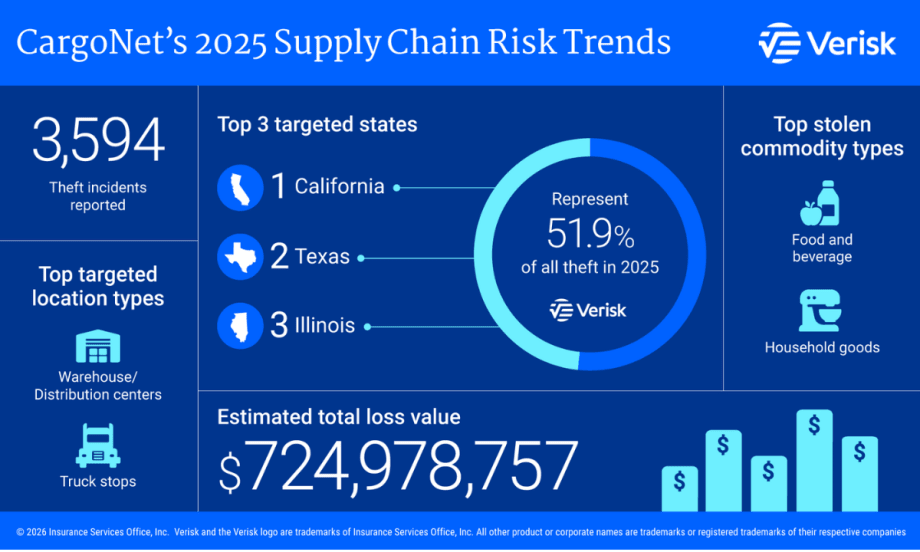
Verisk CargoNet’s annual analysis found that the average value per cargo theft rose in 2025 to $273,990, up 36% from $202,364 in 2024.
Credit: Verisk CargoNet
Verisk CargoNet reported that while the total number of supply chain crime incidents remained relatively stable in 2025, estimated losses surged to nearly $725 million, a 60% increase from 2024, as organized criminal groups increasingly focused on high-value shipments.
According to CargoNet’s annual analysis, the average value per theft rose to $273,990, up 36% from $202,364 in 2024.
CargoNet recorded 3,594 supply chain crime events across the United States and Canada in 2025, essentially unchanged from the 3,607 events reported in 2024. However, incidents involving confirmed cargo theft rose sharply, increasing 18% year-over-year from 2,243 to 2,646.
Key takeaways from the CargoNet analysis include:
Estimated losses surged 60% to nearly $725 million, while confirmed cargo theft incidents increased 18%.
Average theft value rose 36% to $273,990, driven by more selective, high-value targeting by organized groups.
Theft activity dispersed geographically, with major increases in New Jersey (+50%), Indiana (+30%), and Pennsylvania (+24%).
Food and beverage theft spiked 47%, and metals theft climbed 77%, fueled largely by demand for copper products.
Enterprise computing hardware and cryptocurrency mining equipment emerged as top tier targets for organized criminal groups.
Theft Expanded Past Hot Spots
Geographically, theft activity continued to expand beyond traditional hotspots.
California remained the most impacted state with 1,218 incidents, but activity shifted away from Los Angeles County (down 11%) toward historically lower-risk regions such as Kern County (up 82%) and San Joaquin County (up 44%).
Several other states saw significant cargo theft increases, including New Jersey (up 50%), Indiana (up 30%), and Pennsylvania (up 24%).
Targeted Commodities Shift
Shifts in targeted commodities were also notable. Food and beverage products experienced the largest increase, with 708 thefts, a 47% jump from 2024.
Meat and seafood products and tree nuts were particularly affected by cargo theft, with trends varying by region. Meat and seafood were heavily targeted in the Northeast, especially New Jersey, while tree nut thefts were more common on the West Coast. Metal theft rose 77%, driven by ongoing demand for copper products.
Consumer Electronics Theft
Meanwhile, theft of consumer-grade electronics such as televisions and personal computers declined. In contrast, criminals increasingly targeted enterprise computer components and cryptocurrency mining hardware. Vehicle-related products including tires, auto parts, and motor oils, also remained attractive, with a notable focus on engines and components bound for domestic vehicle assembly plants.
“Criminal enterprises are becoming more selective and sophisticated, targeting extremely high-value shipments rather than relying on opportunistic theft,” said Keith Lewis, vice president of operations at Verisk CargoNet. “This strategic shift explains how losses can rise 60% even as overall incident volume holds steady.”
2026 Theft Risk Outlook
CargoNet expects continued targeting of high-value technology products in 2026, particularly RAM modules, storage drives, and enterprise computing equipment.
Theft by deception groups are anticipated to increase their focus on misdirecting shipments tendered to legitimate carriers, sidestepping compliance controls that have traditionally centered on the tendering process itself.
Nondomiciled CDL Enforcement
CargoNet is also monitoring national developments concerning nondomiciled CDL enforcement.
Many complex cargo theft schemes rely on acquiring existing motor carriers with strong load histories. Increased enforcement may reduce available capacity and expand the pool of carriers for sale, potentially creating new opportunities for criminal enterprises to establish fraudulent operations.
Methodology of the Analysis
All comparisons use CargoNet’s delayed reporting adjustment: 2025 data updated through Jan. 12, 2026, compared with 2024 data updated through Jan. 12, 2025.
More Operations

Family Ties Inside the Fleet Families Building Careers Across Generations
Three fleet families share what it really takes to work together, learn across generations, and keep business from following them home.
Read More →
Shades of Fleet Call for Voices: Fleet's Hidden Heroes
Fleet’s hidden heroes are often the ones keeping everything moving behind the scenes. September’s Shades of Fleet is looking for dispatchers, coordinators, parts specialists, and other support pros to share their stories.
Read More →
Truck Centers, Inc. Celebrates National Truck Driver Appreciation Week with $1,000 Fuel Card Giveaways
During National Truck Driver Appreciation Week, Truck Centers, Inc. is offering customers a chance to fuel up for free. Customers at all Truck Centers locations can enter to win one of four $1,000 fuel cards from Sept. 14 - 18.
Read More →From Our Partners



Fleet Guides, AI Time-Savers, Truck Tariffs & Fuel Strategy Lead the News
This week’s Truck Chat Cheat Sheet covers new fleet vehicle guides, practical AI use cases, U.S.-Canada truck production, mixed-energy strategy, and more.
Read More →
What Fleet Employers Are Missing When Hiring Veterans
What if some of the strongest candidates for fleet are already out there, but their experience is written in a language our industry does not always recognize?
Read More →
Automotive Fleet Opens 2026 Personal Use Survey for Commercial Fleet Managers
Less than two weeks left! Commercial and corporate fleet managers are invited to share how their organizations handle company vehicle personal-use policies, charges, and driver eligibility.
Read More →
What Resilient Fleets Do Differently When Conditions Change
Fleet resilience is about more than reacting to disruption. Lauren Fletcher talks with AP Fleet’s Alex Coveney about flexibility, planning, scaling, and what helps fleets adapt when business conditions shift.
Read More →
If We Want the Next Generation in Automotive, We Have to Give Them a Reason to Care
The automotive industry talks constantly about its workforce shortage. But before we can recruit the next generation, we may need to do a better job giving kids a reason to care about automotive in the first place.
Read More →
Ram ProMaster City Under $40K, Truck Tariffs, and AI Maintenance Lead the News
A sub-$40K commercial van, tariff questions, AI-powered maintenance, and a new EV production strategy headline this week’s Truck Chat Cheat Sheet.
Read More →
Bob Adamsky Shares the Fleet Lessons You Usually Learn the Hard Way
After more than 30 years in fleet, Arrow International’s Bob Adamsky has learned that the job is about far more than vehicles. He shares the lessons he wishes every fleet manager could learn a little earlier.
Read More →