




Analyzing President Obama’s Highway Plan
A “Budget Highlights” document issued by the U.S. Department of Transportation details how the $478 billion apportioned for spending on surface-transportation infrastructure over the next six years would be put to work.
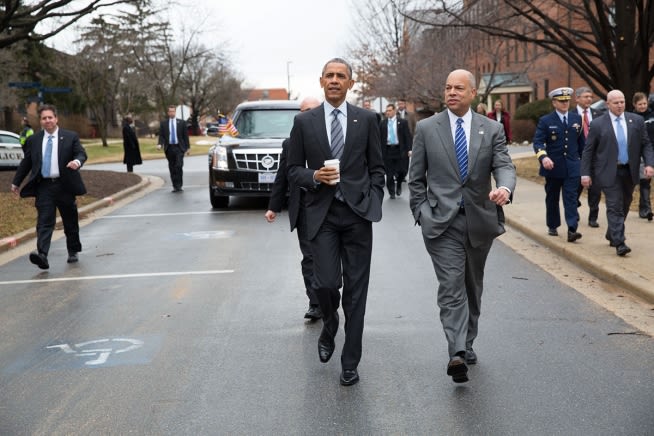
Official White House Photo by Pete Souza.
Official White House Photo by Pete Souza.
A “Budget Highlights” document issued by the U.S. Department of Transportation details how the $478 billion apportioned for spending on surface-transportation infrastructure over the next six years would be put to work — should Congress ultimately sign off on that part of President Obama’s historically gargantuan $4 trillion budget proposal.
The roads-and-bridges reauthorization package will be sent to Capitol Hill “within the coming weeks,” said DOT, as a “resubmission” of the Generating Renewal, Opportunity, and Work with Accelerated Mobility, Efficiency, and Rebuilding of Infrastructure and Communities throughout America (GROW AMERICA) Act that the President originally submitted to Congress last year.
The revamped GROW AMERICA Act calls for spending, again, over a period of six years, in this manner:
$317 billion to improve the nation’s highway system, an amount that DOT said will increase highway funds by an average of nearly 29% above FY 2015 enacted levels, while "emphasizing policies and reforms that prioritize investments for much-needed repairs and improvements."
Nearly $115 billion to enhance transit systems, which would up average transit spending by nearly 76% above FY 2015 enacted levels. This funding would be aimed at projects involving light rail, street car, and bus rapid transit systems
$28.6 billion to fund the development of "high-performance rail and other passenger rail programs as part of an integrated national transportation strategy"
$7.5 billion to "more than double the size of the highly successful" TIGER discretionary grant program that enables DOT “to invest in road, rail, transit and port projects that promise to achieve critical national objectives”
$6 billion to expand financing options under the Transportation Infrastructure Finance and Innovation Act (TIFIA), which DOT noted "leverages Federal dollars by facilitating private participation in transportation projects and encouraging innovative financing mechanisms that help advance projects more quickly"
$18 billion to develop a multi-modal freight program that would "give freight stakeholders a meaningful seat at the table in selecting funded projects" through "better coordination of planning among the Federal Government, States, ports, and local communities to improve decision-making"
$935 million for investing in future vehicle and safety technology, "including the advancement of vehicle automation and vehicle-to-vehicle technologies"
$7.35 billion to improve safety on local rural roads as part of the Critical Immediate Safety Investments Program; per DOT, this funding "will help States improve safety on non-State owned roads that do not often benefit from Federal funding"
$16 billion for the existing Highway Safety Improvement Program, "to save lives and prevent serious injuries for all road users, including pedestrians and bicyclists"
Nearly $6 billion to increase the National Highway Traffic Safety Administration's capability "to ensure that vehicles on the road meet the highest safety standards and that the agency has the personnel and tools to identify vehicle defects early and respond quickly."
Originally posted on Automotive Fleet
More Operations
Family Ties Inside the Fleet Families Building Careers Across Generations
Three fleet families share what it really takes to work together, learn across generations, and keep business from following them home.
Read More →
Shades of Fleet Call for Voices: Fleet's Hidden Heroes
Fleet’s hidden heroes are often the ones keeping everything moving behind the scenes. September’s Shades of Fleet is looking for dispatchers, coordinators, parts specialists, and other support pros to share their stories.
Read More →
Truck Centers, Inc. Celebrates National Truck Driver Appreciation Week with $1,000 Fuel Card Giveaways
During National Truck Driver Appreciation Week, Truck Centers, Inc. is offering customers a chance to fuel up for free. Customers at all Truck Centers locations can enter to win one of four $1,000 fuel cards from Sept. 14 - 18.
Read More →
Fleet Guides, AI Time-Savers, Truck Tariffs & Fuel Strategy Lead the News
This week’s Truck Chat Cheat Sheet covers new fleet vehicle guides, practical AI use cases, U.S.-Canada truck production, mixed-energy strategy, and more.
Read More →
What Fleet Employers Are Missing When Hiring Veterans
What if some of the strongest candidates for fleet are already out there, but their experience is written in a language our industry does not always recognize?
Read More →
Automotive Fleet Opens 2026 Personal Use Survey for Commercial Fleet Managers
Less than two weeks left! Commercial and corporate fleet managers are invited to share how their organizations handle company vehicle personal-use policies, charges, and driver eligibility.
Read More →
What Resilient Fleets Do Differently When Conditions Change
Fleet resilience is about more than reacting to disruption. Lauren Fletcher talks with AP Fleet’s Alex Coveney about flexibility, planning, scaling, and what helps fleets adapt when business conditions shift.
Read More →
If We Want the Next Generation in Automotive, We Have to Give Them a Reason to Care
The automotive industry talks constantly about its workforce shortage. But before we can recruit the next generation, we may need to do a better job giving kids a reason to care about automotive in the first place.
Read More →
Ram ProMaster City Under $40K, Truck Tariffs, and AI Maintenance Lead the News
A sub-$40K commercial van, tariff questions, AI-powered maintenance, and a new EV production strategy headline this week’s Truck Chat Cheat Sheet.
Read More →
Bob Adamsky Shares the Fleet Lessons You Usually Learn the Hard Way
After more than 30 years in fleet, Arrow International’s Bob Adamsky has learned that the job is about far more than vehicles. He shares the lessons he wishes every fleet manager could learn a little earlier.
Read More →