




Achates Opposed-Piston Engine Targets 37 MPG for Pickups
The 2.7L demonstration engine will be integrated into a drivable prototype in 2018 and development engines will also be available for automakers.
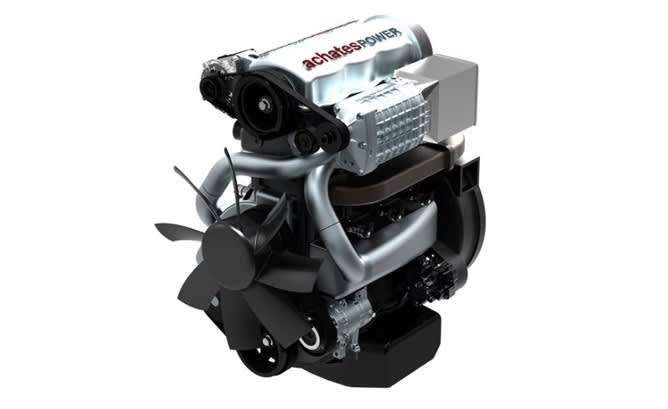
Photo courtesy of Achates.
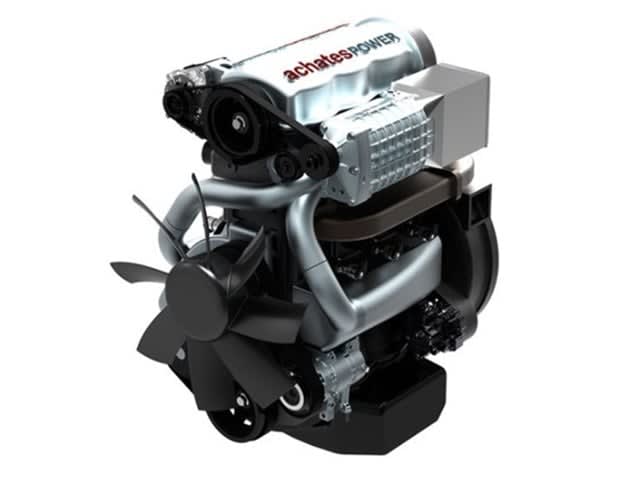
Photo courtesy of Achates.
Achates Power, Inc. has developed an engine for a light-duty truck demonstration vehicle that will surpass corporate average fuel economy regulations in 2025. The opposed-piston engine, will be from 30% to 50% more efficient than comparable engines, reduce emissions, and cost less than alternative technologies under development for meeting the standard.
The new Achates Power 2.7L opposed-piston engine will achieve 270 hp at 37 mpg, above the 2025 requirement of 33 mpg for a full-size, light-duty pickup truck (65 to 70 square feet). The demonstration engine will be integrated into a drivable prototype in 2018. Development engines will also be available for automakers.
"While we continue to work on our customer programs, and research and development programs (like gasoline compression ignition), we are excited to showcase the fuel efficiency, low emissions, and outstanding driving characteristics of our OP engines," said David Johnson, president and CEO of Achates Power. "There is no technical solution to respond to the proposed 2025 CAFE regulation that is as cost effective, compatible with our existing vehicles and fuels, ready for production, and adaptable to future renewable fuels as our opposed-piston engines."
The EPA's draft Technical Assessment Report released in 2016 forecast cost increases to integrate fuel saving technology, using this information and a related National Academy of Sciences report, Achates Power determined that including the opposed-piston engine in the roadmap to achieve CAFE will be at least $1,000 less expensive than other options, according to the company.
The opposed-piston engine uses fewer parts, including the eliminating the cylinder heads and related components, eliminating the valvetrain and related components, and a reduction in the aftertreatment system size and cost. A comparison between the 2.7L OP engine and a comparable V-6 with supercharger shows a part reduction of more than 60%, enabling an approximate 10% cost reduction.
"In 2014, we presented a peer-reviewed technical paper, Meeting Stringent 2025 Emissions and Fuel Efficiency Regulations with an Opposed-Piston, Light-Duty Diesel Engine, at the SAE World Congress showing how we were able to meet CAFE 2025 regulations in a full-size truck," said Fabien Redon, vice president of technology development at Achates Power. "And in 2018 we will have a demonstration vehicle that proves an internal combustion engine is able to cost effectively meet the CAFE standard, does not require the adoption of costly infrastructure upgrades, vehicle modifications or a change in how the driver operates or maintains the vehicle."
Achates Power has spent 13 years improving the opposed-piston engine, a historically efficient engine originally developed in the late 1800's. The Achates Power opposed-piston engine features two pistons per cylinder, working in opposite reciprocating action; the opposed-piston engine does not need cylinder heads, which are a major contributor to heat losses in conventional engines.
Ports in the cylinder walls replace the complex poppet valves and friction-creating valve trains of conventional engines. The intake ports at one end of the cylinder and exhaust ports at the other are opened by the piston motion and enable efficient uniflow air scavenging. The two-stroke, compression-ignition engine has been engineered to achieve superior thermal efficiency by the virtue of its lower heat losses, higher expansion ratio, lean combustion and reduced pumping losses.
Achates Power currently has engine programs under development with 12 engine manufacturers, including work with Cummins on the next-generation combat engine for the U.S. Army; an opposed-piston, gasoline compression ignition engine for the U.S. Department of Energy in partnership with Argonne National Laboratory and Delphi Automotive; and Fairbanks Morse.
Updated: March 24, 2017
Originally posted on Automotive Fleet
More Green Fleet

Fleet Forward Conference Introduces One-Day Passes for 2026
New one-day registration gives fleet professionals the flexibility to attend Tuesday, Wednesday, or Thursday, with passes available for $199 through Sept. 18.
Read More →
CALSTART Rebrands as Catalyst Mobility, Will Combine with Forth in 2027
CALSTART has rebranded as Catalyst Mobility and will combine with Forth at the start of 2027. The new organization said it is poised to become one of the world's largest, strongest, and most impactful clean transportation nonprofits.
Read More →
Electric Truck and Charging Programs to Boost Sustainability at NY & NJ Ports
Together, the Port Authority of New York and New Jersey and CALSTART will electrify drayage and terminal operations serving the East Coast’s busiest container port. A pair of incentive programs totaling $45 million has launched to accelerate adoption of zero-emission drayage trucks and terminal tractors.
Read More →
Xos Hub Surpasses One Gigawatt-Hour of Energy Delivered in the Field
A single Xos Hub has surpassed one gigawatt-hour of energy across more than 33,600 charging sessions in the field, demonstrating performance that supports Xos' expansion across new products and markets.
Read More →
Carrier Transicold Launches All-Electric Vector 8200 TRU for Diesel-Free On-Site Cold Storage
Carrier Transicold’s first engineless multi-temperature TRU helps fresh- and frozen-food fleets add supplemental cold storage capacity during seasonal peaks.
Read More →
Narro Trucks Introduces Electric Utility Vehicle
Narro Trucks officially launched its operations on Aug. 20 and hosted a ride and drive to showcase its electric truck, which will be produced in Virginia.
Read More →
Samsung SDI Takes Full Control of GM Battery JV as Indiana Plant Pivots to Energy Storage
Samsung SDI is taking full control of its Indiana battery plant with GM, marking a major shift from the EV-focused joint venture Charged Fleet first covered in 2023.
Read More →
NWSA Taps CALSTART to Administer Zero-Emission Drayage Assistance Program
CALSTART will provide free technical assistance services to drayage fleets serving the Ports of Seattle and Tacoma and looking to transition to cleaner technologies and help decarbonize freight hubs.
Read More →
EV Fleet Reality Check: What Operators Wish They Knew Before Electrifying Their Work Vans
Electric work truck upfits bring new compatibility questions. Learn how parts availability, OEM guidance, power demands, and route planning can affect fleet performance.
Read More →
Peterbilt Expands Sourcewell Partnership with Electric Vehicle Lineup
Peterbilt Motors Company’s cooperative purchasing agreement with Sourcewell and its Canadian partner, Canoe Procurement Group, now includes including Peterbilt's battery-electric vehicle lineup.
Read More →