




2006 Dodge Ram Mega Cab Goes Dually
New Dually, available in January 2006, is designed for enhanced payload capacity and towing capability.
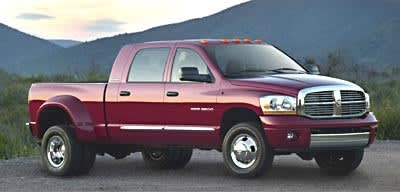
The Chrysler Group announced last week that the 2006 Dodge Ram Mega Cab will get a dual-rear-wheel model. Featuring dual rear wheels that expand the rear-wheel track to six feet, four inches, the 2006 Dodge Ram Mega Cab Dually provides more payload capacity and enhanced trailer-towing stability, according to Dodge. The Mega Cab Dually model comes standard with 610 lb.-ft. of torque, from its 5.9-liter Cummins Turbo Diesel engine. The Ram Mega Cab Dually is available as a 3500 series with a six-foot, three-inch box. It can be configured with 4x2 or 4x4 drivetrains, in SLT or Laramie trim, and comes standard with a six-speed manual or optional automatic transmission. An electric-shift transfer case is standard on four-wheel-drive models, and a limited-slip differential is optional. The new dual-rear-wheel model boosts the Dually's Gross Vehicle Weight Rating (GVWR) to 10,500 lbs., payload capacity to 3,240 lbs., and rear Gross Axle Weight Rating (GAWR) to 9,350 lbs. The Gross Combined Vehicle Weight Rating (GCWR) of 23,000 lbs. and maximum trailer weight of 15,600 lbs. place the Dodge Ram Mega Cab Dually among the top of its class. Options include a Class IV hitch receiver with a seven-circuit wiring harness, 750-amp battery, heavy-duty engine cooling and an auxiliary transmission oil cooler. A "Tow/Haul" mode, as well as "Overdrive Off," help reduce gear searching when climbing hills. These systems will also select a lower gear in downhill conditions in order to utilize the engine's breaking capability. Customizable trailer-tow mirrors provide two views on both sides: close-up and wide-out. In addition, mirrors flip up 90 degrees for viewing beyond wide trailers.
More Small Fleet


Developing Budget-Friendly Driver Safety Programs
From driver training and safety meetings to one-on-one coaching and incentive programs, several small fleets share how they have developed a safety culture with their drivers using low- to no-cost resources.
Read More →
Boosting Last-Mile Fleet Uptime, Safety, and Value with AI Vehicle Inspections
AI-powered inspections are transforming last-mile fleets by replacing manual checks with highly accurate automated scans that detect defects in seconds. By giving fleet operations visibility into the daily condition of their vehicles, you can identify trends over the vehicle’s lifecycle that enable improved procurement decisions, route management, driver training and accountability.
Read More →
Five Ways Seat Belts Help Prevent Injuries
There are five ways seat belts protect occupants from injuries, according to the Tennessee Department of Safety and Homeland Security.
Read More →
It’s here: The 2026 Fleet Technology Trends Report
What does AI mean for fleets? Get the answer — and learn other top tech trends.
Read More →
Small Fleets, Big Impact: How Independent Drivers Power Wreaths Across America
Check out how small fleets and independent drivers power Wreaths Across America each December and why their impact matters more than ever.
Read More →
VMS Survey Finds 65% of Small Fleet Managers Run Operations Alone
A new VMS survey shows small fleet managers are stretched thin, with most handling operations solo and eager to adopt digital tools for relief.
Read More →
Tips for Driving Safely on Halloween Night
This video features a reminder from the Connecticut Department of Transportation (DOT) and the Connecticut Police Chiefs Association, urging drivers to prioritize safety this Halloween.
Read More →
AI, Access, and Uptime: VMS’s Next Chapter with David Prusinski
VMS’s new Co-CEO, David Prusinski, shares how an AI-first approach will give small fleets and repair shops the tools to compete like big players.
Read More →
Fleet Managers Share Winter Prep Tips: It's Never Too Early!
Three fleets share best practices to prep vehicles for winter and prevent downtime when the cold sets in.
Read More →