




The Power of Data: Changing Driver Behaviors
Technology can help monitor your drivers’ behaviors, but this small fleet puts the data into the drivers’ hands with a friendly peer competition.

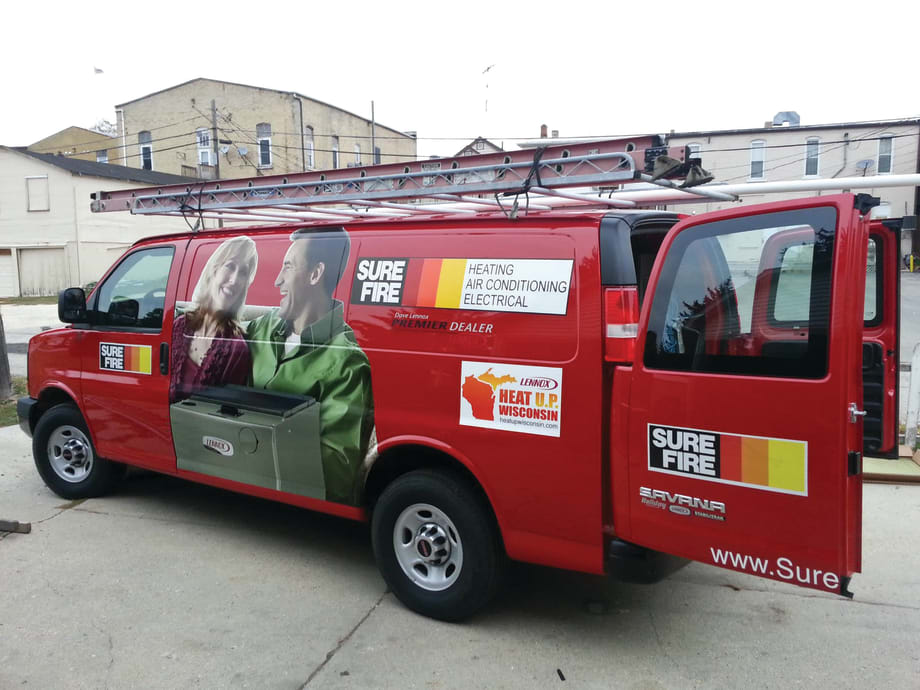
Expanding into commercial services and responding to emergency calls, Sure-Fire Inc. in Wisconsin has to be prepared with a full inventory in each vehicle. This added weight makes each driver’s fuel efficiency a top priority.
Expanding into commercial services and responding to emergency calls, Sure-Fire Inc. in Wisconsin has to be prepared with a full inventory in each vehicle. This added weight makes each driver’s fuel efficiency a top priority.
The power of peer competition can play a strong role in changing behaviors at the workplace, and the same is true for drivers in your fleet.
Sure-Fire Inc., a heating, ventilation and air conditioning (HVAC) service company in Horicon, Wis., has had telematics for more than four years with different companies. But Sure-Fire’s Risk Manager Casey Malesevich says that what became most effective in achieving those goals is how information from those telematics systems is used to promote friendly competition and open communication.
“Our biggest concern is fuel economy on top of the ability to carry all the weight that we could possibly need at any point,” Malesevich says.
‘Put a Dollar on It’
Since tracking speeding and other driving behaviors with NexTraq beginning in February 2012, Sure-Fire has realized a noticeable decrease in speed alerts. The company has a two-tier system: drivers caught speeding up to 15 miles per hour over the speed limit receive a regular speed alert; greater than 15 miles per hour warrants a severe alert.
Malesevich says the fleet has reduced its severe speed alerts since February by about 50% and regular speed alerts by 25%.
Aside from safety, Malesevich says the reason behind the speed alerts was also to help with fuel economy. But just installing the software is not necessarily what brought the alerts down so quickly. “I am pretty proud of the monthly reporting we do and being open to the employees about the results,” he says. “You put it right in their hands.”
Part of this open reporting is that every driver can see where others stand in their driving alerts. Every quarter Sure-Fire compiles the alerts, and drivers with the lowest ratio of alerts per 100 miles win a small cash prize. “Put a dollar on it,” he says, adding that “no one likes to be on the bottom of the leader board.”
Being Flexible
Sure-Fire was established in 1947 as a family-owned residential service company. But now with a fleet of 20 vehicles, it also provides commercial and electrical services. Because of this growth, Sure-Fire’s fleet needs to fit each job and have all parts on hand as much as possible, which means a fleet consisting of mostly Ford E-Series cargo vans, five Ford F-150s, a Ford Ranger and another handful of Chevrolet and GMC pickups.
A lot of the calls are for emergency repairs. “It’s a constant inventory battle,” Malesevich says. “The ideal is to have every part of every furnace ever made, but that’s just not possible. You would like to know, but you just usually don’t.”
Five of the fleet vehicles are considered spares, being used sometimes in service or for running inventory out to a job. Malesevich says moving into the commercial side of business has forced the company to be more flexible and have a spare vehicle on hand for a new hire. “It’s difficult to predict our labor force,” he says.
The company tries to stay within 25 miles of its office, but has had jobs far enough away to necessitate temporary housing for the workers.
On top of it, Malesevich says not every employee has the same skillset. The dispatcher sends the employee who has the best skills for the job, not who is closest in miles. “You have to be flexible as a smaller company,” he says.
See more articles from the January/February Business Fleet magazine issue here.
You can also view more small fleet profiles at www.businessfleet.com/profiles.
More Small Fleet


Developing Budget-Friendly Driver Safety Programs
From driver training and safety meetings to one-on-one coaching and incentive programs, several small fleets share how they have developed a safety culture with their drivers using low- to no-cost resources.
Read More →
Boosting Last-Mile Fleet Uptime, Safety, and Value with AI Vehicle Inspections
AI-powered inspections are transforming last-mile fleets by replacing manual checks with highly accurate automated scans that detect defects in seconds. By giving fleet operations visibility into the daily condition of their vehicles, you can identify trends over the vehicle’s lifecycle that enable improved procurement decisions, route management, driver training and accountability.
Read More →
Five Ways Seat Belts Help Prevent Injuries
There are five ways seat belts protect occupants from injuries, according to the Tennessee Department of Safety and Homeland Security.
Read More →
It’s here: The 2026 Fleet Technology Trends Report
What does AI mean for fleets? Get the answer — and learn other top tech trends.
Read More →
Small Fleets, Big Impact: How Independent Drivers Power Wreaths Across America
Check out how small fleets and independent drivers power Wreaths Across America each December and why their impact matters more than ever.
Read More →
VMS Survey Finds 65% of Small Fleet Managers Run Operations Alone
A new VMS survey shows small fleet managers are stretched thin, with most handling operations solo and eager to adopt digital tools for relief.
Read More →
Tips for Driving Safely on Halloween Night
This video features a reminder from the Connecticut Department of Transportation (DOT) and the Connecticut Police Chiefs Association, urging drivers to prioritize safety this Halloween.
Read More →
AI, Access, and Uptime: VMS’s Next Chapter with David Prusinski
VMS’s new Co-CEO, David Prusinski, shares how an AI-first approach will give small fleets and repair shops the tools to compete like big players.
Read More →
Fleet Managers Share Winter Prep Tips: It's Never Too Early!
Three fleets share best practices to prep vehicles for winter and prevent downtime when the cold sets in.
Read More →