New greenhouse gas regulations will drive greater use of aerodynamics and light weighting in truck designs — and could accelerate the comeback of hybrid and all-electric drivetrains.
by Jack Roberts
November 22, 2016
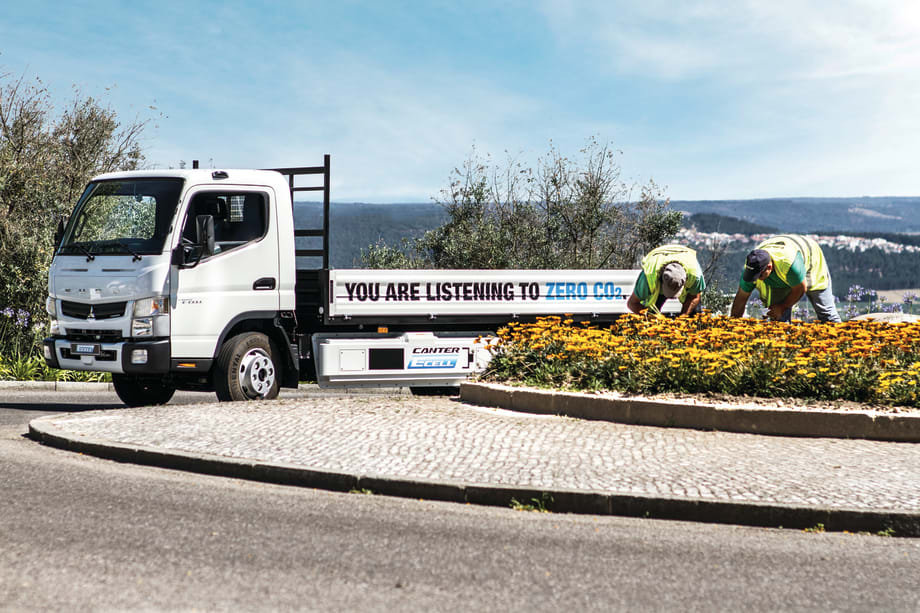
The all-electric Mitsubishi Fuso Canter E-Cell will see a “soft launch” in the U.S. next year, most likely in urban delivery environments in Southern California and New York City. Photo courtesy of Mitsubishi Fuso.
6 min to read
The all-electric Mitsubishi Fuso Canter E-Cell will see a “soft launch” in the U.S. next year, most likely in urban delivery environments in Southern California and New York City. Photo courtesy of Mitsubishi Fuso.
Phase 2 of the federal government’s greenhouse gas and fuel economy regulations (GHG2) for medium- and heavy-duty trucks was announced in late July of this year. And while the initial reaction throughout the North American trucking industry was focused on heavy-duty commercial vehicles, it is clear that these regulations will affect light- and medium-duty fleets, as well, and sooner rather than later.
Ad Loading...
The second round of GHG regulations was released jointly by the White House, the Environmental Protection Agency (EPA), and the National Highway Traffic Safety Administration (NHTSA). They present the North American trucking industry with an environmental and technological to-do list that will keep OEMs, technology suppliers, and fleets busy for the next decade.
Ad Loading...
The additional regulations build upon GHG Phase 1 rules, which were finalized in 2007 — hard on the heels of the implementation of EPA diesel exhaust emissions regulations that drastically reduced the amount of nitrous oxides (NOx) and particulate matter emitted by diesel engines.
Today, the White House and EPA have added the threat of global climate change to the equation, prompting a shift in focus at the federal level to reducing greenhouse gas emissions in trucks by improving fuel economy, boosting research and development in alternative fuels and all-electric vehicles, and exploring ancillary methods for reducing emissions.
Although the latest round of rulemaking has serious backing at the federal level, the state of California is, in many ways, the driving force behind today’s increasingly tough emissions standards. Through its California Air Resources Board (CARB) environmental agency, California has made it clear that it is more focused than ever on cutting more NOx emissions from diesel exhaust; something truck and engine makers say will be difficult to do while improving fuel economy.
In fact, in conjunction with the GHG2 announcement, EPA announced it will be working closely with CARB in the future with a goal of further reducing NOx emissions both in California and nationwide.
Ambitious Goals
Building on Phase 1, GHG Phase 2 final rules are designed to promote a new generation of cleaner, more fuel-efficient trucks by “encouraging the wider application of currently available technologies and the development of new and advanced cost-effective technologies through model year 2027.”
Ad Loading...
The final vehicle and engine performance standards were developed with input from the automotive and trucking industries, environmental groups, labor unions, and other concerned parties. They will cover semi-trucks, large pickups, and vans, and all types of buses and work trucks for model years 2021-2027.
Overall, EPA says that when GHG Phases 1 and 2 come into full effect a decade from now, the combined set of regulations will lower CO2 emissions by approximately 1.1 billion metric tons, save vehicle owners fuel costs of about $170 billion, and reduce oil consumption up to 2 billion barrels over the lifetime of the vehicles sold under the program.
The agencies contend the program will provide $230 billion in net benefits to society, including benefits to our climate and the public health of Americans, and that these benefits outweigh costs by about an 8-to-1 ratio.
There are also separate engine standards. For diesel engines, new standards begin in model year 2021 and phase into model year 2027, with interim standards in model year 2024. The final diesel engine standards will reduce CO2 emissions and fuel consumption up to 5% for tractor engines and up to 4% for vocational engines compared to Phase 1. The standards also require a 16% to 19% efficiency improvement for vocational vehicles and 16% for heavy-duty pickup trucks and vans.
The final rule has more ambitious efficiency goals than the proposed rule unveiled last year, but EPA and CARB argue that a phased-in approach should help prevent sticker shock and forced adoption of not-quite-ready-for-prime-time technologies.
Ad Loading...
Changes in Phase 2 GHG Rules
Here are some key changes in Phase 2 GHG rules compared to the initial GHG1 proposal:
• 10% more GHG and fuel consumption reductions
• More robust compliance provisions, including improved test procedures, enhanced enforcement audits, and protection against defeat devices
• More stringent diesel engine standards
• An improved vocational vehicle program with a regulatory structure better tailored to match the right technology for the job
• Maintaining the structure and incremental phase-in of the proposed standards, allowing manufacturers to choose their own technology mix, and giving them the lead time needed to ensure those technologies are reliable and durable
• Increased flexibility to minimize impacts on small businesses
A Mixed Bag of Tech and Credits
For heavy-duty trucks, most GHG2 compliance efforts will center on diesel engine and aerodynamic enhancements. But things will be a bit trickier for light- and medium-duty vehicle and powertrain designers.
The new regulations will require manufacturers to design and implement technologies to reduce GHG emissions that are not commonly found on fleet vehicles today.
“For Class 4 through 6 vehicles, manufacturers will be required to develop more efficient drivetrains and engines,” says Rene Littaua, manager, strategic planning and development section for CARB. “Technologies such as transmission improvements, efficient engine designs, light weighting, and hybridization will likely need to be implemented to meet these regulations.”
Under GHG2, OEMs will retain the freedom to build less fuel-efficient vehicles, but they will be graded by EPA on their total output of GHG2-compliant vehicles versus non-compliant vehicles. Manufacturers will be penalized for each non- or less-compliant vehicle produced while rewarded for each GHG2-compliant vehicle that rolls off their assembly lines.
To boost OEM interest in working on new and emerging green vehicle technologies, a credit system will award additional points for each advanced technology vehicle built.
Looking at smaller vehicles, Littaua says it is likely Class 2 and 3 vehicles will utilize greater aerodynamics, light weighting, mild hybridization, start-stop technologies, and engine and transmission improvements. And while there has been much speculation regarding the role all-electric and alternative-fuel vehicles may play as GHG2 phases in, Littaua says CARB has designed the regulations in a way to encourage OEMs without enacting mandates.
“The regulations do not require the use or development of electric vehicles to meet the requirements,” says Littaua. “However, the rules do encourage their development and use through advanced technology credit multipliers, including a 3.5 credit multiplier for plug-in hybrid-electric vehicles, 4.5 for all-electric vehicles, and 5.5 for fuel cell vehicles.”
Ad Loading...
One technology that is poised to play an important role in meeting GHG2 regulations are hybrid-electric drivetrains. These drivetrains spawned a brief burst of interest in the late 1990s and early 2000s. When fuel prices rose to unprecedented levels, OEMs explored their potential as a means to boost fuel efficiency by allowing battery-powered electric motors to launch trucks and vans with a gasoline or diesel engine cutting in once the vehicle reached road speeds.
Early hybrid efforts proved the validity of the concept, since diesel and gasoline engines burn much higher amounts of fuel getting a truck or van moving — with fuel burn falling off significantly once the vehicle has reached cruising speeds. But the technology failed to catch on for various reasons, including system complexity, battery space and weight considerations, high acquisition costs, and, ultimately, the return of low fuel prices.
Although hybrid drivetrains in trucks and vans have largely disappeared from the market, research and development in the technology has continued. And, not surprisingly, hybrid technology is included as one of the technology options whose GHG benefits count toward Phase 2 compliance for vocational vehicles in Classes 2 through 8 and heavy-duty pick-ups and vans.
According to Littaua, the EPA and NHTSA have projected some penetration rates of mild and strong hybrids in certain light- and medium-duty applications as one of the considerations in determining the stringency of the Phase 2 standards.
“This is one reason CARB has recommended that the final rule include a 3.5 advanced technology credit multiplier to incentivize plug-in hybrid electric vehicles,” she says. “Additionally, CARB is planning to harmonize our state regulations with federal emissions provisions to allow the use of hybrid technology in counting towards compliance as well as in providing an advanced technology credit multiplier.”
Ad Loading...
Finally, Littaua says CARB is looking at potential strategies to begin deployment of battery-electric vehicles in the “last mile” delivery sector along with other zero-emission technologies.
Taken as a whole, it seems that GHG2 will largely build upon existing development trends in light- and medium-duty fleet design today while also granting manufacturers the freedom to pursue technology paths that are the most logical given their customers’ applications and job requirements.
On the other hand, it also seems certain that the regulations will spur significant change in vehicle drivetrains in some applications. It is still far too early to guess how soon and how drastically light- and medium-duty commercial vehicles will begin to change, but it is certain that some degree of change is only a matter of time.
From driver training and safety meetings to one-on-one coaching and incentive programs, several small fleets share how they have developed a safety culture with their drivers using low- to no-cost resources.
AI-powered inspections are transforming last-mile fleets by replacing manual checks with highly accurate automated scans that detect defects in seconds. By giving fleet operations visibility into the daily condition of their vehicles, you can identify trends over the vehicle’s lifecycle that enable improved procurement decisions, route management, driver training and accountability.
This video features a reminder from the Connecticut Department of Transportation (DOT) and the Connecticut Police Chiefs Association, urging drivers to prioritize safety this Halloween.