




Want More? Electrification & Grease Options in Trucks
How to Take Advantage of Low-Viscosity Lubricants
Read why selecting more fuel-efficient, low-viscosity lubricants can help you gain efficiencies while helping to future-proof your business.
by Barrie Masters, Lubrizol
May 10, 2022
For fleet owners, FA-4 can raise some natural questions. But working through these questions carefully can be worthwhile for any fleet.
Photo: Lubrizol
6 min to read
Operational efficiency and profitability are top priorities for fleet owners and operators — and as of mid-2022, fuel prices have become a major threat to both of those goals.
Recent data from the Energy Information Administration (EIA) shows that diesel prices have skyrocketed, rising more than two dollars per gallon versus this time just last year. Meanwhile, higher costs at the pump have combined with ongoing driver shortages, which have led freight professionals to optimize load sizes to get more out of every mile. In the western United States, for example, some fleets have reportedly sought to increase agricultural and commodity hauls from 106,000 pounds to 129,000 pounds, which can potentially lead to greater overall wear and tear on a vehicle.
As fleet owners deploy every strategic tool they can to optimize costs under challenging conditions, there is one option that has largely gone underutilized: low-viscosity engine oils, which can reliably help heavy-duty trucks become more fuel-efficient in their everyday operations.
According to “Trucking Efficiency Confidence Report: Low-Viscosity Engine Lubricants,” a joint report from the North American Council for Freight Efficiency and Carbon War Room, the benefits of upgrading to available low-viscosity lubricants are clear-cut. “Class 8 over-the-road fleets can realistically expect fuel savings in the range of 0.5%–1.5% by switching from 15W-40 to 5W/10W-30 engine oil,” the report says.
Even greater fuel savings can be achieved when the right choices are made based on the composition of your fleet.
Let’s explore how and why low-viscosity lubricants make sense for today’s challenging market conditions:
Why Aren’t Low Viscosities Used More Frequently?
Given lower-viscosity formulations’ ability to deliver fuel efficiency, which can lower a fleet’s fuel costs, it leads one to question why they aren’t used more widely. Consider that nearly 81% of heavy-duty diesel lubricants sold in the North American market are 15W-40. No other available grade (including 10W-30 and 5W-30) breaks the 10% threshold.
One reason for slow adoption of low-viscosity lubricants is that the trucking industry has enjoyed historically low fuel prices for the past five years. Fleets’ interest in adopting lower viscosity oils has had lower focus versus other areas of their business.
Another reason is the myth that lower-viscosity engine oils do not provide the same kind of robust protection as a higher-viscosity oil. Though this may have once been true, advances in formulation technology and additive chemistry have enabled modern heavy-duty engine oils to deliver outstanding engine protection in lower-viscosity formulations. Proof lies within today’s API CK-4 and FA-4 performance categories, no matter the viscosity grade. While CK-4 defines more conventional engine oil formulations, the FA-4 category was engineered to deliver enhanced fuel economy benefits in newer-model diesel engines (more on this later). Per API requirements, both CK-4 and FA-4 oils deliver the same levels of high performance and engine protection.
Consider also that North American OEMs factory-fill most new-model engines with 10W-30 grade engine oils, indicating confidence that lower viscosities are a good choice for modern trucks. Together, additive companies, oil companies and OEMs have generated hundreds of millions of miles on lower-viscosity oils and API FA-4 oils in real-world field testing, covering all major OEM engines in a wide variety of duty cycles. This testing is done to validate the performance and durability of lower-viscosity engine oils in both the CK-4 and FA-4 categories.

Higher costs at the pump have combined with ongoing driver shortages, which have led freight professionals to optimize load sizes to get more out of every mile.
Source: EIA
Overcoming Hesitancy
If simply switching to a lower-viscosity formulation can have clear fuel economy benefits, going further to FA-4 formulations where applicable can provide even greater savings. “The savings from switching to the fuel-efficient FA-4 variant … can be expected to add a further 0.4%–0.77% of increased fuel efficiency,” according to the Trucking Confidence Report.
FA-4 lubricants, however, hold a lower market share than CK-4 formulations. This is due in part to the fact that FA-4 lubricants are designed for newer-model engines and are not backward compatible with engines older than model-year 2010. Meanwhile, some truck manufacturers have simply not approved the use of FA-4 oils in their vehicles.
For fleet owners, FA-4 can raise some natural questions. But working through these questions carefully can be worthwhile for any fleet. Throughout the lifetime of service, which may include more than a million miles on the road, FA-4 has the potential to deliver significant operational cost savings via improved fuel efficiency. Especially in light of dramatically rising fuel prices and increasing cargo loads, which can lead to additional maintenance needs, lower-viscosity lubricants can help you achieve fuel economy gains that may help offset maintenance costs.
How to Switch to Lower-Viscosity Formulations
If you’re interested in exploring lower-viscosity lubricants, a recently approved recommended practice from the Technology and Maintenance Council (TMC) is a good place to start. Per TMC, here’s a short breakdown on how to make the switch:
If you operate engines that are newer than model-year 2010, and those vehicles are made by OEMs that approve the use of FA-4 (Detroit Diesel, Cummins and Navistar), FA-4 lubricants are a good option for those vehicles.
For newer vehicles by OEMs who have not explicitly recommended FA-4, TMC recommends contacting the manufacturers to determine if oil recommendations have recently changed to include FA-4.
For any vehicles newer than model-year 2010, TMC recommends fleets at least consider adopting 10W-30 or 5W-30 CK-4 lubricants to take advantage of the fuel efficiency gains.
Future-Proofing Your Business
Lower-viscosity engine oils are the future of the heavy-duty trucking space — and getting ahead of the curve now can help you be better prepared.
Several forces will drive the trend. First, sustainability has grown from a niche interest to a major focal point in every major industry. Companies are assessing the impact of their overall operations—and if you’re not already thinking about sustainability, your customers probably are. Efficient transport of goods is a part of the sustainability equation, and if your organization can demonstrate a commitment to fuel reduction, you may stand to build an advantage over the competitors in the long term.
Second, API performance categories will only progress in the direction of lower viscosity. FA-4 is only the beginning, and work has already begun on a new performance category (known currently as PC-12) that will replace today’s categories in the coming years. While there is plenty of work still to be done before we can reasonably predict exactly what PC-12 will encompass, it is expected to set viscosity standards even lower to meet the needs of tomorrow’s heavy-duty trucks. Proactive fleets stand to benefit from being prepared early.
Given today’s fuel prices, lower-viscosity engine oil is a choice that just makes business sense. For more information, start a conversation with your lubricant supplier, and find out why making the switch is right for you.
About the Author: Barrie Masters is director, heavy-duty engine oils, America’s for The Lubrizol Corporation, which provides specialty chemicals for the transportation and other markets, including additives for engine oils. He has been with Lubrizol for 12 years holding various commercial roles in the Americas, Europe and Asia. This article was authored and edited according to WT editorial standards and style. Opinions expressed may not reflect that of WT.
Subscribe to Our Newsletter
More Maintenance
Les Schwab Expands Commercial Tire Footprint Into Arizona
Les Schwab Tires has expanded into Arizona with two commercial tire locations in Phoenix and Tucson, strengthening its fleet service footprint in the Southwest.
Read More →
Volvo Trucks’ 'Lock and Leave' Software Updates Go Live Across North America
Unattended over-the-air software updates are now available in Volvo trucks across the U.S. and Canada. The new capability lets trucks stay current with the latest software without interrupting operations or requiring a dealership visit.
Read More →
Why Technician Appreciation Can’t Be a Once-a-Year Thought
For fleets trying to keep skilled technicians, recognition cannot begin and end with Technician Appreciation Week. Learn what year-round appreciation really looks like and why the everyday technician experience matters just as much as pay when fleets are trying to keep good people.
Read More →
How Faster Driver Reporting Can Keep Small Truck Problems Small
When minor damage, warning lights, or equipment issues are reported late, small problems can quickly become bigger maintenance headaches. Conversational AI can help shorten the path from what a driver notices in the field to the person who can act on it.
Read More →
BendPak’s Ranger Wheel Service Equipment Achieves North American Safety Certification
BendPak’s full line of Ranger tire changers and wheel balancers has been ETL certified to UL and CSA standards to improve operator safety.
Read More →
Isuzu & U.S. Department of Labor Celebrate Milestone for Veterans Apprenticeship Program
The Isuzu Veterans Apprenticeship Program (IVAP) signing ceremony highlighted Isuzu’s long-term commitment to veterans, Isuzu dealers, and the skilled workforce supporting its customers and the commercial transportation industry.
Read More →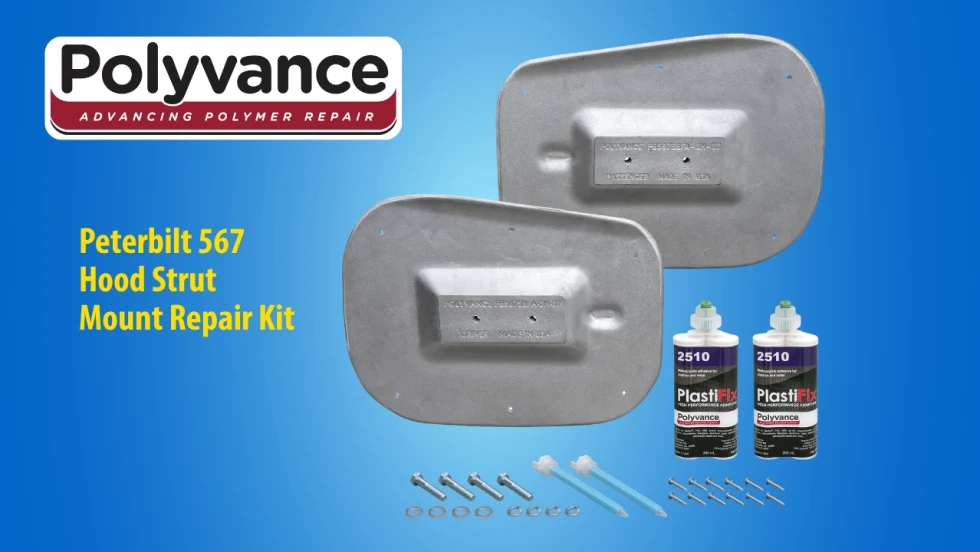
Polyvance Introduces New Peterbilt 567 Hood Strut Mount Repair Kit
Polyvance has launched a repair solution for Peterbilt 567 hood struts, helping truck owners and repair facilities avoid costly hood replacements.
Read More →
Cox Automotive Celebrates Technical Excellence at 2026 Top Tech Finals
The top technicians from Cox Fleet and Manheim tested their skills in Nashville, Tennessee, at Cox Automotive’s 2026 Top Tech Finals. The overall winners will advance to compete at the American Trucking Association’s TMC SuperTech competition.
Read More →
Grote Industries Appoints Vice President of North American Operations
Grote Industries has appointed Patrick Smith as vice president of North American operations as it celebrates 125 years of innovation and manufacturing excellence. He has more than 20 years of manufacturing leadership experience.
Read More →
Winter Fleet Prep: Expert Tips to Keep Vehicles Running Smoothly
Cold weather can expose weak batteries, tires, fuel systems, and maintenance gaps fast. Use this winter fleet checklist to prepare trucks and drivers before temperatures drop.
Read More →