





Related Article: How to Transform Cargo Vans into Mobile Offices
How to Customize a Service Van
A locksmith, an electrician and a forklift tech share tips for upfitting and organizing a workshop on wheels.
June 3, 2015

Customizations on Wayne Winton's mobile locksmith shop include plywood linings with foam insulation, shelving and storage units, a workbench and a key-cutting machine.
5 min to read

Customizations on Wayne Winton's mobile locksmith shop include plywood linings with foam insulation, shelving and storage units, a workbench and a key-cutting machine.
Where would you go to learn how to build out your next service van or organize the one you’re driving now? What would be your first step, and how would you know when it was done?
To find out, Business Fleet spoke with three working tradesmen who used experience, ingenuity and craftsmanship to build their ideal mobile offices.
Organization and Accessibility
Each tradesman uses tools and equipment unique to his field, but all three share a common mantra: Figure out what you need and how often you need it, and then find an appropriate home in the van. In each case, trial-and-error was the path to success.
“I just made it up as I went,” says Wayne Winton, owner of Tri-County Locksmith Service in Glenwood, Colo. “And if it fit, I did it, and if not, I moved it.”
Winton’s van, a 1999 Ford Econoline, replaced a Chevrolet Astro from which Winton was able to salvage a shelving unit but not much else. After lining the interior walls with plywood painted in Tufdek, a vinyl coating for outdoor decks, he installed the shelves, additional storage compartments and a wooden workbench.

Winton's van, a 1999 Ford Econoline, replaced a Chevrolet Astro.
With the big pieces installed, the rest fell into place: Larger tool bags are stored just inside the side door, upon which hangs a nuts-and-bolts bin. The back doors open to the workbench, a roadside emergency kit and, suspended from the rear driver’s-side door, Winton’s key-cutting machine. When the weather allows, he swings the door open and cuts keys outside to avoid filling the cargo hold with brass shavings.
Accessibility was the principal objective for Eric Sherman, an electrician with Western States Electrical Construction in Newport and Lincoln City, Ore. Both interior walls of his 2006 Ford E-250 cargo van are lined with shelves and bins.
With no need to perform work in the van — and a ladder rack and conduit box on the roof — he is able to keep the floor free of clutter. He mounted a frequently used stepladder to the ceiling, which also has hooks attached for a shovel, fish rods and a “hickey,” a tool used to bend conduit.

Electrician Eric Sherman's Ford E-250 cargo van contains shelves and bins for better organization of tools.
“I threw up the long skinny things,” Sherman says. “I had the shovel hanging downward until I banged my head on it.”
Because his daily workload could involve anything from getting a grocery store’s cold storage unit up and running to rewiring electrical panels at a wastewater plant, Sherman built side door-accessible holsters for his power drill, hand sanitizer and paper towel roll.
“The idea is I can reach the most common stuff from the doors,” he says, noting that, when it comes to organization, “I’m a bit obsessive compulsive.”
“You have to think, ‘When I get to the customer, what I am going to need to have handy?’” says Russell Mullis, a forklift field service technician with Charlotte, N.C.-based Lift-One LLC. “I have different bags for different jobs. … Grab it and go.”
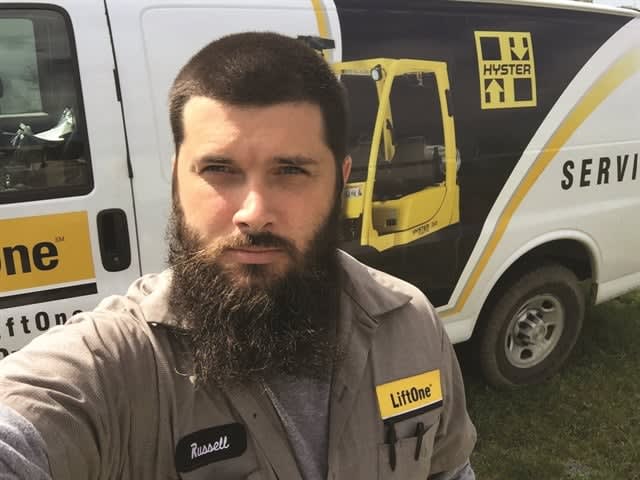
Forklift field service technician Russell Mullis went through a lengthy trial-and-error process to organize his van and then documented the results in a YouTube video.
A typical call for Mullis could involve a half-hour drive to a client’s warehouse and a long walk from the parking lot to the ailing forklift. After months spent making multiple trips back and forth to the van to grab tools and machinery, he carved out space in his late-model GMC Savana for a rolling cart.
“It was trial-and-error,” he says. “It’s about being more efficient.”
Planning and Discipline
None of the three tradesmen BF contacted mapped out their customizations before starting the job, but Sherman would advise first-timers to start with a rough sketch.
“I think the first thing is to figure out what you’re doing with the van and go from there. … Start doodling it out and laying it out. The ideal thing to do is make it kind of modular so it’s easy to move around.”
Once your van is arranged to your liking, he adds, you have to take time at the end of each workday to be sure everything goes back in its place to be sure you can find it the next day. “You can have a really cool setup, and it can get destroyed if you don’t keep on top of it. You have got to be disciplined.”
Sherman recommends avoiding prefabricated systems in favor of a custom setup. Winton applied the same logic to the steel bulkhead that divides his cabin from the cargo hold. Unsatisfied with the flimsy L-brackets that came with the kit, he reinforced the bulkhead by adding thicker brackets and framing it with angle iron.
“I know how much weight I roll around with,” Winton says. “People don’t realize that all that stuff in the back comes flying up if you come to an abrupt stop.”
Without a brick-and-mortar office to return to, Winton built his van to serve as a rolling workshop with all the comforts of home, including climate control. A radiant heater hangs from the safety cage on the passenger side, and he used expanding foam to fill in beam ridges and stuffed packing peanuts between his plywood bulkheads and the interior panels. The insulation helps maintain comfortable temperatures in the winter (and summer) months — and as an added bonus, it deadens cabin noise.
Winton says the plywood, Tufdek and multiple layers of insulation combine for “a very solid ride,” adding that all the planning, work, reinforcement and documentation were worth the effort. “If I put in the time now, then that will pay off in the future. … I took so much care in setting it up because it is my office. I’m in the van all day long.”

Sherman organized his van with an emphasis on accessibility, keeping the floor relatively clear and making sure frequently used tools remain within easy reach.
Subscribe to Our Newsletter
More Small Fleet


Developing Budget-Friendly Driver Safety Programs
From driver training and safety meetings to one-on-one coaching and incentive programs, several small fleets share how they have developed a safety culture with their drivers using low- to no-cost resources.
Read More →
Sponsored•March 9, 2026
Boosting Last-Mile Fleet Uptime, Safety, and Value with AI Vehicle Inspections
AI-powered inspections are transforming last-mile fleets by replacing manual checks with highly accurate automated scans that detect defects in seconds. By giving fleet operations visibility into the daily condition of their vehicles, you can identify trends over the vehicle’s lifecycle that enable improved procurement decisions, route management, driver training and accountability.
Read More →
Five Ways Seat Belts Help Prevent Injuries
There are five ways seat belts protect occupants from injuries, according to the Tennessee Department of Safety and Homeland Security.
Read More →
Sponsored•January 14, 2026
It’s here: The 2026 Fleet Technology Trends Report
What does AI mean for fleets? Get the answer — and learn other top tech trends.
Read More →
Small Fleets, Big Impact: How Independent Drivers Power Wreaths Across America
Check out how small fleets and independent drivers power Wreaths Across America each December and why their impact matters more than ever.
Read More →
VMS Survey Finds 65% of Small Fleet Managers Run Operations Alone
A new VMS survey shows small fleet managers are stretched thin, with most handling operations solo and eager to adopt digital tools for relief.
Read More →
Tips for Driving Safely on Halloween Night
This video features a reminder from the Connecticut Department of Transportation (DOT) and the Connecticut Police Chiefs Association, urging drivers to prioritize safety this Halloween.
Read More →
AI, Access, and Uptime: VMS’s Next Chapter with David Prusinski
VMS’s new Co-CEO, David Prusinski, shares how an AI-first approach will give small fleets and repair shops the tools to compete like big players.
Read More →
Fleet Managers Share Winter Prep Tips: It's Never Too Early!
Three fleets share best practices to prep vehicles for winter and prevent downtime when the cold sets in.
Read More →