




How Fleets Are Reacting to the Cell Phone Ban
A new survey gauges reaction to the FMCSA’s ban on hand-held use of mobile phones while driving. Where do you stand, and how will you act?

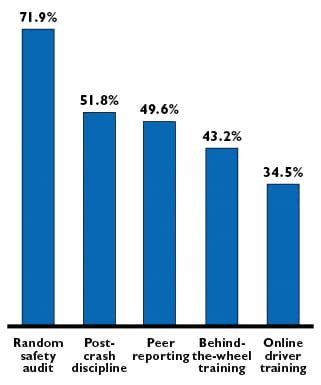
Respondents' reported enforcement methods.
In January 2012, the Federal Motor Carrier Safety Administration (FMCSA) put into effect its ban on hand-held cell phone use by interstate truck and bus drivers while driving. This rule affects some 4 million drivers and 700,000 fleet operators.
Whether your fleet falls under interstate commercial motor vehicle (CMV) rules or not, there is an increasing amount of legislative focus on cell phone use by consumers and commercial drivers at both the state and federal levels.
ZoomSafer, a company that provides software to prevent distracted driving, conducted a survey that measures industry reaction to the new regulations. The survey queried 570 executives involved in numerous types of commercial and government fleets.
Have you recently instituted or updated your cell phone policy based on new local or federal regulations? How do your compliance efforts compare to those in the survey? Here are highlights of the survey.
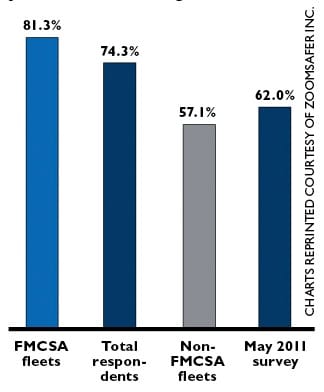
Respondents that already have a cell phone policy.
Cell Phone Policy Implementation Is Growing
The chart at right tracks the percentage of respondents whose companies already have a written policy pertaining to employee use of mobile phones while driving.
This current survey of FMCSA-regulated fleets reveals significant changes in corporate attitudes pertaining to employee use of cell phones while driving on the job compared to previous survey data collected in May 2011 (of both FMCSA-regulated fleets and non-FMCSA-regulated fleets). While policy adoption was up compared to the May 2011 survey, FMCSA-regulated fleets are leading this charge by nearly a 30% margin.
In addition, of those companies surveyed that don’t yet have a cell phone policy, 72.2% of FMCSA-regulated fleets say they plan to implement a policy, versus only 30% of non-FMCSA fleets.
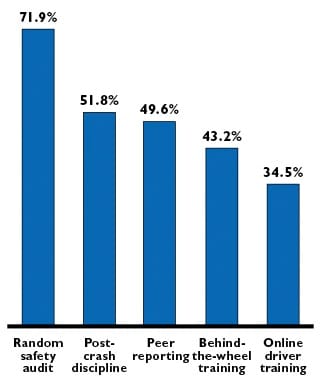
Respondents' reported enforcement methods.
Policy Enforcement Methods
Fleets with cell phone policies report that they make some attempt to enforce compliance, averaging 90.4% for FMCSA and 88.6% for non-FMCSA fleets. That’s up from 53% in the May 2011 survey. However, the chart at left of FMSCA fleet respondents shows that such efforts are exclusively reactive.
Furthermore, less than one-third (33.1%) of respondents report that they are “very confident” their companies’ current enforcement methods are sufficient to ensure compliance with FMCSA regulations. Most FMCSA-regulated drivers (82%) carry personally owned cell phones, further complicating enforcement. [PAGEBREAK]
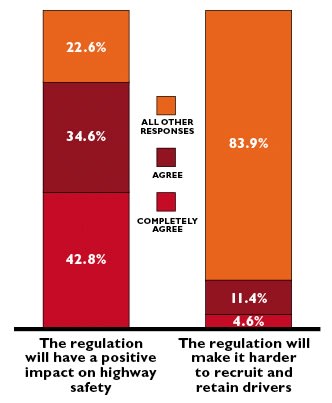
Respondents' views on effects of regulation.
Industry Views: Pros and Cons
Will the regulation improve safety or hinder driver recruitment? The chart at right shows more than two-thirds of respondents agree or completely agree that the regulation will have a positive impact on safety, while 16% say that the regulation will make it harder to recruit and retain drivers.
Other Findings: Driver Fitness and Employee Screening
The ZoomSafer survey also queried fleet executives on the percentage of companies that require screening of employee drivers. While nine out of 10 (90.27%) FMCSA fleets require screening, less than half (44.4%) of non-FMCSA fleets do (see graph below).
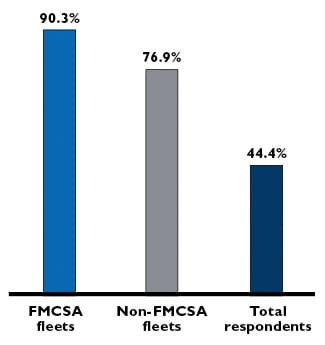
Respondents that screen their drivers.
This stark difference between FMCSA and non-FMCSA fleets could be the result of the FMCSA’s Unsafe Driving Behavioral Analysis Improvement Categories (BASICs), a scoring system that measures a fleet’s safety readiness.
Drivers who get cited for safety infractions will impact a company’s safety score, which is available publicly and is a key component for trucking companies in getting hired.
The cell phone use ban also affects a company’s BASIC score, which may also account for the greater percentage of cell phone policy implementation among FMCSA fleets.
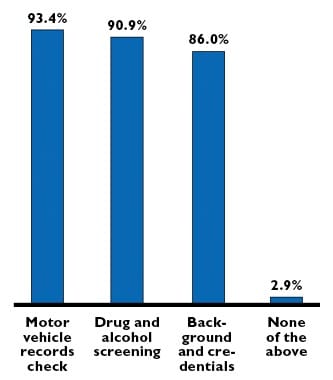
Tools used by FMCSA-regulated fleets for driver screenings.
FMCSA fleets that screen drivers relied on the following tools (see graph at right):
The Rule Details
The final rule prohibits commercial drivers from using a hand-held mobile telephone while operating a commercial truck or bus.
Who It Covers:
CMV drivers are banned from using hand-held cell phones while driving. For intrastate drivers, the ban also applies to those hauling hazardous materials.
A CMV is classified as a vehicle with a gross vehicle weight rating of 10,001 pounds or more; or is designed to transport more than eight passengers for compensation; or is designed to transport more than 15 passengers and is not used for compensation.
What Is Allowed:
Hands-free use of a cell phone is allowed using either a wired or wireless earpiece, or the speaker phone function of the cell phone. Wireless connection of the phone to the vehicle for hands-free operation, which would allow the use of single-button controls on the steering wheel or dashboard, is also allowed. In order to comply with this rule, a driver must be able to initiate, answer and terminate a call by touching a single button while in the seated driving position and properly restrained by a seat belt.
Drivers are allowed to use push-to-talk mobile communications equipment while driving, provided the driver does not reach for, dial or hold the actual mobile telephone in hand while driving and the driver is able to touch the button needed to operate the push-to-talk feature from the normal seated position with the safety belt fastened.
Penalties:
Drivers who violate the restriction will face federal civil penalties of up to $2,750 for each offense and disqualification from operating a CMV for multiple offenses. Additionally, states will suspend a driver’s commercial driver’s license after two or more serious traffic violations. Commercial truck and bus companies that violate the rule will face a maximum penalty of $11,000.[PAGEBREAK]
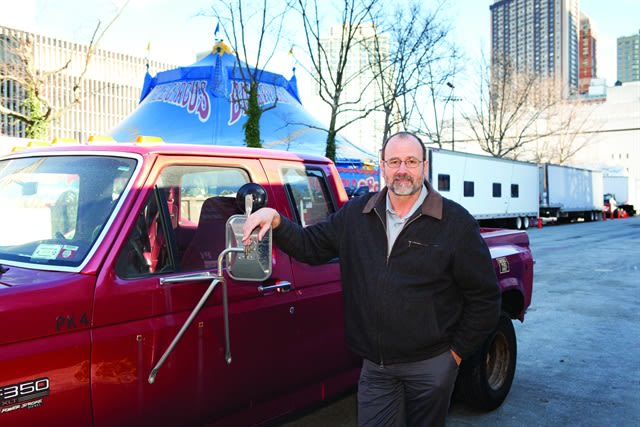
Tom Larson, general manager of New York’s Big Apple Circus, plans to use technology to help his staff comply with the new ban on the use of held-held mobile devices while driving. Photo by Jason Rhee
Fleets Weigh in On Cell Phone Policies
Here is a sample of responses from various types of fleets regarding their cell phone policies, enforcement of those policies and reaction to the new FMCSA regulations.
“We’ll see how it goes for the coming circus tour season. I will certainly offer to provide drivers with dash mounts for their phones and headsets as needed — even apps or software for phones that are capable of dialing on voice command, so that they can comply with the regs when driving company vehicles.”
- Tom Larson, Big Apple Circus, Brooklyn, N.Y.
“We take safety very seriously at McPherson Oil. Our implementation of ZoomSafer software has given us confidence that our drivers are in compliance with the FMCSA cell phone regulations. We use it to enforce our policy of zero phone use while driving.”
- Charles Tipton, McPherson Oil, Trussville, Ala.
“Sempra does have a cell phone use policy. … Sempra does not currently have an all-out ban on cell phone use while driving; however, a few departments have implemented a zero cell phone-use policy while driving on company business. Enforcement of this policy is generally approached by responding to public calls received from an 800 number on our fleet vehicles, with investigation and follow-up with both the public and the employee witnessed to have been driving in an unsafe manner.”
- Tony Orta, Southern California Gas Company, Sempra Energy Utilities
“Driving and talking or messaging is strictly prohibited. But I met with each driver and made sure that if they got into an accident, the first order of business would be to pull the records on their phone. If it was a legal case I would — and have — use litigation or subpoenas to retrieve the information for court cases. No one has a problem. If caught, they understand the consequences.”
- Frank Steinocher, Shumate Mechanical, Duluth, Ga.
“We do have a policy in our employee handbook that covers the use of cell phones and, among other things, the policy states that employees are to obey all laws governing the use of cell phone usage while driving. We expect employees to follow the law but, honestly, the only way we would be aware of a violation is if there was an accident. To date we haven’t had any issues, but discipline could be as severe as termination if the situation warrants.”
- Debbie Fischer and Jeff Christner, Peninsula Humane Society & SPCA, San Mateo County, Calif.
“We instituted a ban on cell phone usage in January 2011, which included hands-free usage unless there’s an emergency. All staff that have direct contact with our drivers are aware of the policy; they understand that all communication must occur outside of driving hours. The drivers are informed of the policy during our training as well as on a periodic basis when we issue safety bulletins. Our drivers have been very disciplined so far. They have not received any violations and we are not aware of any transgressions.”
- Martin Codd, RedPeg Marketing, Alexandria, Va.
“AdvantaClean promotes safety in all aspects of our business. … Regardless of individual state laws, we encourage our franchise owners/drivers to use Bluetooth or other hands-free devices when using cell phones. … Given the nature of our business, our franchise owners are on call 24 hours a day for emergency services. Some of their work is scheduled in advance, but a lot of times they may have to leave a prior engagement to run to the next call. Since we operate a 24-hour call center, when they see our number on the caller ID, they know they have to answer it regardless of where they are and what they’re doing. A missed call could easily cost them tens of thousands of dollars.”
- Statement from Advanta-Clean Systems Inc., Huntersville, N.C.
More Small Fleet


Developing Budget-Friendly Driver Safety Programs
From driver training and safety meetings to one-on-one coaching and incentive programs, several small fleets share how they have developed a safety culture with their drivers using low- to no-cost resources.
Read More →
Boosting Last-Mile Fleet Uptime, Safety, and Value with AI Vehicle Inspections
AI-powered inspections are transforming last-mile fleets by replacing manual checks with highly accurate automated scans that detect defects in seconds. By giving fleet operations visibility into the daily condition of their vehicles, you can identify trends over the vehicle’s lifecycle that enable improved procurement decisions, route management, driver training and accountability.
Read More →
Five Ways Seat Belts Help Prevent Injuries
There are five ways seat belts protect occupants from injuries, according to the Tennessee Department of Safety and Homeland Security.
Read More →
It’s here: The 2026 Fleet Technology Trends Report
What does AI mean for fleets? Get the answer — and learn other top tech trends.
Read More →
Small Fleets, Big Impact: How Independent Drivers Power Wreaths Across America
Check out how small fleets and independent drivers power Wreaths Across America each December and why their impact matters more than ever.
Read More →
VMS Survey Finds 65% of Small Fleet Managers Run Operations Alone
A new VMS survey shows small fleet managers are stretched thin, with most handling operations solo and eager to adopt digital tools for relief.
Read More →
Tips for Driving Safely on Halloween Night
This video features a reminder from the Connecticut Department of Transportation (DOT) and the Connecticut Police Chiefs Association, urging drivers to prioritize safety this Halloween.
Read More →
AI, Access, and Uptime: VMS’s Next Chapter with David Prusinski
VMS’s new Co-CEO, David Prusinski, shares how an AI-first approach will give small fleets and repair shops the tools to compete like big players.
Read More →
Fleet Managers Share Winter Prep Tips: It's Never Too Early!
Three fleets share best practices to prep vehicles for winter and prevent downtime when the cold sets in.
Read More →