





The Other Side: Small Fleet Budgets Still Have Big Opportunities
Fleet Budgeting with Economy of Scale
Learn how mid-to-large fleets can optimize budgets by leveraging economies of scale, technology, and sustainability for cost-effective operations.
August 14, 2024
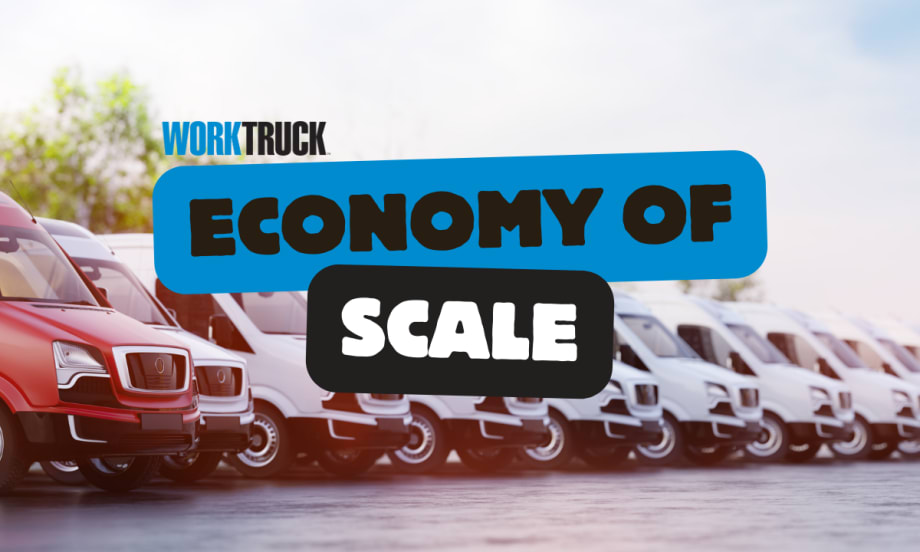
Leveraging economies of scale is essential when managing a mid- to large-sized fleet.
Photo: Work Truck
4 min to read
Budgeting for a mid-to-large work truck fleet isn't just about crunching numbers; it's about making strategic decisions that can keep your operations running smoothly and efficiently. For fleet managers, the task involves keeping an eye on the bottom line while:
Leveraging economies of scale.
Harnessing the power of technology.
Integrating sustainability efforts.
Economies of scale refer to the cost advantages businesses can achieve by increasing the scale of their operations. This often results in reduced per-unit costs due to bulk purchasing, operational efficiencies, and spreading fixed costs over a larger number of units.
In this follow-up budgeting piece, Work Truck dives deeper into the specifics of larger fleets. We'll share expert advice on how to work with fleet management companies, use data to drive decisions and incorporate green initiatives into your budget.
Leveraging Economies of Scale
Leveraging economies of scale is essential when managing a mid- to large-sized fleet. One of the most effective ways to do this is by working with a fleet management company (FMC).
As Lawrence Liu of Merchants Fleet explained, “Working with a fleet management company for fleet services is the best way to leverage economies of scale. An FMC has already leveraged their buying power to negotiate discounted prices on nearly every cost a fleet could expect within their budget.”
This can include consolidating spending among smaller vendors and negotiating discounts, particularly in vehicle procurement and maintenance.
Jim Lager of Penske Truck Leasing emphasized the importance of having reliable partners: “I think it’s important to have a reliable maintenance and leasing partner. You get access to experts but only pay a fraction of the cost.”
Moreover, Ed Powell, director of consulting services for Holman, highlighted the significance of technology and data.
“Midsize and large fleets need to effectively leverage technology and the significant volume of data their fleet generates to gain valuable insight into their operations. This insight will help you identify areas of efficiency and opportunities for improvement,” he said.
By evaluating and measuring information such as maintenance data and fuel spend, fleets can better control costs and optimize budgets.
Brian Hickok of Element Fleet Management added, “To optimize budgets, mid-to-large truck fleets can leverage economies of scale by prioritizing data visibility for cost management, focusing on customer needs, and ensuring the right trucks for specific tasks. By minimizing unscheduled downtime through proactive maintenance and driver behavior monitoring, fleets can enhance operational efficiency and reduce unnecessary costs.”

Aligning fleet goals with business objectives is extremely important for mid- to large-sized fleets.
Photo: Work Truck
Budgeting for Diverse Vehicle Types
A bottom-up approach to budgeting is recommended for managing a fleet's diverse range of vehicle types and uses.
Liu of Merchants Fleet noted, “A bottom-up approach to budgeting is the best practice here. Budgeting at the unit level enables one to approach budgeting specific to each unique asset, resulting in greater accuracy.”
Jim Lager from Penske Truck Leasing reiterated the importance of data: “Data history and visibility are key. Knowing how your fleet operates allows you to budget for the present and future.”
Ed Powell of Holman emphasized the need to establish optimal vehicle replacement parameters.
“Generally speaking, all fleets should establish and follow optimal replacement parameters, but this is especially important for large fleets with a diverse range of vehicles and applications. Establishing optimal vehicle or asset replacement parameters and adhering to those parameters as closely as possible is critical to controlling expenses and accurately forecasting budgets,” Powell noted.
Managing Regional Budgeting Complexities
Budgeting across multiple locations or regions presents unique challenges. Lager from Penske Truck Leasing pointed out the importance of visibility and historical data.
“Trucks operate differently in different parts of the country, so historical and benchmarking data are key pieces of information for the decision-making process,” he shared.
Liu of Merchants Fleet suggested a standardized approach to simplify the budgeting process: “The more standardized the vehicles within a fleet (across locations and regions), the less complex the budgeting process becomes.”
Powell of Holman highlighted the importance of aligning fleet goals with business objectives.
“One of the biggest challenges we often encounter is that fleet goals don’t always align with overall business objectives. This disconnect can make it incredibly difficult to manage operating budgets, especially for decentralized fleets effectively.”
Integrating Sustainability into Budgeting
Incorporating sustainability and green initiatives into the budgeting process is becoming increasingly important. Hickok from Element Fleet Management recommended conducting thorough research on available EV truck products and assessing their fit for operational needs.
“Element recommends that fleet managers allocate resources towards optimizing their platforms to incorporate EV technology and work with a fleet management partner that can offer an EV pilot program, charging infrastructure supplier, and other solutions to support the transition for a greener transportation future,” he added.
Liu of Merchants Fleet reiterated the value of a bottom-up approach:
“When using a bottom-up approach (unit level) to budgeting, you can more easily integrate sustainability and green initiatives into your plan with a higher degree of accuracy,” he said.
Powell of Holman stressed the need for well-defined goals: “As you explore potential fleet ESG initiatives, you’ll want to work closely with various stakeholders from across the organization to identify your overarching goals and determine how fleet aligns with those objectives.”
Subscribe to Our Newsletter
More Operations
Family Ties Inside the Fleet Families Building Careers Across Generations
Three fleet families share what it really takes to work together, learn across generations, and keep business from following them home.
Read More →
Shades of Fleet Call for Voices: Fleet's Hidden Heroes
Fleet’s hidden heroes are often the ones keeping everything moving behind the scenes. September’s Shades of Fleet is looking for dispatchers, coordinators, parts specialists, and other support pros to share their stories.
Read More →
Truck Centers, Inc. Celebrates National Truck Driver Appreciation Week with $1,000 Fuel Card Giveaways
During National Truck Driver Appreciation Week, Truck Centers, Inc. is offering customers a chance to fuel up for free. Customers at all Truck Centers locations can enter to win one of four $1,000 fuel cards from Sept. 14 - 18.
Read More →
Fleet Guides, AI Time-Savers, Truck Tariffs & Fuel Strategy Lead the News
This week’s Truck Chat Cheat Sheet covers new fleet vehicle guides, practical AI use cases, U.S.-Canada truck production, mixed-energy strategy, and more.
Read More →
What Fleet Employers Are Missing When Hiring Veterans
What if some of the strongest candidates for fleet are already out there, but their experience is written in a language our industry does not always recognize?
Read More →
Automotive Fleet Opens 2026 Personal Use Survey for Commercial Fleet Managers
Less than two weeks left! Commercial and corporate fleet managers are invited to share how their organizations handle company vehicle personal-use policies, charges, and driver eligibility.
Read More →
What Resilient Fleets Do Differently When Conditions Change
Fleet resilience is about more than reacting to disruption. Lauren Fletcher talks with AP Fleet’s Alex Coveney about flexibility, planning, scaling, and what helps fleets adapt when business conditions shift.
Read More →
If We Want the Next Generation in Automotive, We Have to Give Them a Reason to Care
The automotive industry talks constantly about its workforce shortage. But before we can recruit the next generation, we may need to do a better job giving kids a reason to care about automotive in the first place.
Read More →
Ram ProMaster City Under $40K, Truck Tariffs, and AI Maintenance Lead the News
A sub-$40K commercial van, tariff questions, AI-powered maintenance, and a new EV production strategy headline this week’s Truck Chat Cheat Sheet.
Read More →
Bob Adamsky Shares the Fleet Lessons You Usually Learn the Hard Way
After more than 30 years in fleet, Arrow International’s Bob Adamsky has learned that the job is about far more than vehicles. He shares the lessons he wishes every fleet manager could learn a little earlier.
Read More →