




Creating an Eye-Catching Vehicle Wrap (Without Going Overboard)
Featuring a photo so detailed it reveals a mosquito's hairs, this startup mosquito pest control company's vehicle wrap stands out on the road, helping to market its brand and business.

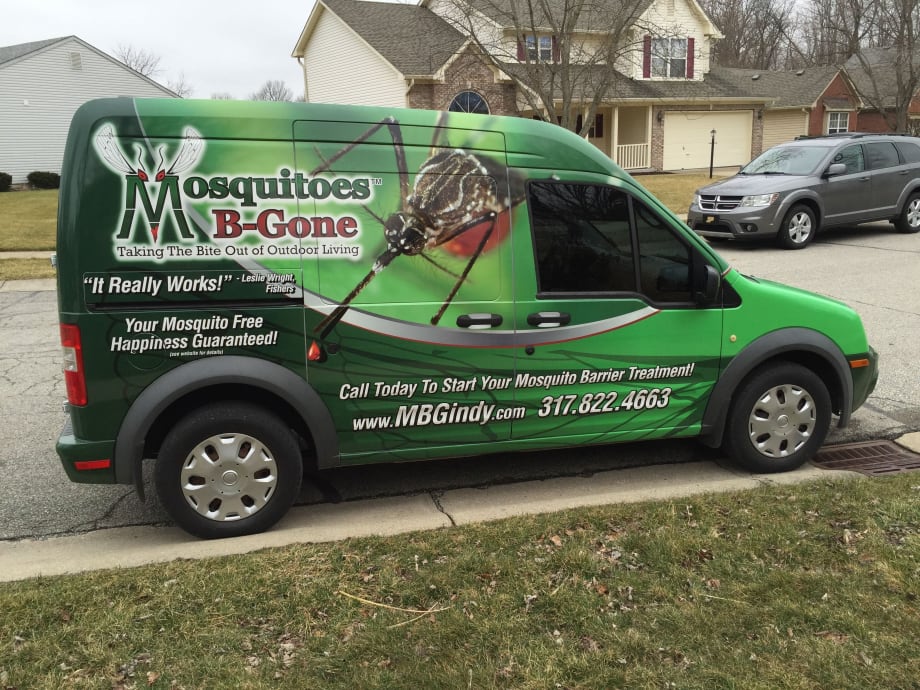
Mosquitoes B-Gone's vehicle wrap includes bright colors, mosquito graphics, and text such as its slogan, website, and phone number. Photo courtesy of Mosquitoes B-Gone.
Mosquitoes B-Gone's vehicle wrap includes bright colors, mosquito graphics, and text such as its slogan, website, and phone number. Photo courtesy of Mosquitoes B-Gone.
In his second year of business, David Simons continues to focus on different ways to market his new mosquito control company. So far, he has redesigned the website, created yard signs, and advertised in the local weekly newspaper.
But the company’s vehicle wrap has helped gain even more exposure by catching people’s attention while driving on the road.
“Our Ford Transit Connect’s wrap is great,” says Simons, owner of Mosquitoes B-Gone. “We drive the van around even during non-business hours. It’s helping get the word out about our brand.”
Simons chose CSI Signs in Noblesville, Ind., to design the wrap on his Ford Transit Connect fleet van. When designing a vehicle wrap, it’s important to create something that stands out without going overboard.
“Less is more when creating a vehicle wrap,” says Chad Huff, owner of CSI Signs. “Don’t overcrowd it. When on the road, you usually only have a few seconds for people to typically read a vehicle wrap.”
Serving Hamilton County in Central Indiana, Mosquitoes B-Gone started operating its mosquito control service last summer. Currently, the company operates with one Ford Transit Connect, but it’s planning to add another van once it hires another technician for its second summer season.
“I started by servicing my house,” says Simons. “The mosquito spray worked so well that my wife and I decided to open up our own business. Because mosquitoes go dormant in the winter, we operate from the end of April through mid to late October.”
Wrap Process
When working with CSI Signs, Simons knew that he wanted a photo of a mosquito as part of the vehicle wrap. He found a close-up photo where the hairs on its legs are even visible.
“We recommend that people bring in photos of what they want on their vehicle wrap,” says Huff. “Simons’ photo gave the designers an idea of the type of mosquito he wanted on the van.”
Typically, CSI Signs will first meet with clients to learn more about their needs and budget. Designers will then discuss the design process and the types of materials used. Instead of using a pre-built online car template, designers will take photos of all sides of the vehicle and build a template using the customer’s car, according to Huff.
“We print out the photos and start getting measurements of the vehicle,” says Huff. “That way, we know where things will fall on the vehicle and a word won’t get cut off by a door handle.”
Once the measurements are taken, CSI Signs starts working on the wrap’s design. Then the graphics are printed. For Simons' van, it took four to five hours to print the graphics and add a laminate that helps protect the wrap from UV rays, according to Huff.
“Once everything is done in production, we install the wrap,” says Huff. “The installation process includes cleaning the vehicle, smoothing out the vinyl wrap, and trimming out door handles and cutting door seams so doors can open. It takes about eight hours for two installers to work on a van.”
Mosquitoes B-Gone’s van went from solid white to a bright and bold wrap featuring different shades of green, mosquito graphics, a company logo, and text including its phone number, website, and slogan “Taking the bite out of outdoor living.”
“If you are trying to drum out business, you want a wrap that’s bright and loud,” says Huff. “Because a vehicle is always moving, people need to be able to read the wrap far away and fast.”
More Small Fleet


Developing Budget-Friendly Driver Safety Programs
From driver training and safety meetings to one-on-one coaching and incentive programs, several small fleets share how they have developed a safety culture with their drivers using low- to no-cost resources.
Read More →
Boosting Last-Mile Fleet Uptime, Safety, and Value with AI Vehicle Inspections
AI-powered inspections are transforming last-mile fleets by replacing manual checks with highly accurate automated scans that detect defects in seconds. By giving fleet operations visibility into the daily condition of their vehicles, you can identify trends over the vehicle’s lifecycle that enable improved procurement decisions, route management, driver training and accountability.
Read More →
Five Ways Seat Belts Help Prevent Injuries
There are five ways seat belts protect occupants from injuries, according to the Tennessee Department of Safety and Homeland Security.
Read More →
It’s here: The 2026 Fleet Technology Trends Report
What does AI mean for fleets? Get the answer — and learn other top tech trends.
Read More →
Small Fleets, Big Impact: How Independent Drivers Power Wreaths Across America
Check out how small fleets and independent drivers power Wreaths Across America each December and why their impact matters more than ever.
Read More →
VMS Survey Finds 65% of Small Fleet Managers Run Operations Alone
A new VMS survey shows small fleet managers are stretched thin, with most handling operations solo and eager to adopt digital tools for relief.
Read More →
Tips for Driving Safely on Halloween Night
This video features a reminder from the Connecticut Department of Transportation (DOT) and the Connecticut Police Chiefs Association, urging drivers to prioritize safety this Halloween.
Read More →
AI, Access, and Uptime: VMS’s Next Chapter with David Prusinski
VMS’s new Co-CEO, David Prusinski, shares how an AI-first approach will give small fleets and repair shops the tools to compete like big players.
Read More →
Fleet Managers Share Winter Prep Tips: It's Never Too Early!
Three fleets share best practices to prep vehicles for winter and prevent downtime when the cold sets in.
Read More →