




Bowfishing Company's Diesel F-250s Go Cross-Country
This Wisconsin-based bowfishing manufacturer has found diesel-powered trucks give that extra power needed when towing up to 5,000 pounds — including a boat, equipment and fish — while traveling across the country.

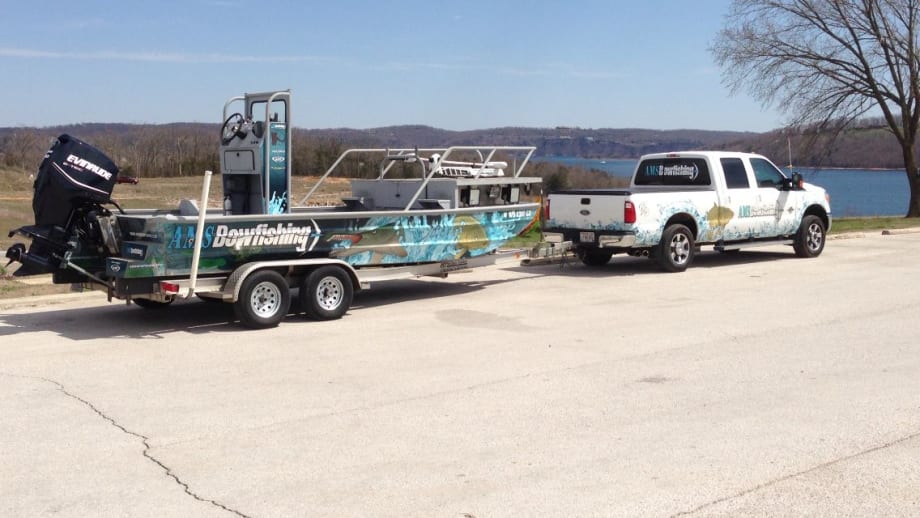
AMS Bowfishing uses diesel F-250 trucks to haul its fishing boats.
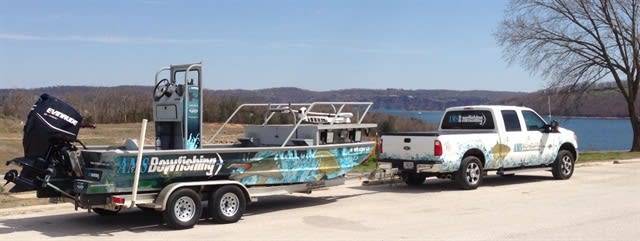
AMS Bowfishing uses diesel F-250 trucks to haul its fishing boats.
For AMS Bowfishing, a reliable and powerful truck is essential for hauling its boats across the country.
“We have two bowfishing boats and haul them across the nation every year attending bowfishing tournaments, trade shows, outdoor events and sports shows,” says Matt Schillinger, public relations director for AMS Bowfishing, a bowfishing manufacturer based out of Stratford, Wisc.
AMS Bowfishing has continued to use Ford vehicles and recently purchased two new F-250 diesel trucks.
Founded in 1997, this bowfishing manufacturer has traveled to bowfishing tournaments as far as Florida, Maryland and Virginia. In addition to tournaments and trade shows, AMS Bowfishing hauls its boats to remote locations for filming TV shows and webisodes on bowfishing, a cross between archery and fishing.
“We had a TV series on Destination America and have developed 30-minute bowfishing shows as well as DVDs on all of the trips we have done,” says Schillinger. “We bring our own cameraman on the trips to film.”
Diesel Trucks
Putting on 50,000 to 60,000 miles per year while hauling a boat, AMS Bowfishing’s F-250 trucks need to be reliable as well as powerful to pull the heavy load.
“The diesel engines are better at pulling large weight compared to gasoline engines,” says Schillinger. “We need that extra power, especially when we could be towing up to 5,000 pounds at times, including the boat, equipment and fish.”
Additionally, there is a cost savings when pulling heavy loads with a diesel versus gasoline engine. "The truck isn't working as hard because of the gear ratios and extra horsepower," says Schillinger.
To pull the boats, AMS Bowfishing didn’t need any upfitting after purchasing the F-250s from its local dealer, V and H Automobile. A helpful tool — included on the truck — has been the backup camera, says Schillinger. Normally a two-man operation with someone guiding the truck to the boat, the backup camera makes it easier for the driver to see while backing up.
When traveling to remote areas for tournaments and filming, the F-250’s low-end torque has come in handy. “We are in a lot of remote areas where the boat launches aren’t too great,” says Schillinger. “The low-end torque can pull not only our boat but also several hundred pounds of fish (in the boat) up steep banks and gravel boat landings.”
Eye-Catcher
Wanting to stand out at tournaments and when traveling on the road, AMS Bowfishing had a local signage shop design a vehicle wrap (with graphics and its company logo) for one of its F-250 trucks to match its wrapped boat.
The wrapped truck hauls the matching boat to all the tournaments, while the non-wrapped F-250 truck is used mainly to pull a trailer to trade shows, hauling the trade show booth and equipment.
“It’s a sharp-looking rig,” says Schillinger. “When we are traveling, we notice drivers taking pictures of the wrapped truck and boat as they pass us on the interstate.”
More Small Fleet


Developing Budget-Friendly Driver Safety Programs
From driver training and safety meetings to one-on-one coaching and incentive programs, several small fleets share how they have developed a safety culture with their drivers using low- to no-cost resources.
Read More →
Boosting Last-Mile Fleet Uptime, Safety, and Value with AI Vehicle Inspections
AI-powered inspections are transforming last-mile fleets by replacing manual checks with highly accurate automated scans that detect defects in seconds. By giving fleet operations visibility into the daily condition of their vehicles, you can identify trends over the vehicle’s lifecycle that enable improved procurement decisions, route management, driver training and accountability.
Read More →
Five Ways Seat Belts Help Prevent Injuries
There are five ways seat belts protect occupants from injuries, according to the Tennessee Department of Safety and Homeland Security.
Read More →
It’s here: The 2026 Fleet Technology Trends Report
What does AI mean for fleets? Get the answer — and learn other top tech trends.
Read More →
Small Fleets, Big Impact: How Independent Drivers Power Wreaths Across America
Check out how small fleets and independent drivers power Wreaths Across America each December and why their impact matters more than ever.
Read More →
VMS Survey Finds 65% of Small Fleet Managers Run Operations Alone
A new VMS survey shows small fleet managers are stretched thin, with most handling operations solo and eager to adopt digital tools for relief.
Read More →
Tips for Driving Safely on Halloween Night
This video features a reminder from the Connecticut Department of Transportation (DOT) and the Connecticut Police Chiefs Association, urging drivers to prioritize safety this Halloween.
Read More →
AI, Access, and Uptime: VMS’s Next Chapter with David Prusinski
VMS’s new Co-CEO, David Prusinski, shares how an AI-first approach will give small fleets and repair shops the tools to compete like big players.
Read More →
Fleet Managers Share Winter Prep Tips: It's Never Too Early!
Three fleets share best practices to prep vehicles for winter and prevent downtime when the cold sets in.
Read More →