




2014 L.A. Auto Show Press Day Impressions
Compact crossovers, performance vehicles, and hydrogen fuel-cell technology takes center stage in Los Angeles.

Ford's Explorer adds a 2.3L EcoBoost engine. Photo by Paul Clinton.

Ford's Explorer adds a 2.3L EcoBoost engine. Photo by Paul Clinton.
The 2014 Los Angeles Auto Show's annual press days again provided a snapshot of automaker strategy, as the rapid-fire 25-minute press conferences from 20 brands over two days revealed a renewed focus on performance-based upgrades, hydrogen fuel-cell development and proliferation of compact SUVs.
The editors of Bobit Business Media's automotive and truck fleet publications – Automotive Fleet, Government Fleet, Auto Rental News, Work Truck, Business Fleet, and Green Fleet – attended the announcements that included a more-powerful Ford Explorer SUV, several performance-oriented luxury coupes, a compact SUV from Mazda, and the appearance of Toyota's 2016 fuel-cell Mirai.
Chris Brown, executive editor for Auto Rental News and Business Fleet, most noticed the higher horsepower numbers at announcements.
"I haven't heard as much mention of horsepower in the 400- to more-than-500 range in years," Brown said. "While the heavy-horsepower models are more show than sales, the OEMs seem to have put the EV track on hold for now – or at least they de-emphasized it in Los Angeles."
The intersection between green-car technology and performance in vehicles such as the 2015 Mercedes-Benz S550 plug-in hybrid and BMW i8 plug-in hybrid was noticed by Adam Pringle, AutoGroup associate editor.
"While walking through this year’s Los Angeles Auto Show, one thing became clear to me: Eco-friendly vehicles have come a long way in terms of performance," Pringle said. "Witness Mercedes-Benz's 2015 S-Class Plug-In Hybrid, which generates 436 hp and goes 0-60 mph in 5.2 seconds. And there's the plug-in hybrid version of Volvo's XC90, which delivers 400 hp. It’s a brave new world."
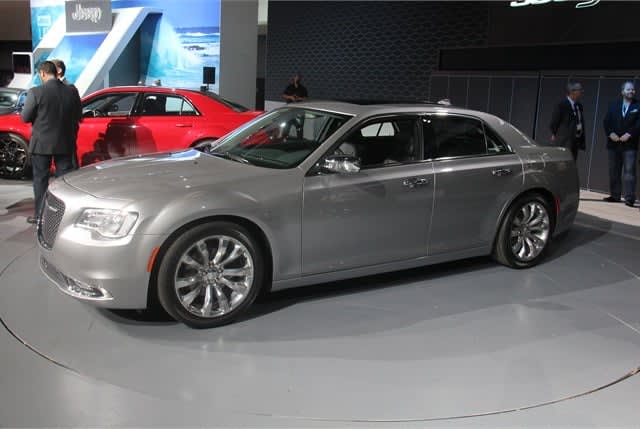
The V-8 Chrysler 300C will get improved fuel economy. Photo by Paul Clinton.
Mazda's CX-3, Honda's HR-V, and the Lexus NX compact SUVs added more vehicles to a growing list in this still-hot vehicle segment that reaches across the price spectrum.
"If there was one vehicle type that seemed to dominate the OEM debuts it was probably the SUV, particularly the compact SUV, showing this segment is definitely in the forefront of automakers strategies," said Chris Wolski, AutoGroup senior editor.
The CX-3 in particular had generated much cross-talk leading up to its unveiling about its size, which proved to be sleeker than expected.
"After Mazda raised its curtain on its new CX-3 I was expecting to see a much bulkier looking vehicle," said Becky May, a web editor. "The car was sleek and a lot more stylish than I would expect."
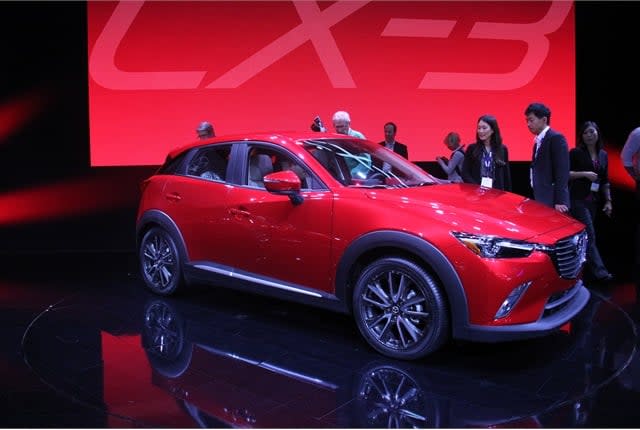
Mazda introduced its CX-3 compact SUV. Photo by Paul Clinton.
With California's roll-out of hydrogen fuelling infrastructure and the state's zero-emission vehicle mandate looming on the horizon, automakers discussed the development of hydrogen fuel-cell vehicles as a recurring theme in the presentations.
"Specific automakers seem excited about the fuel cell technology with Honda's announcement to provide $13.8 million in financial assistance for fueling infrastructure and Toyota's new Mirai at the show," said Thi Dao, executive editor for Government Fleet. "Both will release vehicles for the 2016 model year."
Hydrogen announcements also came from Audi, who showed its A7 Sportback h-tron quattro concept, and Volkswagen, who announced it would produce a fuel-cell powered Golf "as soon as the conditions are right."
"Hydrogen fuel cells are gaining momentum," said Amy Winter, associate editor. "Audi, Volkswagen and Toyota had their new fuel cell vehicles on display."
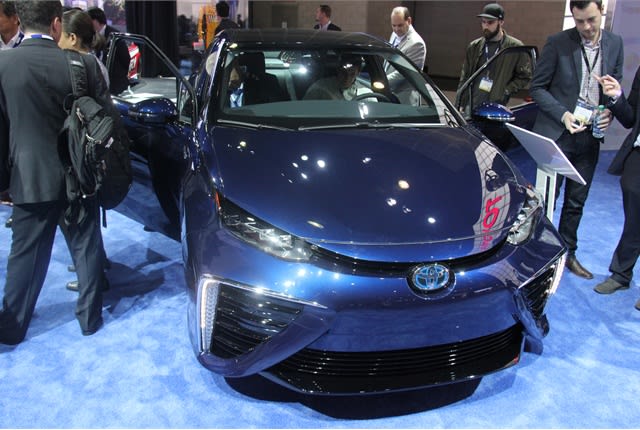
Toyota brought its Mirai hydrogen fuel-cell vehicle. Photo by Paul Clinton.
Originally posted on Automotive Fleet
More Green Fleet

Fleet Forward Conference Introduces One-Day Passes for 2026
New one-day registration gives fleet professionals the flexibility to attend Tuesday, Wednesday, or Thursday, with passes available for $199 through Sept. 18.
Read More →
CALSTART Rebrands as Catalyst Mobility, Will Combine with Forth in 2027
CALSTART has rebranded as Catalyst Mobility and will combine with Forth at the start of 2027. The new organization said it is poised to become one of the world's largest, strongest, and most impactful clean transportation nonprofits.
Read More →
Electric Truck and Charging Programs to Boost Sustainability at NY & NJ Ports
Together, the Port Authority of New York and New Jersey and CALSTART will electrify drayage and terminal operations serving the East Coast’s busiest container port. A pair of incentive programs totaling $45 million has launched to accelerate adoption of zero-emission drayage trucks and terminal tractors.
Read More →
Xos Hub Surpasses One Gigawatt-Hour of Energy Delivered in the Field
A single Xos Hub has surpassed one gigawatt-hour of energy across more than 33,600 charging sessions in the field, demonstrating performance that supports Xos' expansion across new products and markets.
Read More →
Carrier Transicold Launches All-Electric Vector 8200 TRU for Diesel-Free On-Site Cold Storage
Carrier Transicold’s first engineless multi-temperature TRU helps fresh- and frozen-food fleets add supplemental cold storage capacity during seasonal peaks.
Read More →
Narro Trucks Introduces Electric Utility Vehicle
Narro Trucks officially launched its operations on Aug. 20 and hosted a ride and drive to showcase its electric truck, which will be produced in Virginia.
Read More →
Samsung SDI Takes Full Control of GM Battery JV as Indiana Plant Pivots to Energy Storage
Samsung SDI is taking full control of its Indiana battery plant with GM, marking a major shift from the EV-focused joint venture Charged Fleet first covered in 2023.
Read More →
NWSA Taps CALSTART to Administer Zero-Emission Drayage Assistance Program
CALSTART will provide free technical assistance services to drayage fleets serving the Ports of Seattle and Tacoma and looking to transition to cleaner technologies and help decarbonize freight hubs.
Read More →
EV Fleet Reality Check: What Operators Wish They Knew Before Electrifying Their Work Vans
Electric work truck upfits bring new compatibility questions. Learn how parts availability, OEM guidance, power demands, and route planning can affect fleet performance.
Read More →
Peterbilt Expands Sourcewell Partnership with Electric Vehicle Lineup
Peterbilt Motors Company’s cooperative purchasing agreement with Sourcewell and its Canadian partner, Canoe Procurement Group, now includes including Peterbilt's battery-electric vehicle lineup.
Read More →