




10 Ways to Become a Depreciation Management Pro
In North America, depreciation is generally the largest operating expense for a vehicle fleet. Fleet managers must know what depreciation is, how it is applied, and how a corporate fleet program influences this key cost driver.
At a Glance:
Ten aspects of depreciation fleet managers must know are:
Lingo/terms.
Calculations.
Process.
Net depreciation and capitalized costs.
Best acquisition approach.
Vehicle purpose.
Inventory.
Vehicle incentives.
Lifecycle.
Timing purchases.
Fleet managers must know all the facts about depreciation. Focus on the following 10 areas:
1 Know the Lingo
Knowing depreciation terms and definitions makes fleet managers more
fluent in this important business issue.
Capitalized cost: Amount paid for the vehicle after incentives, discounts, delivery fees, and upfitting.
Reserve rate: Client-controlled monthly payment that determines the book value.
Market value: Value the resale market places on a vehicle at any given point in time - varies based on model demand, market conditions, vehicle age, odometer, and condition.
Book value: Remaining "balance sheet" value of the vehicle.
Residual value: Vehicle's perceived market value when it comes off lease.
2 Know the Math
Net depreciation is the difference between the amount paid for the vehicle at the time it was acquired and the amount it's worth when sold. This is represented by a basic calculation:
Capitalized costs - residual value = net depreciation
To determine the effective monthly depreciation, divide the net depreciation by the number of months the vehicle was in service. To determine the effective monthly reserve rate, divide the monthly depreciation by the capitalized cost.
3 Know the Process
Every vehicle's residual value continually declines. Two ways a fleet manager may account for this according to the vehicle's reserve rate are:
Flat depreciation rate: Uses the same reserve rate each month for the life of the vehicle, or until the vehicle has a zero-dollar book value.
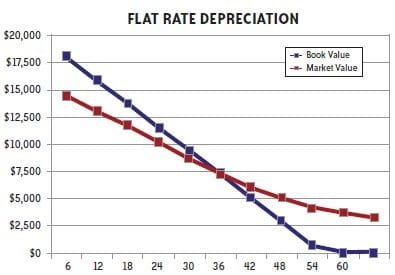
Flat rate depreciation uses the same reserve rate each month for the life of the vehicle, or until the vehicle has a zero-dollar book value.
Declining rate: Sets a higher reserve rate in year one and decreases each subsequent year the vehicle is in service, which helps the vehicle keep its book value closer to market value over time. This is valuable for fleets with a high monthly mileage, and also decreases the risk of a large debit disposal adjustment (which occurs if ending book value is greater than residual value).
4 Know the Cost
When evaluating total vehicle cost, consider net depreciation costs in addition to capitalized cost. This helps set reserve rates that align with the expected net depreciation rates and are reflected accurately throughout the vehicle lifecycle.
The ideal goal is to be within $500 of the market rate at the end of the vehicle life. Depreciating a vehicle more quickly than the market rate reduces cash flow (larger payment on the vehicle), while under-depreciating a vehicle results in large single payments upon disposal (since book value will be higher than residual value).
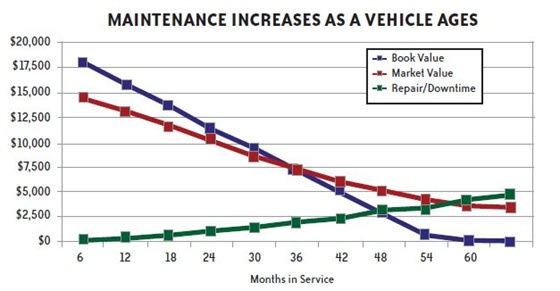
As a vehicle ages, it requires more repairs and maintenance, leading to increased repair, rental costs, and vehicle downtime. While these do not typically outweigh the cost of a new vehicle, the cost impact of driver downtime should not be undervalued.
5 Know the Deal
From an acquisition standpoint, utilizing factory-ordered vehicles can control depreciation costs. Factory orders typically provide incentives and discounts and allow control over custom vehicle options. Certain manufacturers, as well as fleet management companies, also offer "pools" of popular fleet models from which vehicles may be ordered. These offer a cost-effective option for immediate vehicle needs.
When traditional acquisition options are impractical, out-of-stock acquisitions can be used; however, they often entail additional fees and unwanted options. Avoiding unnecessary dealer stock purchases can typically save at least $2,000 on the capitalized cost.[PAGEBREAK]
6 Know the Job
Each fleet vehicle used must be evaluated to ensure models ordered match specific applications and help control
depreciation costs. Some key considerations:
Vehicle size: Is room required for multiple passengers or cargo, or will a smaller vehicle suffice?
Upfitting: Does the vehicle require specialized upfitting/decals to safely and efficiently transport cargo or support company branding?
Personal vs. business use: Will the driver use the vehicle for personal purposes outside of normal business use?
7 Know the Inventory
It's common for commercial fleets to maintain spare vehicles to eliminate downtime and address seasonal business demands. However, an excessive stockpile of vehicles can create a large and unnecessary expense. Check fleet inventory regularly to identify and appropriately allocate or dispose of underutilized vehicles.
8 Know the Incentives
Most automakers offer acquisition incentives directly to fleet managers, which can reduce vehicle invoice cost and help manage depreciation by:
Properly accounting for the cost of the asset as it's placed into service.
Reducing finance charges incurred for leasing purposes.
Ensuring accurate calculations of net effective depreciation costs when the vehicle comes out of service.
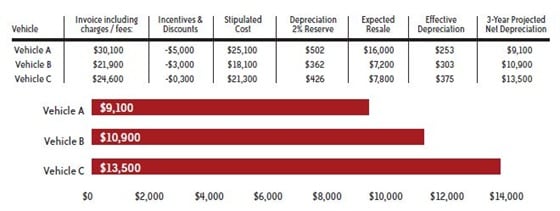
A higher capitalized cost doesn't necessarily mean a vehicle will be a more expensive option. Rather, a high-capitalized cost vehicle with a high-residual value could help control depreciation costs better than a lower-capitalized cost option.
9 Know the Lifecycle
Generally, the longer a fleet vehicle is used, the easier it is to control depreciation costs. But the ideal lifecycle for each vehicle is dependent on many factors:
Downtime: As vehicles age, they require more repairs and maintenance, leading to increased repair, rental costs, and vehicle downtime.
Brand image: The age, make, and quality of fleet vehicles impact your customers' impression of the business; vehicle conditions can send positive or negative messages.
Employee morale: If vehicles are used to recruit/retain employees or encourage productivity, replacing vehicles regularly is likely to have a positive impact on employee morale.
New technology: A shorter lifecycle allows an organization to take advantage of emerging technologies, including fuel economy improvements, driver comfort/entertainment enhancements, and latest safety technology.
10 Know When to Buy
Residual markets generally peak in the fall and spring. The best way to take advantage of favorable markets is to order vehicles slightly before these peaks, helping maximize residual values and control depreciation costs.
About the Author

Michele Zeiler is an account manager for Wheels Inc. She can be reached at mzeiler@wheels.com.
Originally posted on Automotive Fleet
More Vehicle Research
2026 Ram 1500 Tradesman Put to a Real-World Fleet Test
A few days behind the wheel of a 2026 Ram 1500 Tradesman turned into a test of visibility, parking, work-ready features, and even severe-weather driving.
Read More →
Isuzu N-Series Gas Fleet Guide: Specs, Capability and 2027 Model-Year Updates
Explore Isuzu Truck North America’s N-Series Gas fleet specs, engine performance, GVWR and payload capability, configurations, chassis dimensions, work-focused features, and 2027 model-year information.
Read More →
Chevrolet Silverado 1500 Fleet Guide Specs Capability and 2027 Model-Year Updates
The next-generation 2027 Chevrolet Silverado 1500 brings new V-8 engines, updated technology, expanded safety features, and a fleet-focused Work Truck. Here’s what commercial fleets need to know so far.
Read More →
Ram ProMaster City Fleet Guide Specs Cargo Capacity and 2027 Updates
Work Truck’s Ram ProMaster City Fleet Guide tracks the latest specifications, cargo capability, configurations, fleet technology, pricing, and model-year updates for Ram’s mid-size commercial van.
Read More →
Ford F-150 Fleet Guide Specs Capability and 2026 Model-Year Updates
Explore 2026 Ford F-150 fleet specs, engines, towing and payload capability, configurations, work features, technology, and model-year updates.
Read More →
TCI Now Sells & Supports Battle Motors’ Vocational Trucks
Midwest truck dealer Truck Centers, Inc. (TCI) has expanded its transportation solutions with sales and service support for Battle Motors’ heavy-duty vocational trucks at locations in locations in Indiana, Illinois, and Missouri
Read More →
Ram 1500 Fleet Guide Specs, Capability and 2027 Model-Year Updates
Explore always up-to-date Ram 1500 fleet specs, engines, towing and payload capability, configurations, technology, pricing updates, and model-year changes.
Read More →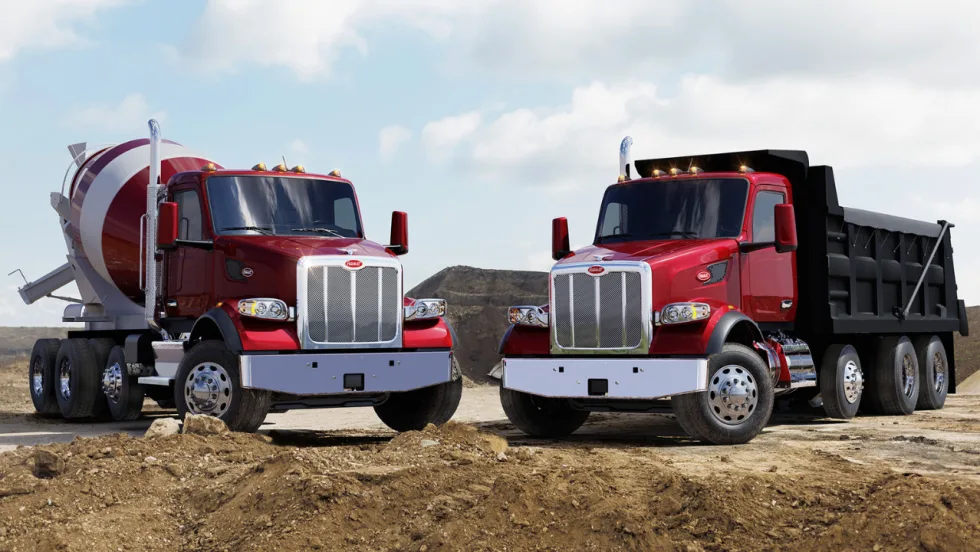
Peterbilt Trucks Equipped with Paccar TX-18 Pro Boost Efficiency for Maryland Fleet
Patuxent Companies is replacing aging trucks with the Peterbilt Model 567 and Model 589, specified with the Paccar TX-18 Pro 18-speed automated transmissions, and is reporting an 8% to 10% improvement in fuel economy.
Read More →
Stellar Expands into Fire Apparatus Market with Acquisition of Midwest Fire
Stellar Industries has acquired Midwest Fire, a custom fire apparatus manufacturer headquartered in Luverne, Minnesota, with nearly four decades of specialized apparatus experience.
Read More →
Recalls You Need to Know About in August 2026
If you have Altec, Chrysler, Ford, Heil, General Motors, International, Mack Trucks, Paccar, Rivian, Royal Truck, Toyota, US Truck Body, or Volvo Trucks vehicles in your fleet, you should check these important recalls issued by the National Highway Safety Administration.
Read More →