





Related: ROUSH CleanTech Offers Propane Fuel System for Ford F-750
Propane Autogas Fuels Fleets
Both Nestlé Waters North America and Bimbo Bakeries USA have added to their propane-autogas-fueled vehicle fleet, reducing overall emissions by millions of pounds over each fleets lifetime.
June 15, 2016
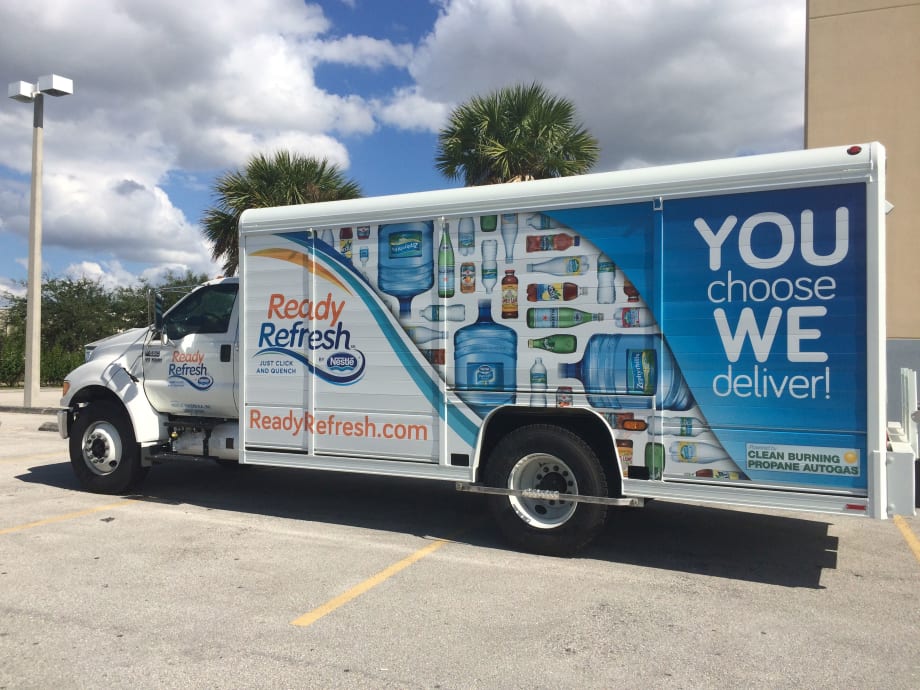
Nestlé Waters North America added 155 propane autogas trucks to its fleet after piloting 29 vehicles in 2014 and 2015. (PHOTO: Nestle Waters USA)
3 min to read
Of the almost 9,000 vehicles equipped with ROUSH CleanTech fuel systems, nearly 500 operate in the food and beverage industry. This includes Bimbo Bakeries’ new Ford F-59s and Nestlé Waters North America’s 185 Ford F-650s.
“Propane autogas makes the most sense for fleets operating trucks and/or buses in the Class 4-7 range,” according to Todd Mouw, vice president of sales and marketing for ROUSH CleanTech. “Most of our customers do not want to deal with the added cost and complexity of diesel and propane autogas is a great alternative option based on its lower fuel/maintenance costs and significantly reduced emissions.”
Propane autogas has many advantages driving adoption in Class 4-7, according to Mouw.
“One advantage is that propane autogas includes the flow pressure. It is a liquid fuel, which allows for a significant capacity of fuel (comparable to diesel) to be packed on the truck,” Mouw explained. “In addition, these trucks have horsepower and torque equivalent to a gasoline engine.”
Nestlé Waters Adds 155 Propane Autogas Trucks
After piloting 29 propane autogas trucks in 2014 and 2015, Nestlé Waters North America added 155 Ford F-650 beverage delivery trucks powered by the alternative fuel to markets across the nation.
Nestlé Waters’ switch to propane autogas will reduce carbon dioxide emissions by more than 29.3 million pounds over the lifetime of the vehicles.
Nestlé Waters added the medium-duty trucks to save on maintenance and fuel costs and for “environmental stewardship,” according to the company. The trucks were added to the company’s existing propane autogas fleet of 30 Ford trucks of the same model.
“We’ve been running propane autogas vehicles since 2014,” said Bill Ardis, national fleet manager for the company.
Bimbo Bakeries Delivers on Emissions Reductions
Bimbo Bakeries equipped 84 delivery trucks with propane autogas fuel technology to accomplish corporate environmental goals and reduce total operating costs in Chicago, Denver, and Washington, D.C.
The delivery trucks operate with a ROUSH CleanTech propane autogas fueling system mounted to a Ford F-59 stripped chassis truck.
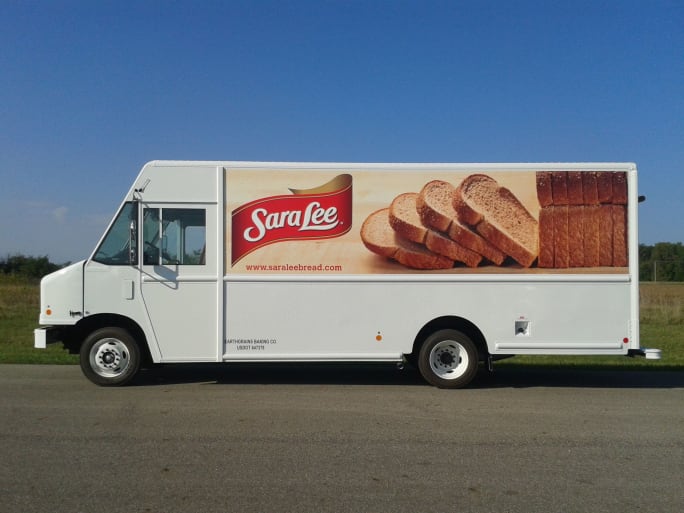
Bimbo Bakeries has added 84 more delivery trucks fueled by propane autogas to its fleet delivering such products as Sara Lee. (PHOTO: Bimbo Bakeries)
“Bimbo Bakeries USA introduced propane autogas vehicles into our Chicago, Denver, and Washington, D.C., regions to help accomplish our corporate environmental goals while lowering our bottom line,” said Gary Maresca, senior director of fleet services for Bimbo Bakeries USA (BBU).
Each new propane autogas fueled delivery truck will cut carbon dioxide emissions by about 192,000 pounds compared to gasoline, which equals 16.1 million fewer pounds over the lifetime of the fleet.
Along with environmental benefits, BBU selected propane autogas trucks for their low up-front costs, minimal impact to operations, and stability of fuel costs.
Thirty units began operating from the company’s Chicago-area location in January 2016, and 27 units are now operating from its Denver-area office, with the remaining 27 units serving the Washington, D.C., region.
The alternative-fueled trucks work as route vehicles delivering Bimbo Bakeries products, such as Thomas’, Oroweat, Entenmann’s, and Sara Lee, to retail locations.
The fleet installed on-site fueling stations at each location, eliminating the need to refill at retail stations.
Subscribe to Our Newsletter
More Green Fleet

Fleet Forward Conference Introduces One-Day Passes for 2026
New one-day registration gives fleet professionals the flexibility to attend Tuesday, Wednesday, or Thursday, with passes available for $199 through Sept. 18.
Read More →
CALSTART Rebrands as Catalyst Mobility, Will Combine with Forth in 2027
CALSTART has rebranded as Catalyst Mobility and will combine with Forth at the start of 2027. The new organization said it is poised to become one of the world's largest, strongest, and most impactful clean transportation nonprofits.
Read More →
Electric Truck and Charging Programs to Boost Sustainability at NY & NJ Ports
Together, the Port Authority of New York and New Jersey and CALSTART will electrify drayage and terminal operations serving the East Coast’s busiest container port. A pair of incentive programs totaling $45 million has launched to accelerate adoption of zero-emission drayage trucks and terminal tractors.
Read More →
Xos Hub Surpasses One Gigawatt-Hour of Energy Delivered in the Field
A single Xos Hub has surpassed one gigawatt-hour of energy across more than 33,600 charging sessions in the field, demonstrating performance that supports Xos' expansion across new products and markets.
Read More →
Carrier Transicold Launches All-Electric Vector 8200 TRU for Diesel-Free On-Site Cold Storage
Carrier Transicold’s first engineless multi-temperature TRU helps fresh- and frozen-food fleets add supplemental cold storage capacity during seasonal peaks.
Read More →
Narro Trucks Introduces Electric Utility Vehicle
Narro Trucks officially launched its operations on Aug. 20 and hosted a ride and drive to showcase its electric truck, which will be produced in Virginia.
Read More →
Samsung SDI Takes Full Control of GM Battery JV as Indiana Plant Pivots to Energy Storage
Samsung SDI is taking full control of its Indiana battery plant with GM, marking a major shift from the EV-focused joint venture Charged Fleet first covered in 2023.
Read More →
NWSA Taps CALSTART to Administer Zero-Emission Drayage Assistance Program
CALSTART will provide free technical assistance services to drayage fleets serving the Ports of Seattle and Tacoma and looking to transition to cleaner technologies and help decarbonize freight hubs.
Read More →
EV Fleet Reality Check: What Operators Wish They Knew Before Electrifying Their Work Vans
Electric work truck upfits bring new compatibility questions. Learn how parts availability, OEM guidance, power demands, and route planning can affect fleet performance.
Read More →
Peterbilt Expands Sourcewell Partnership with Electric Vehicle Lineup
Peterbilt Motors Company’s cooperative purchasing agreement with Sourcewell and its Canadian partner, Canoe Procurement Group, now includes including Peterbilt's battery-electric vehicle lineup.
Read More →